Showing posts with label country humor. Show all posts

Monday, June 12, 2017

Sam Lovullo: 9/30/28 - 1/3/17

The passing of television producer Sam Lovullo back on January 3rd of this year (age 88) is something that I couldn't compose a blog entry about because of the impact he indirectly had on my own upbringing and life through a certain television program. I'm not going to say that his death impacted me in the way it did those that personally knew him (those in the entertainment business and his own family) but it was something I didn't want to write much about. If you're familiar with my blog entries about Hee Haw then you'll know how much I loved that program and how it was must-see television every Saturday, and later, Sunday, during the weekends in which I'd spend with my grandparents. Eventually I'd stop spending the weekends with them but I continued to watch Hee Haw any chance I could get at my own house (I have several siblings, two of them older than I, so a lot of the time I didn't "control" the second TV...but the times that I did I made it a point to catch Hee Haw!). Just this past Sunday night (June 11th) the episode of Hee Haw that aired on RFD-TV guest starred Bobby Goldsboro and The Oak Ridge Boys (from October 1978).

Born on September 30, 1928 Sam Lovullo became identified for most of his adult life as the driving force behind Hee Haw and as a result of being such a driving force it caused me to appreciate him even more. He didn't come off as a cynic or the kind of producer that distanced himself from the program's that carried his name. In Sam Lovullo I saw a television producer who was just as enthusiastic and a fan of the program as the viewers happened to be. In other words he wasn't a turn-off. Lovullo wrote about his professional career (with some backstage offerings added in) with the help of another author, Marc Eliot, in a book published in 1996 titled Life in the Kornfield: My 25 Years at Hee Haw.

The career of Sam Lovullo is often traced back to the CBS variety series, The Jonathan Winters Show, which aired for 2 seasons, 1967-1969. Several key people associated with Hee Haw were also involved in Jonathan Winter's program. Key people? None other than Hee Haw creators John Aylesworth and Frank Peppiatt. Lovullo happened to be an associate producer of Jonathan's program. In interviews and in the 1996 book, Lovullo stated that the ratings in the Southern states spiked whenever country music artists appeared on Jonathan's program and eventually this rating fact and the popularity of Laugh-In inspired the creation of Hee Haw in 1969. It hit the air this week on CBS in 1969 (actual debut being June 15, 1969). Sam Lovullo was not only the producer but he was also the casting director. This assignment gave him an even more hands-on approach to the show as it was Lovullo in charge of picking and choosing who was going to be part of the show's main cast (including the co-hosts, Buck Owens and Roy Clark).

The show had a summer run and after which it then went on hiatus. It returned later in the year as a mid-season replacement and was canceled once more in early 1970. Eventually, however, CBS picked the show up once more and added it to their 1970-1971 line-up. It was canceled one final time by CBS after the end of the 1970-1971 television season.

Not wanting to see the series end (and certain unemployment for almost all of it's staff...including the cast) Lovullo, more than anybody else connected with the show, believed the show could thrive in syndication...offering the show to local affiliates across the country to program during the local access time slot. The FCC had mandated that a certain time of the day were to be turned over to local affiliates to air local programming (Prime Time Access Rule) rather than every channel being consumed by national/network programming. This rule, instituted in 1970, aided the syndicated market in a big way...and first-run syndication broadcasts eventually became just as profitable and just as attractive to sponsors as network broadcasts. Interestingly, this FCC rule was repealed in 1996, the year Sam's Life in the Kornfield book hit the stores.

As history shows, Sam Lovullo remained a vital part of Hee Haw and he remained it's driving force throughout it's entire 22 years in syndication (1971-1993). The 1992-1993 season, however, was a compilation series of sketches and music performances to celebrate the program's Silver Anniversary. The final first-run episode of Hee Haw aired on May 30, 1992.

In addition to The Jonathan Winters Show and Hee Haw, Sam Lovullo produced several variety programs in his career. A majority of those were one-time specials rather than a series. One of those one-time specials starred John Wayne...the 1970 NBC special, Swing Out, Sweet Land. Lovullo happened to be the associate producer, technically. It was filled to the brim with all kinds of celebrities from all time periods...and those celebrities mostly all portrayed historical figures from all different time periods...and you can watch it on YouTube. Roy Clark is on the special as a banjo player for Andrew Jackson's inaugural ball.

Yet the most notable of Sam's non-Hee Haw efforts, which happened to be a weekly series, is Nashville Palace. The program aired in the early 1980s and it featured a lot of cross-over with the stars of Hee Haw but the Palace was a conventional variety series. In fact, Roy Clark hosted the first episode of Nashville Palace (airing October 24, 1981). The Palace series happened to be one of the last regularly scheduled, country music-oriented, variety programs on network television for more than a decade. It also aired prior to the 1983 launch of cable television's The Nashville Network, also known as TNN (1983-2000). Reruns of Hee Haw would air on TNN for four years (1993-1997).

From 2009 until 2011 Sam was the President of the Pacific Pioneer Broadcasters organization. 

The Oklahoma Historical Society put together a salute to Hee Haw in 2014 (the 45th anniversary of it's 1969 debut) and a video retrospective/documentary was also put together. You can see that video by clicking HERE. As you could imagine Sam Lovullo is featured several times throughout the video clip.

TVLEGENDS, a YouTube channel, has a 10-part interview with Sam Lovullo. Some, if not all, of the segments have extremely low volume, though...so you may need to adjust your device's volume. You can see part 1 by clicking HERE. You can access the rest of the clips once you're over on YouTube.

This book is something that I highly recommend. Although I do not think it is in print anymore it never hurts to check on-line auction sites. I purchased this book when it was 'hot off the presses' in 1996. At the time of the book's release Hee Haw had been airing in reruns on The Nashville Network since 1993 and Time Life had been offering a VHS called Hee Haw Laffs. TNN originally aired their reruns of Hee Haw on Saturday night at 7pm Eastern and they would re-air at 10pm. By the time the book hit the stores TNN had re-arranged it's Saturday night line-up and Hee Haw no longer aired at 7pm but it remained in the 10pm slot following The Statler Brothers Show. The Opryland Theme Park had also began staging a live production of the series...an hour program called Hee Haw Live which featured recreations of sketches, characters, and imagery on a sound stage at the Opryland park. If I remember correctly the half hour program was broken into 2 segments: 30 minutes of comedy and 30 minutes of serious performances of country and gospel music. I think this production lasted a couple of seasons. Several of the show's longtime cast members (Lulu Roman, Grandpa Jones, George Lindsey, and Gunilla Hutton) appeared in this Opryland production in addition to several newcomers (one of them a guy named Jason Petty...who later became extremely popular as Hank Williams in the Lost Highway production). In the book Sam tells the story behind Hee Haw and it's massive popularity in first run syndication. A cast-member and selected guest star section is featured as is an exhaustive break-down of the behind the scenes crew. A lot of the information from the book is also covered in those TVLEGENDS YouTube video clips I earlier mentioned.

Monday, August 22, 2011

Hee-Haw: 1969-1992, Part Eleven...

In this on-going series of blogs I've touched upon the fact that 2009 marked the 40th anniversary of Hee-Haw's debut on CBS in 1969. 2011 marks the 40th anniversary of the program's re-launch into syndication. After CBS canceled the series in 1971 it went into first-run syndication later in the year and it remained in first-run syndication for the next 21 years (through May 1992). The follow-up series, Hee-Haw Silver, ran from the fall of 1992 through 1993. If you're familiar with that particular program let me know about it. I'd only heard about it but never saw any of those episodes. I know Roy Clark acted as host and Cathy Baker appeared at the end of each episode to say her signature sign-off line...but I learned of that from reading the Life in the Kornfield book that Sam Lovullo wrote in the mid '90s. I don't think the Hee-Haw Silver series will ever be uploaded onto You Tube or made available on DVD anytime soon...but I'm still interested in seeing the program.

Sunday evening's Hee-Haw episode on RFD-TV featured Connie Smith and Tommy Ambrose as special guests. It was the final episode of the 1971-1972 season (it's first season in syndication). Next Sunday's episode should be episode 1 of the 1972-1973 season or episode 2. I say this because a couple of months ago they aired the first episode of the 1972-1973 season (Ray Stevens and Dizzy Dean were the guests) and so they may skip that and pick up with episode 2. The 1972 season opener, by the way, featured the debuts of cast-members Marianne Gordon, Misty Rowe, Anne Randall, and Gailord Sartain (dressed as a cop). George Lindsey began making infrequent appearances on the program in 1972. He played the Goober character that he'd been playing since 1964 on The Andy Griffith Show and Mayberry RFD. Lindsey, however, didn't appear in the opening cast credits of Hee-Haw until several weeks into his run. He'd remain on the series through it's final episode in May 1992 and often appeared at Hee-Haw related functions in the years following it's cancellation. In 1995 he released his life story called Goober in a Nut-Shell and it became a runaway success. Also, it was at this point in time where Lindsey was in the middle of commemorating his 30th anniversary as 'Goober'.

Over the course of the last several weeks during the Hee-Haw reruns on RFD-TV they've been airing commercials that were taped at the recent get-together of the cast. The commercials feature cast-members saying who they are, often standing in front of a replica Hee-Haw prop, and thanking the viewers for watching the reruns.

Wednesday, May 25, 2011

Hee-Haw: 1969-1992, Part Eight...


According to the one who uploaded the above video this is from the final episode of Hee-Haw which aired on May 30, 1992. I've never seen a complete episode from the last season but in the above video we see a sketch called the Bus Stop. In the background you can hear the familiar banjo playing away and so I assume this was the urbanized version of the Kornfield. Gary Morris, Sweethearts of the Rodeo, and Hal Ketchum were the guests on what turned out to be the final first-run episode of the series. The series that appeared in the fall of 1992 was the "best-of" series called Hee-Haw Silver, which ran through the summer of 1993. In the above video you'll see Roy Clark, Grandpa Jones, Gordie Tapp, Mike Snider, Gary Morris, and several others trade jokes standing on a city street at a "Bus Stop".

In the video below we see a commercial for the Miracle Nose. It features Gary Morris and the Norris Twins. From 1969 through 1986 the program featured the Hagers, twin brothers who performed a lot during the show's earliest days. The arrival of the Norris Twins in 1992 marked the first time since the Hagers that twins were part of the series.


In the video below you'll see the relatively small cast...Roy Clark was the lone host during the show's final two seasons, 1990-1992. Roy had been joined by a different guest co-host each week between the years of 1986 through the spring of 1990. Prior to the fall of 1986 Buck Owens had co-hosted the show with Roy each week. Roy and Buck were the co-hosts from it's debut in 1969 through the spring of 1986.


The videos were uploaded by a fan of Gary Morris. I have no idea if other video from Hee-Haw's final episode exists but I'd like to see an episode from 1992 in it's entirety. As most people who read this blog are aware of I was never able to see the last season of the series because the local TV stations in my area didn't carry the show anymore. The final episodes that I saw were in 1991.

Trivia: What other television landmark came to a close in May 1992?

Answer: The Tonight Show starring Johnny Carson.

Yes...that's right! The last Tonight Show that Johnny Carson hosted aired on May 22, 1992...which was on a Friday. 8 days later, on May 30th, Hee-Haw ended production of new episodes after a 24 season run.

Saturday, January 9, 2010

Ray Stevens: The ObamaCare Song

The feeling continues to grow as "We The People" climbs into the Top-30 on Amazon's best-selling MP3 list. As far as country music MP3's are concerned it's still among the Top-3. The official web-site of Ray Stevens crashed multiple times on Friday January 8th and a lot of it had to do with increased traffic which as everyone knows causes a web-site to crash. I believe a lot of this increased traffic stems from the television exposure that Ray's music video had in a brief segment on The O'Reilly Factor. I think that the exposure helped to introduce the song to those who aren't as conversant when it comes to social networks like You Tube or Facebook and as a result even more visitors checked out Ray's web-site looking for the ObamaCare information. There's always a risk or a slim chance that an internet hit isn't well known outside the confines of cyber-space. Some people who don't frequent places like You Tube or just don't even pay attention aren't going to know a music video is available. One of the things that this experience has done with "We The People" taking on a life of it's own is that a good 75 to 80% of people weren't even aware that Ray had been active. A lot of people make the statement that they thought he had retired or had died years ago...so on one hand it's satisfying to see Ray get a lot of media hype and attention and on the other hand it's ironic to see that a lot of people didn't, on their own, seek Ray's music out and instead are just becoming aware of his presence through the "We The People" song.

There's also a good chance that people who discovered Ray through this song will check out his catalog of music...which dates back to the late 1950's. I think one of the things that's surprising to a lot of people who weren't really into all things Ray Stevens is how serious he actually is. As I mentioned in the earliest blog entries that I wrote, Ray had always wanted to be taken seriously and sing serious songs and love ballads but he had a sense of humor and also wanted to express it occasionally. The thing that happened, as long-time fans already know, is that the love ballads and non-comical songs weren't obtaining the same degree of attention from the buying public. One of the things that may be fascinating for some to learn is that the music critics, both in pop and country, almost always gave Ray's serious side good reviews and they would groan and bellyache whenever he'd issue a comical song or an entire album of comical songs. The exact opposite would occur with the buying public...with the exception of a few non-comical songs from Ray that achieved Top-40 rankings, nearly all of his biggest commercial successes came with the comical material. So it was like the buyers wanted fun and silliness from Ray while the critics wanted the serious, thought-provoking Ray.

Those who are amazed or surprised that Ray has serious opinions and world views perhaps thought that an artist known for light, comical banter doesn't take anything seriously? That's just my guess as to why some out there are shocked or stunned by the song...more stunned that it came from someone like Ray whose branded "safe" or "non-threatening". I think the very idea that the song comes from someone the public would least expect is where the 'novelty' aspect comes from...even though the lyrics are dead-serious. This is where I think the genius of Ray Stevens shines through and it has to do with the song's arrangement and the humorous music video imagery. The arrangement is bouncy and the chorus is catchy while the music video is funny to watch...and something else that's funny...

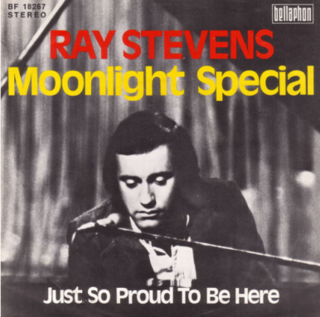
I've been a fan of Ray's 1974 single, "The Moonlight Special", ever since I first heard the song. It was on a 1983 Greatest Hits tape that RCA issued. The tape came into my possession during the early '90s when I located it at K-Mart. The song is a parody of the Midnight Special TV show which featured Wolfman Jack. I happen to think that the inability of a lot of teenagers and even young adults to laugh at themselves is why the single wasn't as big a hit as I think it should have been. As far as statistics go the single peaked just inside the Top-75 of the pop music chart and I believe it was based upon strength of sales instead of airplay. I did a blog entry about this single and titled it "Anniversary Under the Moonlight". 2009 had marked the single's 35th anniversary. The song itself is broken into three acts and the Sheep Dog acts as presenter/emcee. The Sheep Dog, of course, is the Wolfman Jack parody. Ray's own voice appears throughout singing the chorus of the song...but mostly the song is composed of his impressions of Wolfman Jack and the guests appearing on "The Moonlight Special".

For those who want to hear an R&B, bluesy take on "Indian Love Call" look no further than Ray's version of the song. He recorded it in 1975 and it became a Top-40 country music hit. Surprisingly the single didn't do as well with the pop audiences and that's perhaps because the overall feel of the song didn't mesh with the sound of pop radio at the time...or another reason could be that pop music DJ's didn't like the song altogether, no matter whose singing it. Some songs just seem to have this vibe that causes DJ's or music buyers to freak out and they don't want to hear the song by any artist and perhaps "Indian Love Call" is one of those songs? If that's the case the sentiments don't extend to the pop-standards crowd who loved the first known recording by Nelson Eddy and Jeanette MacDonald in 1936. Slim Whitman recorded the song in 1952 and his version is often considered the definitive recording because of his yodeling techniques when phrasing some of the lyrics. Ray's version I'd assume was a sleeper hit with country audiences because it doesn't exactly sound 'country' and the origins of the song aren't 'country'. I will make the assumption that a big factor in the song's acceptance had to do with Ray himself and perhaps the country DJ's getting a kick out of Ray's bluesy arrangement.