Good morning all...breaking news fills the blog entry this morning about the death of George Lindsey, better known to millions of television viewers as Goober Pyle from The Andy Griffith Show, Mayberry RFD, and Hee-Haw. He appeared on Griffith's comedy from 1964 to 1968 and expanded the role in Mayberry RFD during 1968 through 1971...sometimes appearing in what I call civilian clothes, rather than his more familiar work uniform. As many die-hard fans of The Andy Griffith Show and all things Mayberry already know, Lindsey was brought in to fill the eventual void that would be left when Jim Nabors' character, Gomer Pyle, would join the Marines. According to trivia, Goober's last name wasn't going to be Pyle but when the writers and those behind the scenes dreamed up the concept of sending Gomer to the Marines and into a new series it was then determined that Goober would be written in with the last name of Pyle and introduced as Gomer's cousin.
I guess the news of George Lindsey's death broke late last night or quietly yesterday evening but the news outlets have just started running with it in over-drive within the last 30 minutes. Admittedly, I wasn't watching much news programming on Sunday. I was watching various baseball games on and off and then I watched Hee-Haw last night at 8pm. George, of course, was on there. He did a few jokes in the Kornfield and delivered a couple of one-liners at other moments in the show, reacting to Junior Samples' bloopers, and did a "Pffft! You Was Gone!" routine with Archie Campbell.
In the link below you will be able to watch a video and read an article on George Lindsey. The video was put together and narrated by Nashville entertainment critic, Jimmy Carter, who tweeted a link to it on Twitter at 9:31pm Sunday night...
WSMV George Lindsey Tribute
A couple of on-line memorials have erroneously given 1935 as his birth year but he was born in 1928.
I've known of George Lindsey, I can say, my whole life...well, except for the first 5 years of it. My introduction to his career came with Hee-Haw. Those who've read my various blog entries about Hee-Haw will perhaps know that I was introduced to this show through my grandparent's who watched it every weekend. On this show, especially in the '80s, Lindsey was billed in the opening credits as George 'Goober' Lindsey. At that point in time I was unaware of The Andy Griffith Show and Lindsey's connection to it. As a child of the '80s I was introduced to the career of George Lindsey via his appearances on Hee-Haw and, just as ironic, I first heard of Don Knotts via his hysterical appearances on Three's Company as landlord, Mr. Furley. Once I got older and found The Andy Griffith Show on the TBS station I then started to see the characters that my grandparent's and parent's often talked about and made reference to in conversations. On Hee-Haw, Lindsey's contributions evolved through the years. At first he made sporadic, surprise cameo appearances delivering one-liners...not credited in the opening cast.
Later on he began making even more appearances...mostly reacting to the bloopers and the various ways Junior Samples could mess up on-camera. Then Lindsey began appearing in the Kornfield, trading jokes with any number of regulars...coming off as a natural...like he'd been a cast-member since day 1. That's how well he and his character fit into the series.
In his earlier appearances on Hee-Haw he didn't wear the famed Goober cap or mechanic suit...he wore the traditional bib overalls, usually with some sort of over-sized tie or something unusual. He was inserted into the opening credits in the following season, 1973-1974. Wearing large ties, big hats, wigs, and other costumes became a tradition for Lindsey on this program. Pie throwing wasn't common but sometimes it wouldn't be out of the question for Lindsey to play the straight-man, not tipping off the other person about what was going to happen, and then ~SPLAT!!~ a pie in the face...all caught on camera and aired for the country to see. As the program went on, Lindsey's involvement solidified. He appeared in various sketches throughout the '70s. Eventually he became the focal point of his own sketch which took place, you guessed it, at a gas station. In quite a few of these sketches he was joined by an uncredited Jack Burns who'd play the part of a city slicker/con-man always trying to pull one over on Goober but it would always backfire with Goober coming out on top by having more smarts and common sense. In 1978 Lindsey starred in a program called Goober and the Trucker's Paradise. Ray Stevens performed the theme song. I have never seen this program but only one episode was made...it may not even exist on tape anymore.
Also on Hee-Haw, Lulu's Truck Stop became a frequent setting for George Lindsey's comedic antics, too. He'd usually play a fussy customer or one who was in such a hurry that he'd literally cram his mouth with food and dash off. In the ever popular sketch referred to as Minnie's School House, Lindsey was often playing the part of either the sarcastic student, always with a quick one-liner to throw back at Minnie, or the class dunce. Junior Samples played that character most of the time prior to his death in 1983. Minnie and Grandpa Jones once had a sketch that was set in a kitchen and later they were both placed in a sketch that took place in a post office. Lindsey appeared frequently as the mail man who usually began a sketch with pride but would always have that pride diminished when Grandpa or Minnie would tell him that he delivered the wrong letter to someone else by mistake or forgot to deliver an urgent package somewhere, etc. etc. It was always a cute sketch involving the three of them.
At the start of Hee-Haw in 1969 there had always been a segment known as "Pffft! You Was Gone!" where, typically, Archie Campbell would sing a short, comedic tale and then elbow Gordie Tapp, who'd have his back to the camera, and he'd turn around and sing the chorus of the song with Archie...climaxing with a Bronx cheer in one another's face. As the 1980's dawned, Lindsey found himself performing in this sketch with a lot of regularity. The sketch had been so popular for years and the guest stars wanted to take part in it and so usually Gordie, Archie, and George would take turns with a different guest and perform the routine. Sometimes 3 or 4 of these routines appeared in one episode...featuring a guest star paired up with either Archie, Gordie, or George.
In a 1980 episode, George Lindsey performed the routine with Ray Stevens. After Archie Campbell's death in 1987, Lindsey remained a permanent fixture of this routine...trading off with Gordie Tapp...through the end of the series in 1992.
Upon the end of Hee-Haw, Lindsey would go on to appear in the Opryland stage-show revival called Hee-Haw Live! and then release Goober in a Nut-Shell, a book that was so popular, primarily in the southern half of the country, that it necessitated three printings. Lindsey had a cameo role in a Ray Stevens direct-to-home video movie, Get Serious!, in 1995. In the film, Lindsey plays the part of the leader of a local Shriner organization who presents Ray with a yellow dune buggy, which goes on to benefit Ray a great deal as the story unfolds. Lindsey participated in the Get Serious! night on the TNN program, Music City Tonight, in the fall of 1995 and spoke about his experiences on the set. Later in the show, Lindsey appears as Coy when Ray performs a live version of "Shriner's Convention". A year later, 1996, Lindsey won the Minnie Pearl Award for his charitable and humanitarian contributions.
A glance at various on-line sites will show that George Lindsey appeared on various television programs over the decades...everything from drama to his more well-known comedic appearances. In 1982 Lindsey appeared on the Conway Twitty on the Mississippi television special and did a stand-up routine. For many years he hosted a golf tournament in Montgomery, Alabama for charity and was one of the people responsible for a film festival down there which was officially billed as The George Lindsey UNA Film Festival and you can read about it here.
George Lindsey performs "Mountain Dew" on one of his early Hee-Haw appearances right here. For those who want to see the Salute to the Kornfield program, which lasts for 6 hours altogether, you can buy a copy of it here. The show features George Lindsey among the MANY guests and it was taped about a year ago. The program aired on RFD-TV for the first time in January of this year so it's still less than half a year old as far as a television special is concerned. A lot of footage that didn't make it to the airwaves is on the DVD's. In the link you'll also be able to watch the brief commercial for the project.
George Lindsey
1928-2012
Showing posts with label ray stevens. Show all posts
Showing posts with label ray stevens. Show all posts
Monday, May 7, 2012

Tuesday, August 2, 2011
The 2 Hour Ray Stevens Interview...
On August 1st Ray Stevens was the special guest on WSM radio's Intimate Evenings series hosted by Eddie Stubbs. The show aired for 2 hours and was available for on-line streaming but for those who didn't hear it here's a run down of some of the things that went on...
The show took place at the Ford Theater at the Country Music Hall of Fame and Museum.
The program opened up with "Jeremiah Peabody's Green and Purple Pills". Eddie introduced Ray and the two of them spoke about the song becoming a chart hit in 1961 with Ray bringing up that he'd been recording and releasing songs for several years prior to his arrival on Mercury Records but none of his releases had reached the national charts until "Jeremiah Peabody" came along. He made mention that his earliest recordings made local radio station charts but didn't break out nationally. Ray spoke of his 1960's single, "Sgt. Preston of the Yukon", and how it led him to write "Jeremiah Peabody" given how the Sgt. Preston single (a novelty song) had racked up more sales than any of his previous releases to that point. Ray, around this time in the interview, also spoke of his desire to get back out on the road much more than he's been lately. A running joke throughout most of the first hour of the program had Ray playing the part of an artist desperate to do any kind of show...constant reminders of how available he is often found their way into the interview.
Eddie, a couple of times throughout the program, remarked on how packed the venue was and that they had to bring in extra chairs to accommodate all of the people who stopped in to hear Ray speak about his experiences in the music industry and hear tidbits about the songs he's written or recorded. Eddie asked Ray about the gospel songs he's recorded and this led into Ray speaking about his dad's favorite song being "Turn Your Radio On". Ray spoke of his days under the guidance of Bill Lowery and about the years he spent working on local radio programs in Georgia with Joe South, Jerry Reed, Billy Joe Royal, and Tommy Roe. Ray spoke of how Nashville has changed so much since the early '60s and commented that the easy-going, open-doors attitude of late '50s and early '60s recording studios is what enabled him to get his foot in the door. Ray remarks that his Sunday school teacher was instrumental in getting him in contact with Bill Lowery.
Ray recounts his first meeting with Ken Nelson, of Capitol Records, in the late '50s. Ray had made a demo recording at some point in 1957 which Lowery sent to Ken Nelson. One thing led to another and Ray found himself with a recording contract on Capitol's subsidiary, Prep Records, when he was still a teenager. Although not mentioned in the interview it was also during this time that it was suggested that Ray use a stage name. His birth name is Harold Ray Ragsdale...but neither "Harold" nor "Ragsdale" in the minds of the promotional department at Capitol had a lot of pizzaz and so the decision was made to have him use his middle name, Ray, and his mother's maiden name, Stevens, and from that moment on he would go by the name 'Ray Stevens'.
The conversation shifts to his modern-day recordings with Eddie remarking how incredible it is that at this point in Ray's career he's still highly active and working on multiple recording projects. Eddie only had to mention the phrase "Obama Budget Plan" and it sent the audience into applause and laughter...for the audience was well aware of the song's content and the music video. Eddie also asked about "The Skies Just Ain't Friendly Anymore" and this led into Ray speaking of his recent experience with political songs and mentioning his C-PAC appearance several months ago. The audience laughed and cheered during his humorous quips about the current situation in Washington. Eddie played "The Skies Just Ain't Friendly Anymore" and Ray commented afterward that during the C-PAC event he appeared on a political discussion panel. He remarked that he felt that a good number of the politicians on the panel, in general, perhaps only knew of him by way of the older songs from the '60s and '70s and probably weren't too sure why 'Ray Stevens' was sitting on a political panel discussing such heavy topics as the debt, deficit, and health care. He mentioned that as soon as he started into "The Skies Just Ain't Friendly Anymore" he could feel electricity in the air from the audience...he said that they enjoyed it and got a kick out of it. After speaking a little about the Spirit of '76 Eddie plays "Obama Budget Plan".
Eddie, in all seriousness, asked Ray where he comes up his song ideas...instant laughter from the audience resulted from that question. Eddie plays "It's Me Again, Margaret" and how the song's writer, Paul Craft, had released the song nearly a decade before Ray's more familiar version was recorded. Ray commented on the inclusion of the 'dirty laugh' and he re-created the laugh several times during the conversation surrounding the song. From there Eddie brings up "Misty" and Ray talks about how that recording and it's arrangement came into being. It was during this point in the program that Eddie gave some spotlight on Ray's arranging skills. He marveled at Ray's talents at being able to hear songs play out in his head and know which instrumentation to use and everything else that goes into arranging music. He credits Bill Justis with teaching him how to be a music arranger. Eddie brought up Ray's multi-instrumental talents and the numerous recording sessions for other artists that Ray participated in during the '50s, '60s, and early '70s. Ray said that he used to smoke...but quit in 1969. He also commented that session musicians were paid around $50.00 per session.
Hour 2 kicked off with "Ahab the Arab". Ray gave the history of the song and Eddie commented that during the same recording session as "Ahab the Arab" Ray played on LeRoy Van Dyke's "Walk On By" and Joe Dowell's "Wooden Heart". The recording, according to Ray's recollection, happened in January 1962 and it was released as a single in the spring. Out of the blue Ray mentioned that he was working on a book about his career and life with the help of his songwriting associate, friend, and business partner Buddy Kalb. He didn't give a release date but said that it's in the works!
Eddie named off several of Ray's songs. Eddie and the audience chuckled when he got to "Bridget the Midget the Queen of the Blues". Ray remarked that the single wasn't that big of a hit in America. He felt that it was possibly due to political correctness. It's a possibility because political correctness, in it's earliest stages, was starting to creep into television around the turn of the decade (1970-onward) and as the years went by more and more regulations on what could be seen on TV or heard on the radio became more and more prevalent. Ray, defending the song, commented that he was simply wanting to do a song with the Chipmunk sound effects...this caused laughter from Eddie and the audience...and then Ray commented that it became a big hit in England.
Ray's version of "Oh, Lonesome Me" is played. The conversation then turns to Ray's reputation for zany, comical recordings. Eddie brings up the One For the Road collection and the conversation of travel and being on the road leads to "Hang Up and Drive", a song Ray recorded about people driving and talking on their cell-phones.
Eddie brings up how busy Ray continues to be and this leads into a discussion about Ray's sit-com, We Ain't Dead Yet. The sit-com had a trial run on a former web-page that Ray's people operated called Ray Stevens Backstage. It was a premium web-page and it was up and running for nearly 2 years before it went off-line. Those who were members of this site were able to see a few episodes. I hope a general audience will be able to see the shows one day. They're funny, cute, and unique.
Eddie mentions that Ray won two Grammy awards...one for "Misty" and another for "Everything Is Beautiful". Streaking came up and this led into Ray talking about where the idea of the song came from and how he was able to get a jump on the fad nearly a month before it was all over the national news. "The Streak" was played and by then the program was nearly over. Eddie remarked that the Intimate Evenings series had never featured a performer primarily known for comedy but given that this was something new for the series he wanted Ray to have the honor of being the first comedian to make an appearance should they decide to have other comical entertainers stop by in the future. The show closed with Ray's song, "Thank You", from the We The People collection.
All in all the interview was great! Ray's had a varied career that encompasses just about every aspect of the music business: singing, songwriting, producing, arranging, and session playing. There were some highlights of his career that they didn't get around to discussing such as his You Tube music video successes; his revolutionary home video sales successes in the 1990's; his years in Branson, Missouri and the story behind "Shriner's Convention". I have no idea if the interview will be archived at WSM's web-site or not. I'll check their web-site periodically and see if an audio link becomes available.
Sunday, March 13, 2011
Ray Stevens Animated Music Videos...
Country singer Ray Stevens has issued several limited animation music videos down through the years. His initial step into that sort of product came along with the release of a project called Cartoon Video Collection which features 8 music videos where live-action Ray is shown with an animated back-drop. Several years later Ray began issuing music videos that were completely animated...including animated versions of his own image on screen. The results shown up on a couple of DVD releases in 2006.
Those music videos, coupled with brand new additions and some other previously released videos, shown up on Cartoon Carnival, Volume One, a DVD release of 10 animated music videos. That DVD collection was released along side Cartoon Carnival, Volume Two. Keep in mind the years that these individual music videos were released doesn't necessarily reflect the year they were originally recorded. Ray has made a lot of music videos, both live action and animation, of previous recordings that otherwise had no music video counterpart.
The 20 limited animation music videos that a person gets on the two Cartoon Carnival DVD's are as follows...
The Moonlight Special (2009)
Gone For Good (2003)
Along Came Jones (2006)
Barbeque (2006)
Smokey Mountain Rattlesnake Retreat (2009)
The Ballad Of Cactus Pete And Lefty (2006)
Power Tools (2003)
Can He Love You Half As Much As I (2006)
Deerslayer (2003)
Gourmet Restaurant (2006)
Hugo, The Human Cannonball (2009)
Hang Up And Drive (2003)
This Ain’t Exactly What I Had In Mind (2006)
Teenage Mutant Kung Fu Chickens (2006)
Bridget The Midget the Queen of the Blues (2003)
The Camping Trip (2009)
Harry The Hairy Ape (2006)
Erik The Awful (2003)
Jeremiah Peabody's Green and Purple Pills (2006)
Misty (2006)
I highlighted the four exclusive music videos that were added to the collection. This was one of the last projects released by Ray Stevens prior to his change in direction to releasing topical/politically-humorous music videos...which have been seen by millions on You Tube.
Saturday, January 9, 2010
Ray Stevens: The ObamaCare Song
The feeling continues to grow as "We The People" climbs into the Top-30 on Amazon's best-selling MP3 list. As far as country music MP3's are concerned it's still among the Top-3. The official web-site of Ray Stevens crashed multiple times on Friday January 8th and a lot of it had to do with increased traffic which as everyone knows causes a web-site to crash. I believe a lot of this increased traffic stems from the television exposure that Ray's music video had in a brief segment on The O'Reilly Factor. I think that the exposure helped to introduce the song to those who aren't as conversant when it comes to social networks like You Tube or Facebook and as a result even more visitors checked out Ray's web-site looking for the ObamaCare information. There's always a risk or a slim chance that an internet hit isn't well known outside the confines of cyber-space. Some people who don't frequent places like You Tube or just don't even pay attention aren't going to know a music video is available. One of the things that this experience has done with "We The People" taking on a life of it's own is that a good 75 to 80% of people weren't even aware that Ray had been active. A lot of people make the statement that they thought he had retired or had died years ago...so on one hand it's satisfying to see Ray get a lot of media hype and attention and on the other hand it's ironic to see that a lot of people didn't, on their own, seek Ray's music out and instead are just becoming aware of his presence through the "We The People" song.
There's also a good chance that people who discovered Ray through this song will check out his catalog of music...which dates back to the late 1950's. I think one of the things that's surprising to a lot of people who weren't really into all things Ray Stevens is how serious he actually is. As I mentioned in the earliest blog entries that I wrote, Ray had always wanted to be taken seriously and sing serious songs and love ballads but he had a sense of humor and also wanted to express it occasionally. The thing that happened, as long-time fans already know, is that the love ballads and non-comical songs weren't obtaining the same degree of attention from the buying public. One of the things that may be fascinating for some to learn is that the music critics, both in pop and country, almost always gave Ray's serious side good reviews and they would groan and bellyache whenever he'd issue a comical song or an entire album of comical songs. The exact opposite would occur with the buying public...with the exception of a few non-comical songs from Ray that achieved Top-40 rankings, nearly all of his biggest commercial successes came with the comical material. So it was like the buyers wanted fun and silliness from Ray while the critics wanted the serious, thought-provoking Ray.
Those who are amazed or surprised that Ray has serious opinions and world views perhaps thought that an artist known for light, comical banter doesn't take anything seriously? That's just my guess as to why some out there are shocked or stunned by the song...more stunned that it came from someone like Ray whose branded "safe" or "non-threatening". I think the very idea that the song comes from someone the public would least expect is where the 'novelty' aspect comes from...even though the lyrics are dead-serious. This is where I think the genius of Ray Stevens shines through and it has to do with the song's arrangement and the humorous music video imagery. The arrangement is bouncy and the chorus is catchy while the music video is funny to watch...and something else that's funny...
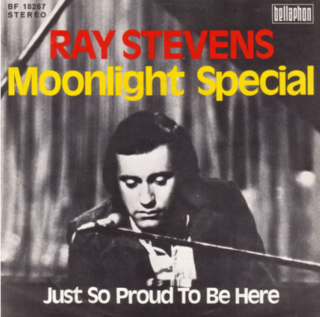 I've been a fan of Ray's 1974 single, "The Moonlight Special", ever since I first heard the song. It was on a 1983 Greatest Hits tape that RCA issued. The tape came into my possession during the early '90s when I located it at K-Mart. The song is a parody of the Midnight Special TV show which featured Wolfman Jack. I happen to think that the inability of a lot of teenagers and even young adults to laugh at themselves is why the single wasn't as big a hit as I think it should have been. As far as statistics go the single peaked just inside the Top-75 of the pop music chart and I believe it was based upon strength of sales instead of airplay. I did a blog entry about this single and titled it "Anniversary Under the Moonlight". 2009 had marked the single's 35th anniversary. The song itself is broken into three acts and the Sheep Dog acts as presenter/emcee. The Sheep Dog, of course, is the Wolfman Jack parody. Ray's own voice appears throughout singing the chorus of the song...but mostly the song is composed of his impressions of Wolfman Jack and the guests appearing on "The Moonlight Special".
 For those who want to hear an R&B, bluesy take on "Indian Love Call" look no further than Ray's version of the song. He recorded it in 1975 and it became a Top-40 country music hit. Surprisingly the single didn't do as well with the pop audiences and that's perhaps because the overall feel of the song didn't mesh with the sound of pop radio at the time...or another reason could be that pop music DJ's didn't like the song altogether, no matter whose singing it. Some songs just seem to have this vibe that causes DJ's or music buyers to freak out and they don't want to hear the song by any artist and perhaps "Indian Love Call" is one of those songs? If that's the case the sentiments don't extend to the pop-standards crowd who loved the first known recording by Nelson Eddy and Jeanette MacDonald in 1936. Slim Whitman recorded the song in 1952 and his version is often considered the definitive recording because of his yodeling techniques when phrasing some of the lyrics. Ray's version I'd assume was a sleeper hit with country audiences because it doesn't exactly sound 'country' and the origins of the song aren't 'country'. I will make the assumption that a big factor in the song's acceptance had to do with Ray himself and perhaps the country DJ's getting a kick out of Ray's bluesy arrangement.
There's also a good chance that people who discovered Ray through this song will check out his catalog of music...which dates back to the late 1950's. I think one of the things that's surprising to a lot of people who weren't really into all things Ray Stevens is how serious he actually is. As I mentioned in the earliest blog entries that I wrote, Ray had always wanted to be taken seriously and sing serious songs and love ballads but he had a sense of humor and also wanted to express it occasionally. The thing that happened, as long-time fans already know, is that the love ballads and non-comical songs weren't obtaining the same degree of attention from the buying public. One of the things that may be fascinating for some to learn is that the music critics, both in pop and country, almost always gave Ray's serious side good reviews and they would groan and bellyache whenever he'd issue a comical song or an entire album of comical songs. The exact opposite would occur with the buying public...with the exception of a few non-comical songs from Ray that achieved Top-40 rankings, nearly all of his biggest commercial successes came with the comical material. So it was like the buyers wanted fun and silliness from Ray while the critics wanted the serious, thought-provoking Ray.
Those who are amazed or surprised that Ray has serious opinions and world views perhaps thought that an artist known for light, comical banter doesn't take anything seriously? That's just my guess as to why some out there are shocked or stunned by the song...more stunned that it came from someone like Ray whose branded "safe" or "non-threatening". I think the very idea that the song comes from someone the public would least expect is where the 'novelty' aspect comes from...even though the lyrics are dead-serious. This is where I think the genius of Ray Stevens shines through and it has to do with the song's arrangement and the humorous music video imagery. The arrangement is bouncy and the chorus is catchy while the music video is funny to watch...and something else that's funny...
I've been a fan of Ray's 1974 single, "The Moonlight Special", ever since I first heard the song. It was on a 1983 Greatest Hits tape that RCA issued. The tape came into my possession during the early '90s when I located it at K-Mart. The song is a parody of the Midnight Special TV show which featured Wolfman Jack. I happen to think that the inability of a lot of teenagers and even young adults to laugh at themselves is why the single wasn't as big a hit as I think it should have been. As far as statistics go the single peaked just inside the Top-75 of the pop music chart and I believe it was based upon strength of sales instead of airplay. I did a blog entry about this single and titled it "Anniversary Under the Moonlight". 2009 had marked the single's 35th anniversary. The song itself is broken into three acts and the Sheep Dog acts as presenter/emcee. The Sheep Dog, of course, is the Wolfman Jack parody. Ray's own voice appears throughout singing the chorus of the song...but mostly the song is composed of his impressions of Wolfman Jack and the guests appearing on "The Moonlight Special". For those who want to hear an R&B, bluesy take on "Indian Love Call" look no further than Ray's version of the song. He recorded it in 1975 and it became a Top-40 country music hit. Surprisingly the single didn't do as well with the pop audiences and that's perhaps because the overall feel of the song didn't mesh with the sound of pop radio at the time...or another reason could be that pop music DJ's didn't like the song altogether, no matter whose singing it. Some songs just seem to have this vibe that causes DJ's or music buyers to freak out and they don't want to hear the song by any artist and perhaps "Indian Love Call" is one of those songs? If that's the case the sentiments don't extend to the pop-standards crowd who loved the first known recording by Nelson Eddy and Jeanette MacDonald in 1936. Slim Whitman recorded the song in 1952 and his version is often considered the definitive recording because of his yodeling techniques when phrasing some of the lyrics. Ray's version I'd assume was a sleeper hit with country audiences because it doesn't exactly sound 'country' and the origins of the song aren't 'country'. I will make the assumption that a big factor in the song's acceptance had to do with Ray himself and perhaps the country DJ's getting a kick out of Ray's bluesy arrangement.
Subscribe to:
Posts (Atom)