Showing posts with label Robert McKimson. Show all posts

Monday, February 11, 2019

Sylvester and Hippety Hopper: Looney Tunes DVD...

Over the course of the last several months I'd been purchasing the DVD releases of the Looney Tunes Super-Star Series. I happen to love the releases...and although I've read many, many, many angry complaints over the years from those that criticize the cropped presentation of the cartoons in those DVD releases I decided to purchase some just to see what all of the criticism was about. This one I'm spotlighting in the photo arrived in the mail the other day but the very first DVD purchase was actually several years ago when I purchased the Foghorn Leghorn and Friends title. When I watched the DVD I couldn't really tell what all the negative fuss was about. I've seen compare/contrast images where someone's posted an original screen shot side by side with a cropped screen shot and while I can tell there's a visual difference in the presentation when images are shown side by side on an internet site the fact remains that when I'm actually watching the DVD I'm more engaged with what I'm watching (the cartoons themselves) and I'm enjoying the vocal work of Mel Blanc...I'm not concerned with aspect ratios and presentations and I think a general audience feels the same way. The Foghorn DVD was subtitled Barnyard Bigmouth. This DVD has the title of Sylvester and Hippety Hopper with a subtitle of Marsupial Mayhem. Also in my collection are Daffy Duck: Frustrated Fowl, Porky and Friends: Hilarious Ham, Bugs Bunny: Hare Extraordinaire, Road Runner and Coyote: Super Genius Hi-Jinks, and Pepe Le Pew: Zee Best of Zee Best.

The Foghorn Leghorn series of cartoons were directed by the under-rated Robert McKimson. I place his directorial style somewhere between Bob Clampett and Friz Freleng. He had been an animator for more than a decade at Warner Brothers before he became a director in 1944. Oddly enough a lot of McKimson's cartoons have heavy doses of wild animation and slap-stick sentiments which align him closer to the styles of Tex Avery and Bob Clampett but while there's precious few interviews either in written form or in audio form of Robert McKimson the interviews that happen to exist often show McKimson referring to the style of animation that consumes a lot of his own cartoons as being over-animated and he makes mention of this in a critical reflection rather than something he embraces as a director. Nevertheless the wild, slapstick style of animation is wonderful to watch and it's on full display on this Sylvester and Hippety Hopper DVD, too. You lose track of how many times the baby kangaroo kicks Sylvester all over the place...with the cat crashing through walls, floors, ceilings, and all kinds of other barriers both interior and exterior...or how many times Sylvester is flattened or tossed around by nameless bulldogs. The formula of the cartoons remains the same: the baby kangaroo wanders away from a zoo or a circus or from a crate and hops around until being spotted by Sylvester who always mistakes the baby kangaroo for a giant mouse.


The cartoons are made more memorable due to the creation of Sylvester, Jr. It is in these series of Sylvester/Hippety cartoons that a new development in Sylvester's personality is explored with that new development being the role of father. The overall formula depicts Sylvester as a bragging father attempting to impress his son but is constantly receiving a physical thrashing at the hands, or the feet, of Hippety whom they both consider a mouse. The fact that his father is constantly getting beaten up "by a mouse" forever leads the son into self-imposed shame...often times putting a paper bag over his head in disgrace and exclaiming melodramatic lines such as "oh, the humiliation...", "oh, the shame!!", or "I can see my friends now...laughing over how my father that can't even catch a mouse...". In Sylvester, Jr.'s eyes he doesn't see how physically strong Hippety actually is...all the son sees is a father getting beaten up by a mouse.


In the first two cartoons in the series "Hop, Look, and Listen" and "Hippety Hopper" a bulldog is on hand as a bystander observing the activity. The dog continually sees Sylvester being thrown out of the house at the hands of a little mouse...what the dog doesn't know is the mouse, in both cartoons, is playing a trick on Sylvester. The mouse has Sylvester believing in the super-natural and that he can change into a giant mouse...and every time the little mouse ducks behind a door or goes into hiding "the giant mouse" appears. The dog is the same one that appears in a couple of other cartoons directed by Robert McKimson...being paired with a nameless cat...in "Early to Bet" and "It's Hummer Time". One of the cartoons on the DVD, 1952's "Hoppy Go Lucky", is a take off on Of Mice and Men. In the cartoon, strangely enough, Sylvester protests to Benny to stop calling him 'George'. Benny (voiced by Stan Freberg) explains that he's unable to pronounce 'Sylvester' and returns to calling him 'George'. The Benny character in this cartoon is the same one that later appears in 1953's "Cat-Tails for Two", also directed by Robert McKimson. That's the cartoon which introduced the Speedy Gonzales character. Sylvester's fatherly protectiveness is on display in "Who's Kitten Who?". There's a scene in which Hippety falls onto a piece of fly paper with Sylvester, Jr. sandwiched between the paper and Hippety's stomach. Sylvester, quite naturally, freaks out over seeing an outline of his son 'inside' the stomach of the giant mouse. He, in turn, places a paper bag over his own head in disgrace for not being able to stop the giant mouse from eating his son. The cartoon doesn't end on that note, though...the son busts out of the flypaper licking a lollipop as the cartoon irises out (while Sylvester, off screen, presumably still has the paper bag over his head).

Sylvester sees the "giant mouse" for the first time!
There are 18 cartoons on this DVD...of all the cartoons that appear 16 had never been available on DVD before. Robert McKimson directed 17 of the 18 cartoons...the only one he didn't direct is the final cartoon on the disc, "Goldimouse and the Three Cats", which was directed by Friz Freleng. The physical appearance of Sylvester in nearly all of McKimson's cartoons was a bit different than how he appeared in Friz Freleng's cartoons. Friz was actually the creator of Sylvester and was utilized by Friz in a wildly popular series of cartoons where Sylvester was attempting to capture and eat a canary named Tweety. In Robert McKimson's cartoons Sylvester had a much more shaggier facial appearance, it seemed, with a smaller red nose in some of the earliest Hippety Hopper cartoons and his speech impediment was exaggerated even more. Also, Sylvester didn't have the white patch of fur at the end of his tail in many of the Robert McKimson cartoons...so there were subtle physical differences of the character depending on which director was working on the cartoon. Robert McKimson's most popular character was the rooster, Foghorn Leghorn...and in one of the Foghorn cartoons, "Crowing Pains", Sylvester co-stars. Sylvester would later become associated with Speedy Gonzales in a series of cartoons in the late 1950s and early 1960s. Friz Freleng and Robert McKimson took turns at directing the Sylvester/Speedy cartoons. For those that want to know more about Robert McKimson as well as his two brothers, Tom and Charles, purchase a copy of the book from Robert McKimson, Jr. called I Say, I Say...Son!!: A Tribute to Legendary Animators Bob, Chuck, and Tom McKimson. Robert, Charles, and Tom McKimson were all artists and each of them had lengthy careers in every facet of art. You can purchase it through AMAZON. I purchased the hardcover coffee table version of the book when it was hot off the presses in 2012. If you're serious about learning the story of the McKimson brothers and their individual career's you need to get this book! It's chock full of photo's, animation screen shots, directorial break down sheets, animator notes, copyright applications, etc. etc.

Saturday, June 1, 2013

The art and animation of the McKimson Brothers...

I was tempted to title this blog entry 'Pay attention, I say...pay attention, son, This is a great book!!' but I decided against it basically because the title probably wouldn't appear completely in the blog listings and so I decided on the title you see above. This book, titled I Say, I Say...Son! looks at the animation/illustration careers of the McKimson brothers: Robert, Tom, and Chuck. Considering that the book's written by Robert McKimson, Jr. there's an understandable main focus on Robert Sr. and his life and times but it also covers the careers of Tom and Chuck, just as the book indicates. I purchased the hardcover book and I did this simply for posterity. Some may opt to purchase the on-line Kindle version for economical reasons or to simply receive the book faster than standard mail shipping. Whichever version you purchase is fine as long as you purchase it. It's one of those kind of books that I think will go out of print and be a rare find in months and years to come. The on-line version, who knows, may be around for eternity but the actual book won't be.

There are a few thorough reviews of this book already and so I'll by-pass re-writing what's already been said. Animation fans and cartoon fans will enjoy the book a whole lot. Anyone aspiring to be a cartoonist or work in the animation industry should purchase the book if only to grasp how far the industry has come since those earliest days and appreciate the technological advances that have come along. As others have mentioned, the book is chock full of illustrations and pictures of behind the scenes workers. There are several moments in the book where the story of the McKimson's is broken up between pages of illustrations. It can be a difficult read if you're not as familiar with these kind of books but the illustrated pages, as I noticed, have a light blue background and so if you look at the side of the book's pages you'll see how many blue pages to turn through before picking up where you left off reading...but, for me, I loved looking through the illustrated pages and I'd simply flip back to where I'd left off reading and then pick up reading once the images had ended.

One reviewer mentioned that the book comes across bitter but I didn't see it that way. In my way of thinking, being bitter means that you're holding a grudge or have a sour mood about whatever it may be. However, if one is familiar with the Warner Brothers cartoons and have some sort of knowledge about various erroneous credits over who created what or who designed what character, etc. etc. then you'll understand the reason for including, for example, images of copyright registrations showing Robert McKimson as the artist who came up with the physical appearance of the Bugs Bunny that we all know and recognize.

If you're familiar with the cartoons of Robert McKimson, or any of the McKimson brothers, but have a hard time finding anything about them on-line then this book is a definite must-have. As far as Chuck McKimson goes, his career as an animator and artist is tied in mostly with his brother's animation unit at Warner Brothers. If you look at any number of Robert McKimson cartoons you're bound to see Charles McKimson listed as one of the animators. The book features illustrations that Chuck did...especially a watercolor rendering of Miss Prissy. Among the pictures in the book is one of Robert and company examining what's referred to as a pencil test.

Chapter Six is titled 'Western Publishing' and it looks at the careers of both Tom and Chuck McKimson. While throughout the book you'll see illustrations credited to Tom and Chuck, as well as pictures of the two, it's mostly in Chapter Six where their individual contributions to animation and art is discussed. In this chapter it mentioned Tom's preference with illustrating comic books, coloring books, and other kinds of book-related media. The author relays the reasoning behind why Tom preferred book illustration to animation. Did you know that Tom and Chuck worked on the Roy Rogers comic books of the late '40s and early '50s? That is just one of the various bits of information found in the book.

The cover art, as you see, depicts a scene from any number of cartoons featuring Foghorn Leghorn and Henery Hawk. What you don't see is the image on the back of the book. It's of the character simply known as Barnyard Dawg and he's in a very familiar pose. The full image is seen on pages 114 and 115. Foghorn was and continues to be one of my favorite characters. For many, many, MANY years I never knew the character's name. I only referred to him as "that big rooster". I was raised on the Warner cartoons that aired on TV throughout the 1980's and 1990's and as many already know the title cards would always be removed. Anyway, as I got older, I found out what a leghorn was after I saw the phrase 'Foghorn Leghorn' written in an issue of TV Guide. The name had appeared in connection with a Bugs Bunny holiday cartoon that was going to air. So, I made the connection that Foghorn Leghorn must mean "loud chicken".

In the late '90s I was listening to an AM radio station that aired a show called When Radio Was. The show, hosted by Stan Freberg, consisted of Stan introducing and giving some insight about old-time radio programs that were to be re-aired during the hour. I knew of Stan Freberg from a few Christmas comedy CD's that I owned featuring various artists, Stan being one of them, but I didn't exactly know his ties with cartoons and advertising, etc. etc. until several years later. I didn't know he was the voice of Pete Puma, the character that appears on Robert McKimson's cartoon "Rabbit's Kin", until sometime in the 2000's.

Anyway...that particular episode of When Radio Was featured a re-airing of a Fred Allen radio show. This one featured a segment known as Allen's Alley and it had a character in it named Senator Claghorn, played by Kenny Delmar. As soon as I heard Claghorn speak for the first time I assumed they'd patterned the character after "that big rooster" but I learned it was the other way around.

The author, on page 119, goes into detail about Foghorn's creation and it's inspiration. Notable characters from Robert McKimson include Foghorn Leghorn, Speedy Gonzales, Tasmanian Devil, Miss Prissy, and Barnyard Dawg. Yes, Robert McKimson created Speedy Gonzales and directed the character's debut cartoon, "Cat Tails For Two", in 1953. There's an image of the character in the book indicating that his creation happened in 1951 but didn't make it onto the big screen until 1953.

The character was re-designed by the Friz Freleng unit after that first appearance. The Speedy cartoons were non-exclusive. Whereas Robert pretty much had exclusive use of Foghorn Leghorn, both the Freleng and McKimson units issued Speedy cartoons throughout the late '50s and into the mid '60s.

Robert McKimson's cartoons, for the most part, have been overshadowed by the directorial masterpieces and achievements of his peers, which included Tex Avery, Friz Freleng, Bob Clampett, and Chuck Jones. This isn't to say McKimson never directed any masterpieces of his own. McKimson's cartoons are just as great and just as popular but most of them never achieved the kinds of lofty acclaim, in later decades, that his peers cartoons have. McKimson did a series of hilarious cartoons featuring a nameless cat and dog. Once you see the character's faces you'll remember the cartoons I'm referring to. In one cartoon, "Early To Bet", the cat is constantly trying to win a card game. A character referred to as the Gambling Bug bites the cat at various moments throughout the cartoon...sending the cat into a delirious state of gambling fever. The dog, meanwhile, always wins. This causes the cat to have to pay a penalty for losing. The hook of the cartoon, and others in the series, is the cat's wild and outlandish reactions every time he reads a penalty that's about to be inflicted on him. The nameless cat and dog appear in another McKimson cartoon titled "It's Hummer Time" which tells of a the cat's desire to capture an elusive hummingbird. The joke is that the bird, much like the gambling bug in the other cartoon, continually leads up to physical trouble for the cat at the hands of the dog. This particular cartoon ends with some ironic justice for the cat.

The book gives great detail about the natural artistic talents of Robert, Tom, and Chuck McKimson and it goes a long way at examining Robert McKimson's contributions to the Warner Brothers characters as he was, at one time, in charge of checking everyone's drawings...from all units! He had his hand in a lot of cartoons that don't credit him simply because there's never been a "Reviewed and checked by" screen credit. If there had been such a credit, based on the information in this book, Robert McKimson's name would appear on a lot of cartoons.

Robert McKimson passed away too young, at the age of 66, in September 1977. His death came just weeks before his 67th birthday. Tom McKimson passed away in February 1998 at the age of 90. Chuck McKimson passed away in April 1999 at the age of 84.

The book contains a foreword by John Kricfalusi and an introduction by Darrell Van Citters. As mentioned, the book is a must-have for cartoon fans and those interested in reading about the brother's McKimson from one that would certainly know the most- Robert McKimson, Jr.

Tuesday, April 30, 2013

Bugs Bunny's original Birthday...

During a news break this morning while listening to the radio it was announced that today marked the 75th birthday of Bugs Bunny. Doing the math, 2013 minus 75 is 1938. It was on April 30, 1938 that an as yet to be named rabbit character appeared in an animated theatrical cartoon titled Porky's Hare Hunt. This rabbit character would evolve over the course of 2 years and visually start to resemble the character we all know as Bugs Bunny. The rabbit got it's name through a chain of events where an employee at Warner Brothers had written the phrase Bugs's Bunny on a model sheet of the yet to be named character. Ben Hardaway's nickname at the studio, according to those who worked with him, was Bugs. Today many historians refer to him as Ben "Bugs" Hardaway. 

Anyway, the alliterative name stuck and from then on Bugs Bunny became the character's name.

However, longtime fans, historians, and those who worked on the cartoons cite 1940 as the official birth year of Bugs Bunny for it was in a July 27, 1940 cartoon directed by Tex Avery titled A Wild Hare which introduced the basic visual appearance that Bugs Bunny has kept over the last 73 years. Porky's Hare Hunt was directed by Ben Hardaway and Cal Dalton. A Wild Hare was directed by Tex Avery. Research shows that there were four theatrical cartoons released between April 1938 and March 1940 starring the future Bugs Bunny. Those cartoons are as follows:

1. Porky's Hare Hunt; 1938  (Ben Hardaway and Cal Dalton)

2. Prest-O Change-O; 1939  (Chuck Jones)

3. Hare-um Scare-um; 1939  (Ben Hardaway and Cal Dalton)

4. Elmer's Candid Camera; March 2, 1940  (Chuck Jones)

A Wild Hare, with the new design of the rabbit, soon followed in July 1940. This is probably the only animated character that has two birthday's. April 30, 1938 and July 27, 1940. Given that the 1940 cartoon by Tex Avery is almost always universally accepted as the first official Bugs Bunny cartoon, 1940 is considered his official 'birth year'. This is why, in 1990, there was a lot of media hype surrounding the character's Golden Anniversary...hitting 50. Ten years later ABC-TV cancelled the long running Saturday morning Bugs Bunny Show franchise (which had evolved into The Bugs Bunny and Tweety Show). This particular series, which ran on various networks and time-slots since 1960, had turned 40 in the year 2000. Since that point in time the Looney Tunes characters have mostly aired on cable television, off and on, in addition to a long list of DVD compilation projects. Down through the years I've been able to purchase several items pertaining to Bugs Bunny and his numerous co-stars plus a couple of items about the man who gave voice to Bugs Bunny from 1938 through 1989, Mel Blanc.

At this time I'd like to put on display some of my Bugs Bunny/Looney Tunes/Mel Blanc items from my personal collection...

This is a relatively brand new book. It hit the market late in 2012 and I finally got around to purchasing it a few weeks ago. I have purchased a couple of other books from the pen of Ben Ohmart within the last several years and so when I first learned that a book about Mel Blanc was on the horizon I couldn't wait until it's release. Throughout the book there is commentary from Mel's son, Noel, taken from an unpublished biography that Noel wrote about his father. Ohmart's book, titled Mel Blanc- The Man of a Thousand Voices, it features many, many, many facts about a man who became one of the most busiest actors in radio, cartoons, and records...and later added television appearances to his long list of credits. Speaking of credits...this book gives a detailed account on everything that Mel Blanc took part in from the early days of his career through his final projects in 1989. It's truly a fabulous, unique, and addictive kind of book for those who are not only fans of Mel Blanc but of classic animated cartoons in general, whether theatrically released or made-for-TV. The book is also filled with quotes and remembrances by a long list of celebrities in an out of animation that Mel worked with or were inspired by. Mel's friendship with Jack Benny is explored in more detail in this book, too. The book is lengthy but this is not to be a surprise for an actor of Mel's considerable longevity...before hitting national radio in the late '30s, right around the time he was just starting his decades long run with Warner Brothers cartoons, Mel was a feature on local radio for a period of years in Oregon prior to making the move down to the Los Angeles area. In addition to the written word there are plenty of pictures throughout. Some of the images, I assume, are exclusive to the book as I hadn't seen quite a few of them until now. This fabulous book can be purchased HERE.  
  
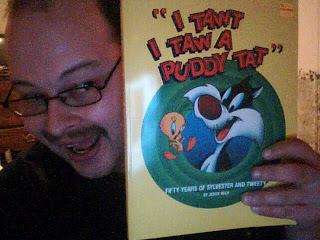
Although this particular book has nothing to do with Bugs Bunny, it's all about Tweety and Sylvester, the canary and cat duo that featured prominently in many of the Warner Brothers releases throughout the mid '40s through the '50s. The book was issued in 1991, written by Jerry Beck. By the early '60s Sylvester's more frequent nemesis had changed from Tweety to the fastest mouse in Mexico, Speedy Gonzales. The book takes a look at every theatrically released cartoon to feature each character, either as a duo or separately. The two characters would, many decades after their creation, star in a television series titled The Sylvester and Tweety Mysteries. The series debuted in 1995, the 50th anniversary of the first theatrical cartoon starring Sylvester titled "Life with Feathers". Like Bugs Bunny, Sylvester was a yet to be named character. In fact, he was referred to as Thomas in early cartoons with Tweety.

In 1988 Mel Blanc issued his autobiography titled That's Not All, Folks!. The book is a fascinating look into the life and times of one of animation's greatest voices. As the years went on and more and more fans had gotten older and more and more aspiring voice actors/actresses came along who had grown up watching the various Looney Tunes programs, the book seemed to take on much more scrutiny than it did when it was originally released. There are a few recollections in the book that contradict information later brought to light and then there's the longstanding argument over the creation of the Foghorn Leghorn voice. At the root of the argument, basically, is the origin of the voice and how possible it is that both Mel Blanc and Kenny Delmar were inspired by similar sounding fictional characters and each used that distinctive voice without copying from the other...Foghorn Leghorn debuted right at the height of the Senator Claghorn craze in 1946. Claghorn was a radio character played by Kenny Delmar on Fred Allen's radio program starting in the latter half of 1945. Keith Scott writes about this very subject HERE.  

June Foray issued her autobiography, Did You Grow Up With Me, Too?, a couple of years ago. It was co-authored by Mark Evanier and Earl Kress. I'm proud to say that I wrote the first Amazon review of this particular book. You can read that review HERE. June had quite an impact in the Looney Tunes series as she gave voice to a few characters that have since become animation icons. The original voice actress of Granny and Witch Hazel was Bea Benaderet. Bea would later give voice to Betty Rubble in The Flintstones. Like June, Bea had a lengthy career in radio and on records in addition to the cartoon work. Bea, however, would become even more recognizable as a face actress in the 1950's and 1960's appearing in an assortment of early television comedies. Bea's longest running television role was as matriarch Kate Bradley on the rural sitcom, Petticoat Junction. June stepped into the roles of Granny and Witch Hazel during the 1950's and she's been the voices of those characters ever since. Unlike Mel Blanc, though, June wasn't tied to just one animation company exclusively for so many years. In addition to her Warner Brothers work she concurrently gave voice to another animated icon, Rocky the Flying Squirrel, on the Bullwinkle series of cartoons by the Jay Ward company. She became even more busy in the 1980's. She gave voice to Jokey Smurf and Mother Nature in the Smurfs series throughout the decade. For the Disney company June was the voices of several characters in the mega hits The Adventures of the Gummi Bears and Duck Tales from the mid '80s onward. You can read more about her by getting the autobiography!

This obscure 2005 CD features quite a number of songs recorded by Mel Blanc. What a lot of people usually forget about or don't know is that Mel had a lengthy recording career outside of animated cartoons. Although a lot of his recordings centered around the animated characters that he gave voice to in a series of children's albums there were quite a few recordings where he uses his natural voice, too, but those weren't as commercially successful as the recordings he did with the humorous voices and sound effects. There are 25 songs featured. Some of the highlights, for me, are "Yosemite Sam", "I Tan't Wait Till Quithmuth Day", "The E.I.O. Song", "Morris", "Yah Das Ist Ein Christmas Tree", "Money", "Barney Google", "That Hat I Got For Christmas Is Too Beeg", "I Tell My Troubles to Joe", and "The Missus Wouldn't Approve". For the latter two songs he uses a voice similar to the one he gave to the Happy Postman character on The Burns and Allen Show. He gives a display of quite a few voices as each voice takes turn performing "Barney Google". The CD kicks off with his version of "The Woody Woodpecker Song". The recording had originally been recorded and released by the immensely popular bandleader, Kay Kyser, in 1948. His recording featured the vocalizations of Harry Babbitt and Gloria Wood. The song is a perfect example of an obscurity amongst a general audience in that Mel Blanc provided the original voice of Woody Woodpecker and created the famous laugh heard throughout a bulk of the series. The Woody character was created by Ben Hardaway in 1940...yes, the same one who played a pivotal role in the original version of Bugs Bunny in 1938. In fact, Woody's vocalization as provided by Mel Blanc was almost exactly the way the original version of Bugs Bunny sounded...right down to the distinct laugh. Mel provided Woody's voice in animated form in just the first four releases. This is because in 1941 Mel signed an exclusive contract with the Warner Brothers cartoon division (Leon Schlesinger Productions) and from that point forward Mel's voice could only be heard on cartoons released by Warner Brothers. This exclusive contract was kept intact for nearly 20 years.

However, the exclusive contract applied to animated cartoons only...it didn't prevent him from using his voice on radio and on records. In radio, Mel was heard on dozens of radio programs playing a wide variety of recurring characters. Given that his radio characters were as animated as the characters in the cartoons it wasn't uncommon for the writers of the cartoons to blend both worlds together and have in-jokes flowing all over the cartoons about various radio comedies that Mel was featured on. References to Jack Benny were used the most given that Jack's radio program was the #1 comedy show for so many years and that Mel provided many character voices on that series. One cartoon in particular, 1959's The Mouse That Jack Built, must have seemed surreal to audiences at the time. It was directed by Robert McKimson and featured the actual cast of The Jack Benny Program providing their character voices, drawn as mice. Mel provided the voice of the Maxwell jalopy as well as the unseen Ed, the Vault Keeper. On radio Joseph Kearns provided the voice of Ed. Considering that Ed only had a brief exchange with the cartoon Jack Benny it was probably decided that it wouldn't make much sense to bring in Joseph Kearns for just one single line reading. Later that year he would take on the role of Mr. Wilson on Dennis the Menace.

I've posted several of these images before in numerous other blog entries. The Looney Tunes Golden Collection continues to be, for me, the bible of Warner Brothers theatrical cartoons from beginning to end. The various DVD discs focus on a particular overall theme, pretty much, and so what you get are deliberately selective cartoon entries on each disc that have to do with the overall theme. For example, one of the disc's may be devoted to just the cartoons starring Bugs Bunny (obviously!) and another disc may deal with cartoons that feature only Daffy Duck or Porky Pig. In some of the last collections there was a lot more coverage of the black and white era and the earliest Looney Tunes characters...I'm referring to the characters that arrived prior to the debut of Porky, Daffy, Bugs, Tweety, and Sylvester. If you don't know who those characters were then they'll be a revelation if you purchase the later installments of the Golden Collection series. Also, I've almost wore out one of the disc's...the one that features the World War Two cartoons found in the collection below. The war cartoons are endlessly entertaining but I went to play it one day and it stopped playing during one of the cartoons. I don't know if I really did wear the disc out or if it's one of those unexplained glitches having more to do with the DVD player rather than the disc itself.
 

Thursday, May 3, 2012

Animator/Director Robert McKimson: 1910-1977

As I scour the internet and blogosphere I'm pleased to see quite a few blogs dealing with Robert McKimson's impact on the Warner Brothers cartoons as an animator and a director. I came across this particular article, written by an author named Michael Mallory, titled The Case for Robert McKimson from a web-site entitled Animation Magazine. That article, and several others at other sites, can give you in-depth and statistical data about Robert McKimson as well as a listing of the cartoons he directed for Warner Brothers. My blog entry is not as in-depth but rather enthusiastic. As I've often pointed out I'm a professional enthusiast...vastly different from a critic. 

As many of you may know, I am nowhere near an expert on all things Looney Tunes...other than being a big fan of the cartoons...but through the joys of watching the cartoons, you, as a viewer, become aware of who the directors were and who some of the writers and animators were and of course who Mel Blanc was, etc. etc. It's all there on the opening credits. Those who are much more in detail about the behind-the-scenes goings on at Warner Brothers during their Golden Period are certainly aware of the various units that were employed at the studio. The unit consisted of writers, animators, layout artists, background painters, and of course the director. Several directors came and went...of those that came and went were Tex Avery, Frank Tashlin, Norm McCabe, Ben Hardaway, Cal Dalton, and Bob Clampett. The core line-up of directors from the mid '40s onward were: Friz Freleng, Chuck Jones, and Robert McKimson. Along the way, for a short period of time, Art Davis directed a series of cartoons for the studio but ultimately went back into animation when the studio started cutting back the number of units. There was considerable unit hopping, as I call it, that took place in the '30s and especially the '40s. When a director would leave, their unit would either be dismantled altogether or be absorbed by another director still with the studio...sometimes a director would hand pick animators or layout artists from a former director's unit and incorporate them into their own unit. Robert McKimson, after years of being content as an animator, found himself being a director after the departure of Frank Tashlin in 1944.

As a fan of the classic Looney Tunes shorts I have an equal appreciation for the directors that came and went and those that stayed for the long haul. McKimson was there from the beginning to the end. For years now there have been many, many attempts by admirers and fans of individual directors at the studio to marginalize the work of other directors. Fan wars, or whatever one chooses to call it, does a disservice, I think, to the overall legacy of the Looney Tunes. For a fan, to single out a director and say that particular director's cartoons are better than anyone else at the studio is normal...but...at the same time it creates division and really serves no purpose beyond chest-pounding and brow-beating.

I'm a tad bit different when it comes to such things. There is something amusing, whimsical, funny, humorous, and outright hysterical about many of the cartoons from the various Warner Brothers directors. A person's individual taste is subjective, obviously, but it shouldn't be so subjective that it becomes blinding to anyone else's work. Friz Freleng created his share of masterpieces as did Tex Avery, Bob Clampett, Norm McCabe, Chuck Jones, and Robert McKimson. Now, of course, some of the lesser-known directors didn't have the luxury of longevity with the studio and so they hadn't obtained the sort of celebrity status that the more tenured directors achieved...that's just a fact...it isn't a case of their work not being important or any good.

Robert McKimson's work as a director was covered in the Six Volume DVD series, Looney Tunes: Golden Collection. However, if you look up the volumes and do a cartoon by cartoon check list by their director, you'll notice that McKimson's work is seriously under represented in comparison to Friz Freleng and Chuck Jones. Sprinkled throughout the DVD's are cartoons from Norm McCabe, Harman-Ising, Ben Hardaway and Cal Dalton, Art Davis, and of course Tex Avery and Bob Clampett. It would take until Volume Five before Bob Clampett got a disc of his own...but McKimson, nor Tex Avery, got a disc of their own during the entire Six Volume series. The Golden Collection series is wonderful, don't get me wrong, but for a certain animator turned director (McKimson) who was at the directorial helm from 1944 through the close of the studio in 1969...for his work to not have a more significant role in the Golden Collection series is a bit of a let down. Fear not, though...on Volume Five of the series there's an extra found on Disc 2 called Drawn To Life: The Art of Robert McKimson. Although a full disc of his cartoons would've been even better, it nonetheless is a wonderful treat to see McKimson's son and peers reflect on the animator turned director who passed away decades before cartoons became celebrated and praised. Robert McKimson passed away on September 29, 1977...ironically, McKimson died while dining with Friz Freleng and David DePatie.

McKimson had become a director of several cartoon shorts for the DePatie-Freleng studio including The Inspector and Pink Panther. McKimson passing away in 1977 coupled with his peers' material getting the lion's share of reruns on Saturday morning television throughout the '70s, '80s, '90s, and into the 2000's didn't help matters.

McKimson's biggest characters/creations for Warner Brothers were Foghorn Leghorn, Speedy Gonzales, Sylvester Jr., and Hippety Hopper (the kangaroo that Sylvester always mistakes for a giant mouse). He also created the Tasmanian Devil. Henery Hawk, the confused pint-sized chicken hawk who rarely knows what a chicken actually looks like in each of his appearances, was created by Chuck Jones...but McKimson borrowed the character and Henery became synonymous with the Foghorn series thereafter. Speedy, on the other hand, was used for one cartoon in the classic era by McKimson. The character was re-designed by Friz Freleng's unit and became one of Freleng's often-used characters. Much in the same way Chuck's Henery Hawk became closely associated with McKimson's cartoons, McKimson's Speedy Gonzales creation became closely associated with Friz Freleng. Later, McKimson resumed directing Speedy cartoons...using Daffy Duck as the villain...and retaining the re-design of Speedy.

Somebody should write a book about Robert McKimson and his two brothers-in-art, Tom and Charles...

Well...wait, I say, wait a minute there, son...someone has...

Robert McKimson, Jr. has authored a book that is said to be released this coming July!

The title is "I Say...I Say...Son!", lifted from the catch-phrase of one of McKimson's creations, the southern rooster Foghorn Leghorn. It'll tell the story of Robert, Tom, and Charles McKimson. Those interested, and I certainly hope you are, can read about it in this link... 

InFurNation

The Amazon Pre-Order link can be found Here.

It states that July 1, 2012 is when the book will be released. During the pre-order it's being sold for a little more than $30.00. The regular price will be $45.00. I'll definitely be keeping my eye on this book in the days/weeks to come as I ultimately put in a pre-order for it, too. It's going to be, in my opinion, one of those books that ultimately will go out of print quickly and later become available for an outrageous asking price on eBay, for example.

Thursday, July 21, 2011

Looney Tunes: Golden Collection, Volume Five...

I'm typically several years late when it comes to purchasing the Golden Collection series and this one's no exception. I purchased this a few days ago and it arrived yesterday. Thanks to the availability of Looney Tunes: Spotlight Collection, Vol. 5 I was able, several years ago, to see 30 of the cartoons that are featured in this edition of the Golden Collection. As usual the Golden Collection is more for the cartoon enthusiasts...animation historians...and die-hard fans of the Looney Tunes. The main reason for the Spotlight Collections were to aim at the general audience and aim at those who wouldn't pay more than $20.00 for a DVD collection (although the Golden Collections are well worth the higher price). A lot of the reviews of this DVD I've not read (there's too many) but those that I've skimmed through touch base on just about everything and so I'm not going to do any break downs of too many individual cartoons.

Given that the Golden Collection, this one being no exception, are filled with extra features and mini-documentaries on animators, directors, and the like I watched most of the extra features and bonus material first and that's what this review will mostly be about.

The documentary I watched right away was "Drawn To Life: The Art of Robert McKimson" which is found on disc 2. I watched this first because I wanted to, first of all, see what the animators, historians and fans of the cartoons had to say. I also watched it first because McKimson is like the unheralded giant of classic Warner Brothers cartoons...and many cartoons by McKimson played a lot on ABC-TV's Bugs Bunny and Tweety Show of the '80s and '90s and I was raised on his cartoons every bit as much as I was raised on the cartoons by Friz Freleng, Chuck Jones, Bob Clampett, and Tex Avery.

The documentary is a celebration of McKimson's career. He's noted as being one if not the only person employed at Warner Brothers cartoons from it's beginning in the early '30s to it's eventual closing in the late '60s. McKimson and his brothers, Charles and Tom, were natural artists and obviously this enabled them to become animators...and later, as we know, Robert became a director at the studio. Within the documentary, strangely enough, there isn't any archival commentary from McKimson's peers at the studio and there's no verbal recordings of McKimson. There are pictures of him shown (of course!) and there's invaluable commentary from his son, Robert McKimson, Jr., and several others but there's no actual footage of the senior McKimson on camera discussing his career or the characters he known for (Foghorn Leghorn, Barnyard Dog, Prissy, Tasmanian Devil, Hippety Hopper, and Sylvester Junior).

While the documentary on McKimson is a celebration of his work and his talents it wouldn't have been realistic without discussing the sad but true fact that he's largely forgotten and unheralded when compared to Friz Freleng, Chuck Jones, Bob Clampett, and Tex Avery. Several historians and cartoon enthusiasts offer their opinion on why that's the case...a lot of it has to do with the fact that McKimson passed away in 1977 before all the nostalgia and enthusiasm for cartoons really started to take off but also, according to some of the commentators, it also had to do with his low-key demeanor. It's a study in extreme ironies: McKimson was a skilled artist, animator, and director who did quite a lot of memorable cartoons but because of his low-key nature and the acclaim put on Friz, Chuck Jones, and the others through the decades it's created a scenario where a director's work is highly memorable albeit the name of the director isn't as well known by comparison. For example...say a couple of people are discussing various Bugs Bunny cartoons. One guy says "oh that was hilarious! let's see now...who directed it? it was either Chuck or Friz....hmmm, oh? it was Robert McKimson? it was a hilarious cartoon!". Other examples can also be used to describe the irony of the "oh, it was Robert McKimson? Hilarious!" realization. After awhile our mythical conversationalists recognize that McKimson directed his fair share of classic cartoons even though his name isn't as lauded as Chuck and Friz.

Another extra is "Once Upon a Looney Tune"...which airs prior to the McKimson documentary on disc 2. In this feature we see the exploration of the zany, irreverent spin on fairy tales which is what's featured on Disc 2 of the collection. There are various spoofs of Little Red Riding Hood and The Three Bears in addition to other fables and fairy tales. It's interesting to note that in the "Once Upon a Looney Tune" feature they air a clip of Coal Black, a parody of Snow White. Those who are die-hard fans of the Looney Tunes know all about Coal Black but it caught me off-guard when I saw the clip pop up on the screen.

Bob Clampett gets his own disc...it's Disc 3. Along side Tex Avery and Robert McKimson, Clampett's cartoons are laugh out loud funny in my opinion. It's often been said that Friz Freleng's cartoons had superior timing and razor sharp music coordination which brought out the humor in almost every cartoon. It's been said that Chuck Jones had superior timing, too, on top of using eye blinks, facial expressions, and word play to bring out the humor in his cartoons...but pretty much everyone who's given commentary about a Looney Tunes cartoon seems to point out Bob Clampett's work as being the looniest of all. Ironically, Clampett received a mini-documentary of his life and career back in the Golden Collection, Volume Two but it took until Volume Five for him to get a disc devoted to his directorial contributions at the studio.

There have been other Clampett cartoons sprinkled throughout Volumes 1 through 4 so it isn't like his work was completely ignored. However, compared to the amount of cartoons directed by Friz and Chuck featured on Volumes 1 through 4, Clampett's contributions pale by comparison. Some say it's because Friz and Chuck were at the studio much longer and made more cartoons therefore more of their contributions are showcased...which makes sense...but then there are those who say that limiting the Clampett cartoons was did intentionally because the irreverence, satire, and all out zaniness clashed with the works of Freleng and Jones.

There are two bonus features on Disc 3...one is all about the "Wacky Warner One Shots". This feature examines quite a lot of the cartoons from Warner Brothers which didn't star any of the popular characters (like Bugs, Porky, Daffy, Sylvester, etc. etc.). The second bonus feature, "Real American Zero: The Adventures of Private SNAFU", looks at Private Snafu...the inept soldier who doesn't do anything right. The training films were designed to teach newly enlisted soldiers how NOT to behave. By watching Snafu do the wrong things and get into a lot of trouble it was teaching soldiers to learn from Snafu's mistakes. The Snafu cartoons were never shown to the general public for obvious reasons. It's fun, though, to see the regular gallery of historians and animators who've contributed to the Golden Collection series speak more R-rated, too. The mini-documentary isn't an all out barrage of cuss words but given that it's all about the Private Snafu cartoons the language is a little bit looser. There are two bonus cartoons of SNAFU adventures and there are three cartoons starring SNAFU's Navy counterpart, Mr. Hook. SNAFU cartoons were made for the U.S. Army while the HOOK cartoons were made for the U.S. Navy.

Disc 1 features cartoons starring either Bugs Bunny or Daffy Duck. Of course there are several cartoons that feature Bugs and Daffy together outwitting a shared enemy. In "Ali Baba Bunny" the shared enemy is Hasan, the simple minded treasure guard who can't remember the magic phrase 'open Sesame'. The main extra feature on Disc 1 is a Chuck Jones documentary from 2000 called "Extremes and In-Betweens: A Life in Animation". This is the second documentary on Chuck...the first, "Chuck Amuck", was featured on Volume One.

Part 2 of the "Extremes and In-Betweens" documentary is on Disc 2...along with another Chuck Jones spotlight called "A Chuck Jones Tutorial: Tricks of the Cartoon Trade". This was originally a bonus feature on the DVD release of "Extremes and In-Betweens".

This Volume Five nearly completes my collection of the series...I now need to get the final volume, Six, to make it complete.

Disc 4 showcases early cartoons. A bonus extra, "Unsung Maestro's: A Directors Tribute" takes a look at various directors at Warner Brothers who contributed quite a few cartoons for the studio but were never given a lot of spotlight. A lot of the time it was because some of the directors were there prior to the arrival of future super star characters like Porky Pig, Daffy Duck, and Bugs Bunny. The directors of the Looney Tunes in the earliest of years get some spotlight in this feature. One of the more notable cartoons on Disc 4 is "Scrap Happy Daffy" from 1943. It was directed by Frank Tashlin. The first cartoon directed by Tex Avery, "Gold Diggers of '49", is featured on Disc 4. It stars Beans the Cat but many historians say Porky Pig is the real star. The cartoon is also notable for injecting a lot of what would become trademarks of the Warner Brothers cartoons: visual humor, pop-culture references, and general craziness. The cartoon premiered in 1935...several years before Mel Blanc would become the voice of Porky Pig and what we have is original voice, Joe Dougherty, providing the vocals. The cartoon was animated by Bob Clampett and Chuck Jones several years before the two of them would become cartoon directors. Research shows that "Gold Diggers of '49" is the second cartoon to feature Porky Pig.

All in all this is another perfect Golden Collection...some have ripped this collection apart but I have no idea why there's anger and bitterness at all. There was bitterness felt by some about Volume 4 due to several of the disc's concentrating on lesser known characters and highlighting cartoons that lacked a lot of the trademark humor of later cartoons from the studio. One of the disc's on Volume 4 was devoted to Speedy Gonzales which infuriated some but delighted others.

This Volume 5, in my opinion, doesn't feature any cartoon that deviates too much from what Looney Tunes enthusiasts crave. You can't go wrong with a disc devoted to Bob Clampett, neither! On top of this there's the wonderful look at Robert McKimson's work that I wrote of at the top of this review...and then there's the Chuck Jones documentary...and there's three Looney Tunes specials added as extra features on Disc 4: "Bugs and Daffy's Carnival of the Animals", "Bugs Bunny's Looney Christmas Tales", and "Bugs Bunny's Bustin' Out All Over".

In the latter, from 1980, several new cartoons are added to the lengthy list of theatrical Warner Brothers releases: "Portrait of the Artist as a Young Bunny", "Soup or Sonic", and "Spaced Out Bunny". The "Soup or Sonic" short is a Coyote and Road Runner adventure.

In "Bugs Bunny's Looney Christmas Tales", from 1979, you get three newly animated adventures: "Freeze Frame" is a Coyote and Road Runner adventure while "Bugs Bunny's Christmas Carol" casts Yosemite Sam as Scrooge, Tweety as Tiny Tim, Porky as Bob Cratchit and Bugs portrays a bystander bent on showing Scrooge how to treat people with respect. The third segment of the 1979 special was titled, "The Fright Before Christmas", and it featured Bugs and the Tasmanian Devil.

The "Bugs and Daffy's Carnival of the Animals" is a 1976 prime-time special featuring all new animated segments of Bugs and Daffy competing against the other which further fuels the Bugs vs. Daffy comical feud first explored in the theatrical cartoons. The 1976 special has a bit too much live action/symphony performance for me but the animated sequences are great.

Monday, August 31, 2009

Looney Tunes...crazy...100% nuts...

Posing with a book that I bought several years ago at a book store in a shopping mall, this blog entry is really about my salute to the Looney Tunes characters and those of the Merrie Melodies. Originally, there was a distinct separation between the two series from Warner Brothers. However, as time went on, the characters started to appear interchangeably to the point where there wasn't much of a distinction anymore other than the differing titles for both sets of cartoons. Originally the Merrie Melodies series featured serious, Disney-like cartoons with heavy use of songs from the Warner Brothers music catalog. The Looney Tunes series featured the wild and crazy cartoons that were funny in comparison. It's these cartoons and that style which pushed the more serious cartoons off to the side as time went on.

The series had it's share of top directors, animators, writers, etc etc and one of the most interesting things about the Warner Brothers cartoon directors and writers is that their names are more widely known than the directors and writers at Disney and MGM, the two chief rivals in the theatrical cartoon business to Warner Brothers. I suppose if I looked it up, the cartoon directors at Disney would be easy to find in this internet age but would they be names that I'm familiar with? I admit that this feeling comes from being raised on the Warner Brothers cartoons. I know of the Disney characters...who doesn't know of Mickey Mouse? Donald Duck? Goofy? Winnie the Pooh? I couldn't tell you who the cartoon directors were. A lot of it has to do with, as I mentioned, not being raised on Disney cartoons. When I was younger the Disney cartoons were exclusive to the Disney channel...a premium channel...that my parent's didn't spend extra money for. This was several years before the local FOX stations started airing Disney cartoons in the afternoons in the late '80s.

As I mentioned, when I was growing up, it was the Warner Brothers cartoons I was most familiar with. Popeye was another...and Tom and Jerry, along with MGM's cast of characters. As I got older I discovered the made-for-TV cartoons of Hanna-Barbera and liked those cartoons as well.

The most talked about, or celebrated, directors at Warner Brothers during their golden age were:

1. Friz Freleng
2. Chuck Jones
3. Tex Avery
4. Bob Clampett
5. Robert McKimson

After those five, you then usually hear about...

6. Frank Tashlin
7. Art Davis
8. Norm McCabe

Ironically, #3 and #4 were with the studio a short number of years, instead of decades like Chuck, Friz, and Bob McKimson...but even today, among Warner Brothers cartoon fans, both Bob Clampett and Tex Avery have just as much discussion as the others.

Who you don't hear much about are #6 through #8. This is just my opinion but the big reason for this is because they didn't make any cartoons that have stood the test of time. Art Davis was more of an animator turned director for a few cartoons. Frank Tashlin made just as many cartoons as Bob Clampett and Tex Avery but his cartoons seldom got much attention due to their lack of exposure to various generations. The Bugs Bunny Show helped expose the characters to 4 generations of audiences starting in 1960. The cartoons from Chuck, Friz, and Bob McKimson were heavily favored.

It was on the air on ABC, then CBS, and then back to ABC during it's 40 year run. The show during it's final ABC run was titled The Bugs Bunny and Tweety Show and it left the air in 2000 after a 40 year run on the air, in various time slots and under various titles.

The book that you see me holding is a companion book, of sorts. It details the history of Sylvester and Tweety and it gives a year by year break down of the cartoons. It gives writer, director, producer, and animation credits along with voice credits for each cartoon listed and if it was nominated or if it won an Oscar then it was noted.

A cartoon winning an Oscar?? Yes...for those who aren't too well studied about theatrical cartoons...there was once a category called "Best Short Subject". There still may be a category called that?? Anyway...that category was usually reserved for the animated cartoon that would air in movie theaters prior to the showing of the movie. The Academy would then nominate which cartoons, or "short subjects", they felt were Oscar worthy. The cartoons were dubbed short subjects because, obviously, the running time was short compared to a feature length movie. Most cartoons ran no longer than 8 minutes...9 minutes was a rare occasion...6 minutes or 6 and a half was the norm for most cartoons.

When the winner was announced, the Oscar was awarded to the producer...the writers or director or anyone else weren't given any Oscar's for their participation. The producer of the cartoons, originally, was Leon Schlesinger. He was the producer until the mid 1940's...around 1944/1945. He sold his company to Warner Brothers and Eddie Selzer became the new producer. From the things I've read and from the commentary made by those who worked on the cartoons, Selzer wasn't too popular among the directors. Friz Freleng recounts an incident where Selzer insisted that Sylvester team up with a woodpecker for a series of cartoons. Sylvester and the woodpecker had appeared in just one cartoon together, prior to the cat officially being called "Sylvester".

Friz had gotten the idea to team Sylvester up with the Tweety character that Bob Clampett created. Selzer didn't like the idea and Friz threatened to walk away from the studio...and then Selzer contacted Friz and gave in and told Friz to go ahead and team Sylvester up with Tweety. Their first cartoon together as a team won an Oscar, 1947's "Tweetie Pie".

Some things the average cartoon watcher may not know is Robert McKimson created the character, Speedy Gonzales, but it was Friz Freleng who had his unit re-design the character into what people recognize today and Friz directed several Speedy cartoons and Robert McKimson later began directing his own Speedy cartoons based on the Hawley Pratt design. Pratt was Friz's layout artist. McKimson is also responsible for Foghorn Leghorn, Sylvester Jr, and the Tazmanian Devil. Henery Hawk was a character created by Chuck Jones but McKimson borrowed the character and used him extensively in the Foghorn Leghorn series of cartoons.

Out of all the directors at the studio, Friz won the most Oscars.

Chuck Jones is often more celebrated and hyped given that his approach to cartoons mirrors the collegiate and intellectual approach to animation. His cartoons, while hilarious, tended to be slightly Avant-garde in comparison to the belly-laugh style of Friz and McKimson. Tex Avery on the other hand went beyond belly-laughs and could have a viewer laughing without anything hilarious going on...a simple facial expression or some other timed gag in one of his cartoons was as funny as dialogue and out of all the directors, Avery could get laughs with sight gags because of how well-timed they were. He would become even more legendary at MGM...the studio he left Warner Brothers for. Bob Clampett, who adopted a Tex Avery style, would also depart the studio. Frank Tashlin left cartoons for live action movies. So, for a bulk of the Looney Tunes and Merrie Melodies throughout the 1940s, 1950's, and into the early 1960's you had three directors: Friz Freleng, Chuck Jones, and Robert McKimson. Mel Blanc was the main voice artist for the studio from the late 1930s through the 1960's. He had co-stars, though. Arthur Q Bryan voiced Elmer Fudd for years. Bea Benaderet voiced Granny and many female characters up through the mid 1950's prior to June Foray coming aboard to voice Bea's characters and others that came along. Daws Butler was often heard doing celebrity impressions. Stan Freberg gave voice to quite a few characters that played off against characters Mel provided the voice to.

For those who want to see hilarious Warner Brothers cartoons seek out the Golden Collection DVD series. Not only will you get the cartoons but you'll also get a boat load of extra's that feature interview clips with the directors and animators involved in the cartoons. All of the major players, speaking about directors and writers and animators, are all gone. A few of the voice actors are still around. Here's a life-line of the heavy hitters at the studio and the lesser-known's...

Leon Schlesinger: May 20, 1884-December 25, 1949 {65; producer}

Eddie Selzer: January 12, 1893-February 22, 1970 {77; producer}

Mel Blanc: May 30, 1908–July 10, 1989 {81; voice artist}

Friz Freleng: August 21, 1906–May 26, 1995 {88; director}

Chuck Jones: September 21, 1912–February 22, 2002 {89; director}

Tex Avery: February 26, 1908-August 26, 1980 {72; animator/director}

Robert McKimson: October 13, 1910-September 29, 1977 {66; animator/director}

Bob Clampett: May 8, 1913-May 4, 1984 {70; animator/director}

Arthur Q Bryan: May 8, 1899–November 18, 1959 {60; voice artist}

**Stan Freberg: August 7, 1926- {currently 83; voice artist}

Bea Benadaret: April 4, 1906–October 13, 1968 {62; voice artist}

**June Foray: September 18, 1917- {curently 91; voice artist}

Daws Butler: November 16, 1916–May 18, 1988 {71; voice artist}

Frank Tashlin: February 19, 1913-May 5, 1972 {59; director}

Art Davis: June 14, 1905-May 9, 2000 {94; animator/director}

Norm McCabe: February 10, 1911-January 17, 2006 {94; animator/director}

Mike Maltese: February 6, 1908—February 22, 1981 {73; writer}

Warren Foster: October 24, 1904-December, 1971 {67; writer}

Tedd Pierce: August 12, 1906—February 19, 1972 {65; writer}

Carl Stalling: November 10, 1891–November 29, 1972 {81; music conductor}

Milt Franklyn: September 16, 1897–April 24, 1962 {64; music conductor}

=======================

**- both June Foray and Stan Freberg are the only surviving members of the Golden Age of Warner Brothers cartoons.

Tuesday, January 6, 2009

Looney Tunes Spotlight Collection 6

I don't know if I'm sub-consciously writing more about Warner Brothers cartoons or not. I may have touched upon this in a previous entry but I tend to not write as much about the Warner cartoons because there's so many people who do...I tend to spotlight the lesser-known or the made-for-TV programs from Hanna-Barbera simply because there's not a whole wide spectrum of sites that specialize in those cartoons whereas the programs from Warner Brothers are embedded into pop-culture so much what isn't there to know?

However, I wanted to spotlight one of the latest spotlight collections, number 6. It's a DVD collection of 30 cartoons on two disc's which comes to 15 cartoons on each. There are 8 more cartoons featured as bonuses: 4 on DVD #1 and 4 on DVD #2. I hadn't had the time to watch DVD #2 but i've watched DVD #1 a couple times. The theme of DVD #1 is "Cartoon Superstars". It features cartoons that star each of the main characters. The first, "Baby Buggy Bunny", centers around Bugs finding an orphan of sorts...actually, some money has been stolen from a bank that finds it's way to Bugs' hole in the ground. The thief, a midget, adopts the identity of a baby and arrives at Bugs' hole as an orphan. Bugs at first is unaware of the baby's true identity...the baby's name is Fenster. After repeated attempts from the baby to grab the money, Bugs excuses himself and later spies the baby shaving and smoking a cigar in the bathroom. Coincidentally, a news report flashes on the TV about a bank robber on the loose...Bugs gets that 'look' on his face that he's been tricked and then gets the devilish look that he's going to get his revenge. He strolls in and starts whipping the kid and throwing him up in the air and shaking him...it's quite a funny scene as guns and weapons start falling everywhere all the while Bugs is still spanking him "Oh Fenster! What a naughty, naughty, boy!!!". The anger in Bugs' voice as he's getting his revenge is quite satonic but that makes it all the more hilarious.

In the next short, "Broom-Stick Bunny", Bugs is out on Halloween dressed as a witch and he stumbles upon the castle of Witch Hazel. This cartoon's plot is Witch Hazel trying to get the "witch" {Bugs} into a pot of boiling water...periodically she stops at a magic mirror asking who's the ugliest one of all. She gets great delight in being declared ugly...she also gets delight in making jokes, causing her to go off into a fit of cackling laughter. Bugs reveals himself as a rabbit which causes Witch Hazel to grow even more determined to fulfill her magic potion. She is about to kill Bugs when he gives her the pouty-eyes routine and she starts crying, thinking about memories of Paul. Bugs turns the tables and offers the witch a drink. She drinks it and turns into a Cinderella-type...and then she goes to her magic mirror asking who's the ugliest one of all...the genie in the mirror doesn't even bother answering her...one look and he hops on his carpet in hot pursuit and flies out of the mirror chasing her.

"To Duck or Not to Duck" is a cartoon starring Daffy Duck and Elmer Fudd. The cartoon is basically about a boxing match between the two of them...with a lot of duck's in attendence cheering on Daffy while only one in the stands cheers on Elmer, namely the hunting dog Ladamore. Each time he cheers on Elmer he gets pelted with fruit. The referee introduces Elmer amidst a series of laughter...and the audience boo's. The referee then turns his attention to Daffy...and in a scene that often becomes a subject of mockery, the referee brings on Daffy with some of the most sentimental words imaginable...going so far as to climb upon Daffy in an intimate way, blinking his eyes and wrapping an arm around Daffy's shoulder, becoming quite affectionate in the process. This, of course, is a spoof of boxing in general...how it often comes across that referee's have favorites and that the fighting is rigged...which is spoofed when the referee goes into his "I wanna clean fight" routine. Elmer, at cartoon's end, turns the tables on the scheming ducks. The cartoon fades out as Elmer's throwing the ducks all over the boxing ring.

"Birth of a Notion" is one of the more hilarious ones. In this, Daffy gets tangled up with an evil scientist wanting his wish bone. The scientist is a caricature of Peter Lorre. Daffy was brought to the castle by a dog named Leopold...Daffy, not wanting to fly south for the winter, befriended the dog and was soon in the castle. Daffy overhears the scientist's plans of needing a duck's wishbone and soon it's a battle of wits between him and Daffy. The action takes place between the two of them so much that in one segment it shows Leopold griping about his lack of screen-time. In one of the most singled-out moments in the cartoon, Daffy attempts to throw a baseball bat at the scientist only for Leopold to grab it in time. This, however, causes the scientist to think his own dog is out to kill him and the scientist breaks the bat into tiny pieces.
Daffy attempts to murder the scientist with a knife but the scientist is prepared...he lets out with a creepy, perverted giggle as he chases after Daffy, who, runs off hollering his trademark "hoo hoo hoo hoo".

The two Foghorn Leghorn cartoons appear on "Crowing Pains" and "Raw! Raw! Rooster". In the first cartoon, we see Henery Hawk on a quest for a chicken. The character has never really been written as a smart guy...more of a little tough guy instead...who can never recall what a chicken looks like since he's so easily fooled by Foghorn in all the cartoons. So, he usually listens to Foghorn's stories and claims about other animal's being chickens. In "Crowing Pains" the action revolves around Foghorn, the Barnyard Dog, and Sylvester the cat...although some cartoon purists would say it isn't Sylvester because the character doesn't have a patch of white fur on his tail...but the character design and speech pattern is definitely Sylvester. So, the three of them are consistently fighting amongst each other while Henery just wants to know which one of them is a chicken. This is one of the earlier Foghorn cartoons as Mel Blanc's vocal performance is more in step with bellowing and hollering his words instead of delivering them as the refined southern blow-hard the character became. 


Foghorn likes to play tricks on the dog...and Sylvester's presence causes the dog to be after the cat, natural instincts. Foghorn plants an egg under Sylvester at one point...further confusing Henery, who's actually inside the egg...a device Foghorn came up with. Henery finally decides to wait until sunrise to see which animal crows...Sylvester, prone to keeping his mouth open even when he isn't talking, has his mouth open a little as the sounds of a rooster is heard. The Dog looks over at Sylvester and gets a disgusted look because he knows Foghorn's tricks...and Henery drags Sylvester away.

"Raw! Raw! Rooster" is one of the later Foghorn cartoons...you'll notice the difference in Mel's delivery. The cartoon is about one of Foghorn's rivals coming for a visit...the rival is a big practical joker, which doesn't sit too well with Foghorn, who would rather play jokes on others instead of having them played on himself. The rival, known as Rhoad Island Red, mingles with Foghorn and has all the hen's love-struck, which causes further jealousy to mount. Rhoad Island Red was voiced by Daws Butler. Foghorn sends his rival away by the end of the cartoon and has a few going away prizes...filled with dynamite.

In "My Favorite Duck", Porky Pig attempts to have a relaxing time at a camp site only to be tormented by Daffy at each attempt. The joke of the cartoon is that the woods has a strict fine on hunting ducks...people aren't even allowed to harass or bother ducks. This, of course, allows Daffy to become over-bearing and do all sorts of things to Porky...who can't do anything because each time he attempts to strangle or hit Daffy, this would cause Daffy to whip out a sign that read "No Duck Hunting" or "No Harming Ducks". Later in the cartoon, the tables are turned, and Daffy finds himself as a most-wanted duck...each sign that he comes up with invites Porky to kill and shoot...one sign I think read "Open season on ducks...no limit". The cartoon ends rather Tex Avery-like with Porky and Daffy chasing one another around and around a tree...before long the cartoon's "film" starts to go haywire and it snaps into. Daffy pokes his head into the scene and goes about telling us how the film ended...only to be pulled off-camera by Porky, who finishes beating him up...with the cartoon ending as Porky drags Daffy across the screen.

"Jumpin' Jupiter" is a surreal cartoon...it involves Porky and Sylvester camping out in a dessert area. Later, aliens come down to Earth and literally lift the camp ground up and fly off with it into outer space. Sylvester awakens and reacts to all of this while Porky remains asleep. Even after the gravity pull is gone, Porky is clueless of what's going on...then the camp site appears on the planet Jupiter. Porky wakes up...Sylvester was up all-night experiencing everything. Sylvester spots one of the aliens...Porky meets the alien but mistakes him for some sort of Indian. Gags from this cartoon were re-used years later on the Daffy Duck film Daffy Duck's Quackbusters including the gag of Sylvester being so scared he turns stiff as a board around Porky's face and when thrown off, hits the ground with a hollow thud. Another re-used gag was the phrase "yellow dog of a cowardly cat", Porky's affectionate description of Sylvester.

In "Satan's Waitin", we see the story of Sylvester and his nine lives. The cartoon centers around a bulldog Devil wanting Sylvester to go through the last 8 lives rather quickly...often causing Sylvester to get into all kinds of predicaments, with his lives evaporating one by one. Each of his lives sit together on a rock couch down in the pits of fire...he soon decides to hide himself in a bank vault where no harm can come to him...since he only has one life left. Later, bank robbers blow up the vault and everyone's killed. The cartoon fades out with Sylvester and the bank robbers all taking a trip down to meet the devil.

The rest of the cartoons on DVD #1 are just as good as those that I mentioned. "Dog Gone South" is a laugh-out-loud cartoon about a dog's adventures on a plantation. In "Often an Orphan" we have the same dog being the victim of owner abandonment. At the start of the cartoon we see the dog purposely being left at a camp site by his master. The dog talks his way into Porky's life by trying to convince him he needs a dog. This goes back and fourth throughout much of the cartoon...near the end we see Porky and the dog in a very familiar scene at a camp site ready to have a picnic. Porky tells the dog to fetch a stick but being through that routine too many times the dog jumps into Porky's car instead and speeds off as the scene fades.