Showing posts with label don messick. Show all posts

Monday, March 2, 2020

Scooby Doo and the Mysteriously Missing Eight...

1976 Scooby Doo episodes
I've written about it before and I'm writing about it again. Why haven't the mysteriously missing eight episodes of The Scooby Doo Show ever been released properly on a DVD? I'm referring to the eight episodes that aired in 1977 as part of the Scooby's All-Star Laff-a-Lympics series. There have been a few 1977 episodes that have appeared as bonus extras and on thematic DVD releases but there's not been a DVD release of those 8 episodes in one collection. It remains a mystery as to why not. The Scooby Doo Show is the syndicated title for the 40 episodes of the series that originally aired between 1976 and 1978. In their original run the first 16 episodes aired on the 1976-1977 series, The Scooby Doo/Dynomutt Adventure Hour. The second 8 episodes aired in 1977 as a segment of Scooby's All-Star Laff-a-Lympics. The final 16 episodes aired in 1978 and were split between two programs: Scooby Doo, Where Are You? and Scooby's All-Stars. The first 9 episodes from 1978 aired under the title of the franchise's debut series in 1969 complete with the original 1969 opening and closing sequence. The remaining 7 episodes aired as a segment on Scooby's All-Stars. When the 1978 episodes were issued on DVD the manufacturers referred to those episodes as Scooby Doo, Where Are You?, Season Three because, as mentioned, when the first 9 episodes originally aired in 1978 the opening title sequence from 1969 was used. In syndication all 40 episodes air under the title, The Scooby Doo Show. It's the opening sequence that features villains from the 1976 episodes, show's Scooby water skiing, and slapping paws with Scooby Dum.

1978 Scooby Doo episodes
This particular DVD release...all these years later...continues to irritate collectors/fans...not because of the content or anything but because it's titled Season Three of a series that didn't officially have a third season. Scooby Doo, Where Are You? originally aired on CBS for two seasons, 1969-1971. This was followed by The All-New Scooby Doo Movies, also on CBS, for a two season run. After a repeat period of several seasons CBS dropped the show from it's Saturday morning line-up and it was immediately purchased by ABC. The first Scooby series for ABC was a program which introduced a couple of new characters...and the title of the show reflected that fact. The Scooby Doo/Dynomutt Adventure Hour premiered on ABC in 1976...and as you can see Scooby shared equal billing with this newcomer. Dynomutt was a robotic canine and sidekick of Big City superhero, Blue Falcon. The robotic dog was referred to most often as Dog Wonder. On a few episodes of Dynomutt's series there were guest appearances by Scooby and the Mystery gang (Shaggy, Fred, Daphne, and Velma). In 1977 the historic 2 hour program, Scooby's All-Star Laff-a-Lympics, debuted. Historic for the fact that it was the first Saturday morning cartoon with a 2 hour running time and it was filled with series of supporting segments. The main cartoon was Laff-a-Lympics, a series which parodied the Olympics and Battle of the Network Stars with elements of Wide World of Sports thrown in. Snagglepuss and Mildew Wolf acted as hosts/commentators as three teams: Scooby Doobies, Yogi Yahooies, and the Really Rottens competed for points and the ultimate prize: The Laff-a-Lympics Gold Medal. 8 all-new episodes of Scooby Doo aired as a segment of this 1977 series in addition to reruns of the 16 that aired in 1976. Those 8 all-new episodes are as follows:

1. The Curse of Viking Like
2. Vampire Bats and Scaredy Cats
3. Hang in There, Scooby Doo
4. The Creepy Heap from the Deep
5. The Chiller Diller Movie Thriller
6. The Spooky Case of the Grand Prix Race
7. The Ozark Witch Switch
8. Creepy Cruise

Those eight episodes have never appeared together in any DVD release, to date. Episodes 2, 3, and 7 have made appearances on select compilation DVD releases of the Scooby series but never has their been an official DVD release spotlighting all 8 episodes. It would be great if someday all 40 episodes produced from 1976 to 1978 would become available in one multi-disc DVD release.

In 1978 Scooby's All-Star Laff-a-Lympics was shortened from 2 hours to 90 minutes and given a new title, Scooby's All-Stars. In the meantime all-new Scooby Doo episodes had been produced and were airing on Saturday morning under the 1969 title of Scooby Doo, Where Are You?. When ABC removed that series from the line-up after the airing of 9 all-new Scooby episodes the remaining 7 episodes from 1978 aired as a segment of Scooby's All-Stars. Those 1978 episodes, as mentioned earlier, make up the content of the DVD titled Season Three of Scooby Doo, Where Are You?. The voice cast was large and varied when you take the time to look at all three seasons of Scooby Doo cartoons that were produced during 1976, 1977, and 1978 but the main vocal cast were: Don Messick as Scooby, Casey Kasem as Shaggy, Frank Welker as Fred, Heather North as Daphne, Pat Stevens as Velma, and John Stephenson was often heard as the villains, scientists, policemen, and other supporting roles. Series regulars Don Messick, Casey Kasem, and Frank Welker could also be heard in supporting roles, too. In the 1976 Dynomutt series you had Gary Owens as Blue Falcon, Frank Welker as Dynomutt, Larry McCormick as the Mayor, and Ron Feinberg as Focus One. John Stephenson, Don Messick, Casey Kasem, and Frank Welker could be heard in an assortment of supporting roles as cops, doctors, or criminals. The series was produced by Hanna-Barbera and based on characters created by Joe Ruby and Ken Spears.

Sunday, September 30, 2018

The Flintstones: September 30, 1960...

Hello one and all...on this date in 1960 the first-ever animated series to air in prime-time made it's debut on ABC-TV. "The Flintstones" hit the airwaves as a satirical mix of contemporary life set in the prehistoric stone-age. The series is from the legendary duo, Bill Hanna and Joe Barbera, and it's based on Jackie Gleason's immortal sitcom, "The Honeymooners". The vocal cast of the original series consisted of Alan Reed as Fred Flintstone, Jean Vander Pyl as Wilma Flintstone; Mel Blanc as Dino and Barney Rubble; and Bea Benaderet as Betty Rubble. The extended voice cast consisted usually of Don Messick, Howard Morris, Hal Smith, Doug Young, and in numerous authority figure roles [including Fred's boss, Mr. Slate], John Stephenson.

The series aired for 6 seasons...it's last prime-time episode airing April 1, 1966...with a grand total of 166 episodes. The topic of pregnancy surfaced in the third season with Wilma giving birth to a baby, Pebbles. Pregnancy was certainly an unusual topic for animated cartoons of the era...and to give it an even more real life, human drama there was a story written in the 4th season about how Barney and Betty were unable to have children and so the two ultimately adopt a baby left on their door-step. The baby is super-strong and was named Bamm-Bamm (voiced by Don Messick).

There were cast changes/additions in later seasons...particularly in the role of Betty Rubble. Gerry Johnson took over the role for the final two seasons on ABC. In January 1961 on Sunset Blvd. Mel Blanc was involved in a near fatal car accident. He was in a coma for several days but eventually came out of it but spent months in a full body cast. Once the doctors felt he was able to leave the hospital he remained somewhat bed ridden in his house for several more months. His son, Noel Blanc, got the idea of having a make-shift recording studio installed in Mel's bedroom so he could continue working during his recovery. In a famed photograph from the time period Mel can be seen lying in bed with a microphone hovering above while the other three vocal performers are standing on either side of the bed with script in hand.

In five episodes from season two another vocal legend, Daws Butler, performed the role of Barney Rubble in a voice similar to Art Carney's Ed Norton. Mel had been performing the character with a much different vocalization more along the lines of the sarcastic best friend forever needling Fred's ego. Once Mel returned to the series he adopted some of the inflections that Daws installed but Mel added a much more dopier voice to it...without it being an exact replica of Ed Norton...and Mel also gave the character a distinctive laugh. The sponsor of the series in it's earliest years was Winston Cigarettes. It's been reported that when the producers and the network realized that the series was becoming increasingly popular with children the decision was made to switch advertisers from Winston to Welch's. In so doing the integrated commercials were much more family-oriented and kid friendly. You can see Winston commercials with Fred and Barney on various video sites from the early 1960s and you will also see the ignorant comments made by people completely unaware that the series original target audience were adults.

After the series ended it's original prime-time run in 1966 it eventually became a long running franchise in local syndication and on cable television. A lot of incarnations of the series popped up on Saturday morning television throughout the 1970s and 1980s in addition to the reruns of the 1960s episodes. Alan Reed, the original voice of Fred, passed away in 1977 and so the role was taken over by Henry Corden and he ended up being the voice of the character for almost 30 years thereafter in animated programming for both network and cable television as well as direct-to-video projects and dozens of television commercials for both Fruity and Cocoa Pebbles cereal. He passed away in 2005. In some of the 1980s incarnations Mel Blanc provided the voice of Captain Caveman as he previously had done in a late 1970s animated series. In these 1980's episodes Captain Caveman is without the Teen Angels from the 1970's series and it's meant to be a look at Captain Caveman's life in the stone-age before he was frozen in a block of ice and discovered by the Teen Angels millions of years later in the late 1970's. A youth-driven incarnation called "The Flintstone Kids" (1986-1988) features Captain Caveman and his son as a pair of super-heroes starring in a show that Fred, Wilma, Barney, and Betty gather around their stone-age TV to watch. Mel returned to voice the Captain while also providing the voice of Barney's father. Jean Vander Pyl remained the voice of Wilma in all the incarnations (except "The Flintstone Kids" series) until her death in 1999.

The pilot of the series was an animated short subject called The Flagstones. Interestingly all of the voices were done by Daws Butler and June Foray. When the series was picked up by ABC there were obviously major changes in store not only in vocal cast but series title. In the later years of the series stone-age caricatures of contemporary television programs and celebrities began to grace Bedrock, the fictional town where the series took place. Harvey Korman became the voice of The Great Gazoo, a tiny green alien that can only be seen by Fred, Barney, and the children. This character became the focal point of much anger and resentment but in all honesty I find the character hilarious...so I've never been on the anti-Gazoo bandwagon that exists. One of the most celebrated episodes of it's later years is when Samantha and Darrin of "Bewitched" have guest appearances. While reading this you may be wondering about "The Simpsons". That particular series has long since took over the history books when it comes to prime-time animated programs. "The Flintstones" were basically doing the same kind of things, as far as concept and satire, decades before "The Simpsons" came along, though, but it doesn't often get credit for it because the passage of time has presented "The Flintstones" more and more as a series aimed at children rather than teenagers and adults.

Friday, September 8, 2017

Don Messick on camera...

Hello all...there are several video clips on YouTube that feature the late Don Messick on camera. There have been uploads of the sitcom, "The Duck Factory", which Don co-starred in as Wally Wooster. There's a clip of him and Daws Butler performing primarily as Boo Boo and Yogi Bear (plus Ranger Smith)...and then there's a video clip I came across yesterday while searching YouTube. Don's birthday happened to be yesterday (born September 7, 1926) and so I did some video searching. I came across this video clip (uploaded a couple of weeks ago) from 1982 (I think). Don mentions a couple of times that he'd been working for Hanna-Barbera for 25 years and given that Bill Hanna and Joe Barbera started their studio in 1957 that means the video clip is from 1982...or possibly early 1983. The video is an interview which lasts a little over 8 minutes.

If you're a dedicated fan of classic cartoons and are familiar with Don Messick's work you'll definitely get a kick out of seeing him perform some characters on-camera. The figurine of the Smurf character in the screen shot is Jokey Smurf (a character June Foray gave voice to) that the interviewer mistook for Papa Smurf. Remember...the interviewers aren't necessarily what you'd call die hard fans of cartoons...but they gave Don a grand opportunity to display his incredible vocal talents. I wish he would've performed the voice of Klunk on camera...I'd love to have seen Don's facial contortions as he spoke in that character's voice. If you're not familiar you'll have to look up video clips of a cartoon called "Dastardly and Muttley in Their Flying Machines". Don voices Muttley, Zilly, and Klunk in addition to providing the opening narration which sets the scene. Klunk has a very distinctive vocalization.


Don Messick: September 7, 1926 - October 24, 1997.

Monday, September 15, 2014

Scooby-Doo and John Stephenson, Too...

Hello all...this is part 3 of my Scooby blog series spotlighting the 45th anniversary (1969-present) of the franchise. I posted part 2 earlier this morning and I posted the initial entry (referred to as part 1) back in March of this year.

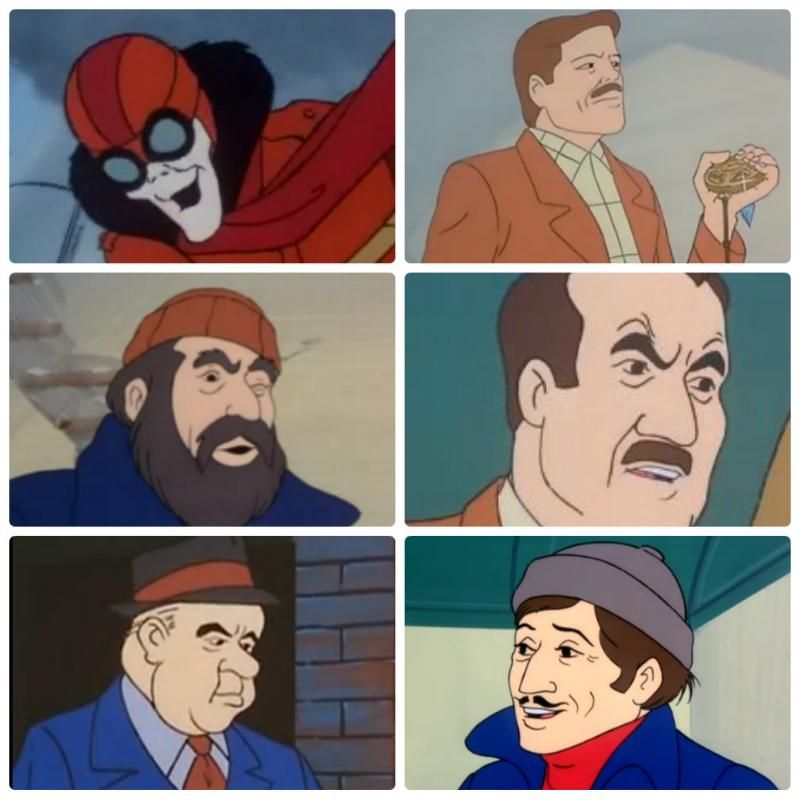
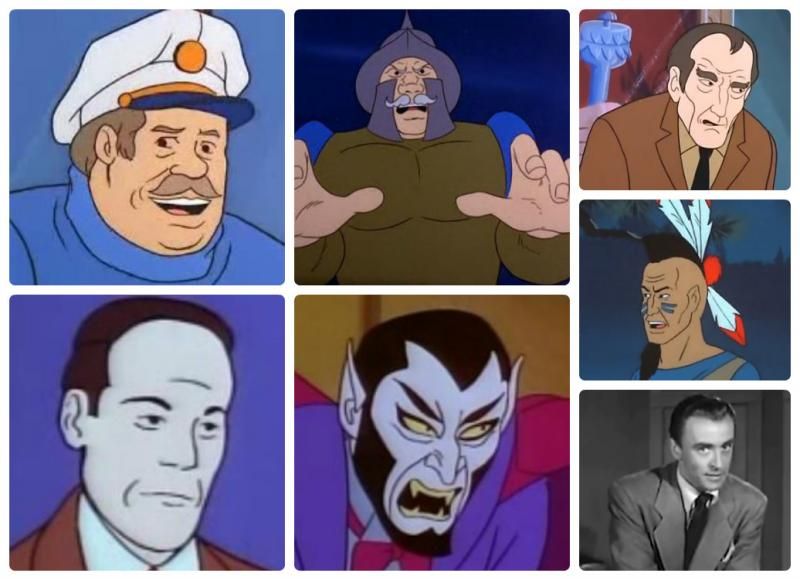
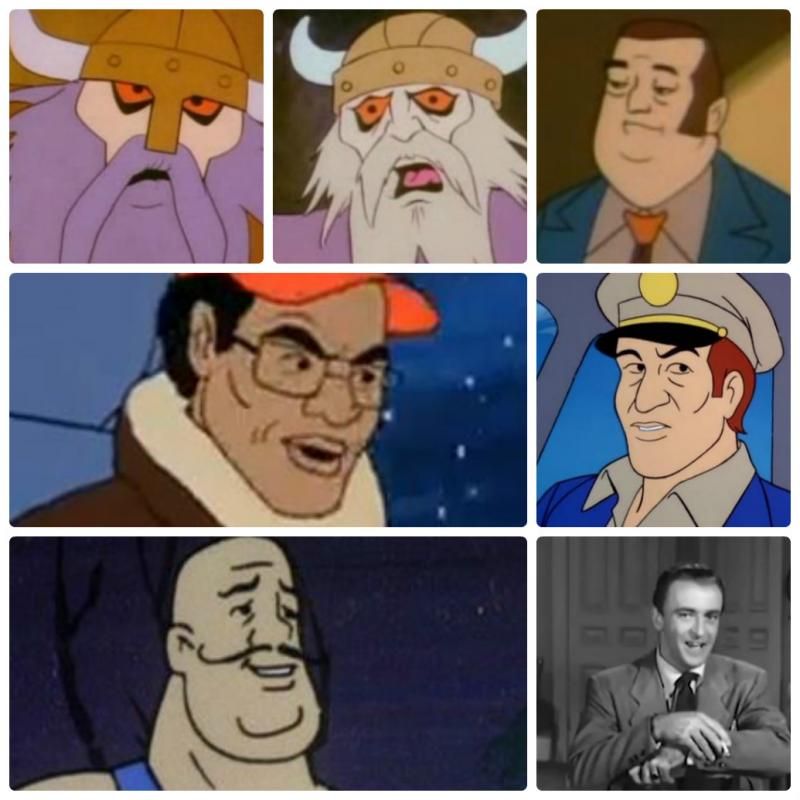
This particular entry simply shines the light on the various characters that were voiced by John Stephenson during the program's various incarnations...imagery from the first 8 years, specifically (1969-1978). I created 8 collage's of John Stephenson's characters and I'm going to post them as a salute to his contributions to the Scooby franchise. You can click on each collage and see the bigger image. I'll be sharing 8 collage's...this should be interesting...

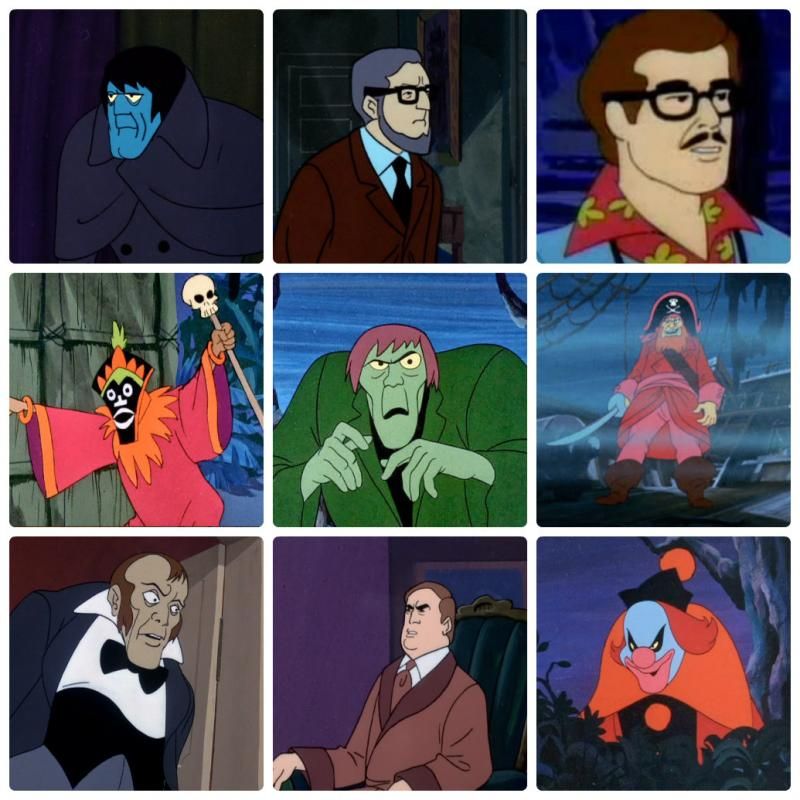
In this collage of 9 pictures, they originate from the first 2 seasons of the program. The character names are Elias Kingston, Uncle Stuart, Mr. Sims, Mano Tiki Tia, The Creeper, Redbeard the Pirate, the Magnus Butler, C.L. Magnus, and The Ghost Clown. As I've mentioned in previous Scooby blogs, many of the episodes had titles filled with alliteration and rhyming. Those 9 characters come from the following episodes: What The Hex Going On?; A Tiki Scare is No Fair; Jeepers, It's the Creeper; Go Away Ghost Ship; and Bedlam in the Big Top. The Kingston Manor, depicted in What the Hex Going On?, appears in the opening credits of the first season...it's also referred to as the black castle with the bats flying around. Also, scenes from that episode appear more times in the opening sequence of the first season than the other episodes. It's also worth pointing out, since this is a John Stephenson character salute blog entry, that his first roles in the Scooby cartoons occurred on the What the Hex Going On? episode.The Magnus Butler is one of several characterizations from Stephenson vocally based on Boris Karloff.

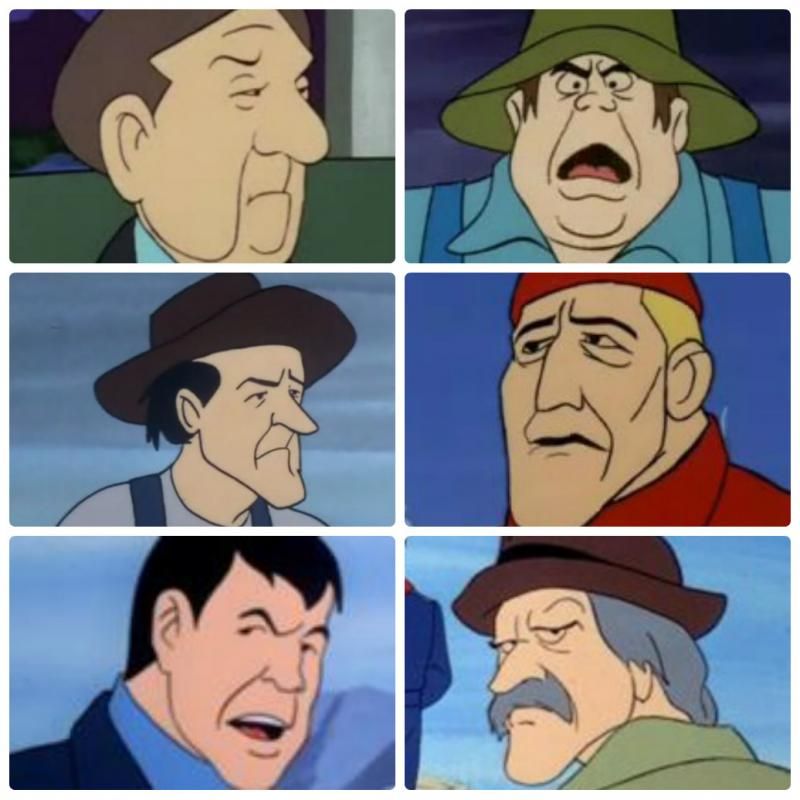
In this collage of 6 pictures I took a look at some of the characters that John voiced in the 1972-1974 series, The New Scooby Doo Movies. The 2 at the top of the collage come from the episode "The Frickert Fracas" (guest starring Jonathan Winters as himself and Maude Frickert). John voiced the characters Simon Shakely and Vernon Crow. In the third box there's the farmer character from the episode "The Ghost of the Red Baron" (guest starring The Three Stooges). It's one of the only characters John voiced in the Scooby cartoons that comes close to sounding like his most famous character, Mr. Slate (from The Flintstones). The fourth picture is Hans Eitherwise, a German-American ski instructor in the episode guest starring Laurel and Hardy, "The Ghost of Big Foot". The bottom 2 sinister looking cut-throats are Morgan and Winslow from the episode "The Loch Ness Mess" (guest starring The Harlem Globetrotters). John, as Winslow, does an impression of Titus Moody (a character from Fred Allen's radio programs and Pepperidge Farm television commercials played by Parker Fennelly).

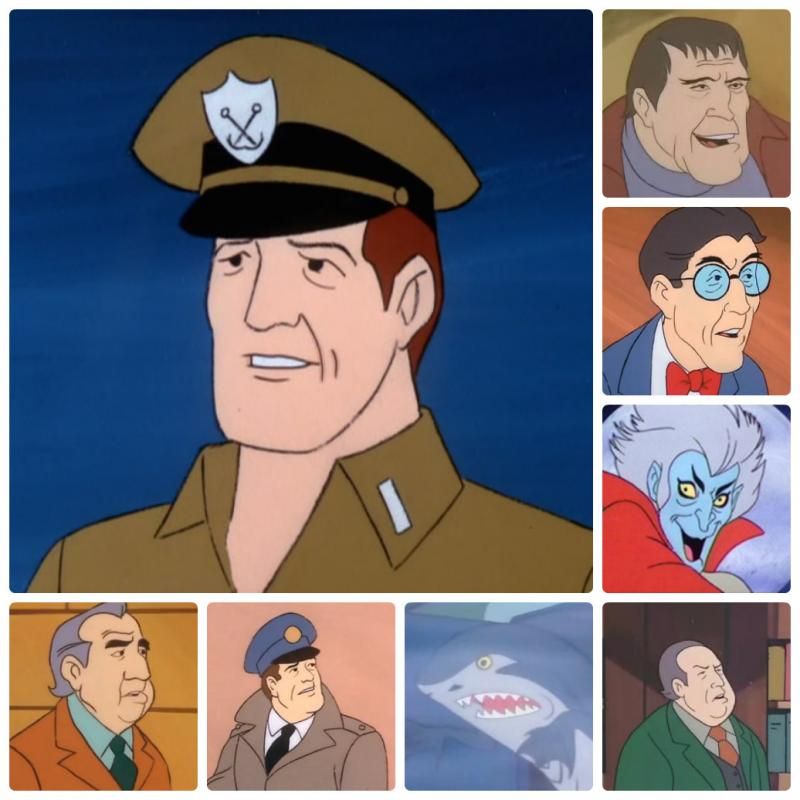
These 8 images represent characters voiced by John Stephenson during the mid-late '70s episodes, roughly 1976-1978. The big image is that of a Coast Guard employee that appears near the end of the episode "Scooby-Doo, Where's the Crew?". Off to the right are Mr. Wells, Mr. Speck, The Specter, Elwood Crane, The Demon Shark, a Customs Agent, and Avery Queen. Mr. Wells, the Demon Shark, and the Customs Agent all come from the episode "There's a Demon Shark in the Foggy Dark". In that episode John roars and growls as the Demon Shark and speaks in a gravelly voice for Mr. Wells. Elwood Crane comes from the episode "The Headless Horseman of Halloween". In the episode he's referred to as Cousin Elwood. John also voiced the Headless Horseman character but I didn't post an image of him...these collage's aren't meant to be a career defining project...just a sampling of his character roles through the various Scooby episodes. Scooby-Dum makes an appearance in that episode...and Janet Waldo voices one of the guest characters, Beth Crane. The Specter and Mr. Speck come from the episode "High Rise Hair Raiser". Avery Queen comes from the episode "The Ghost of the Bad Humor Man".

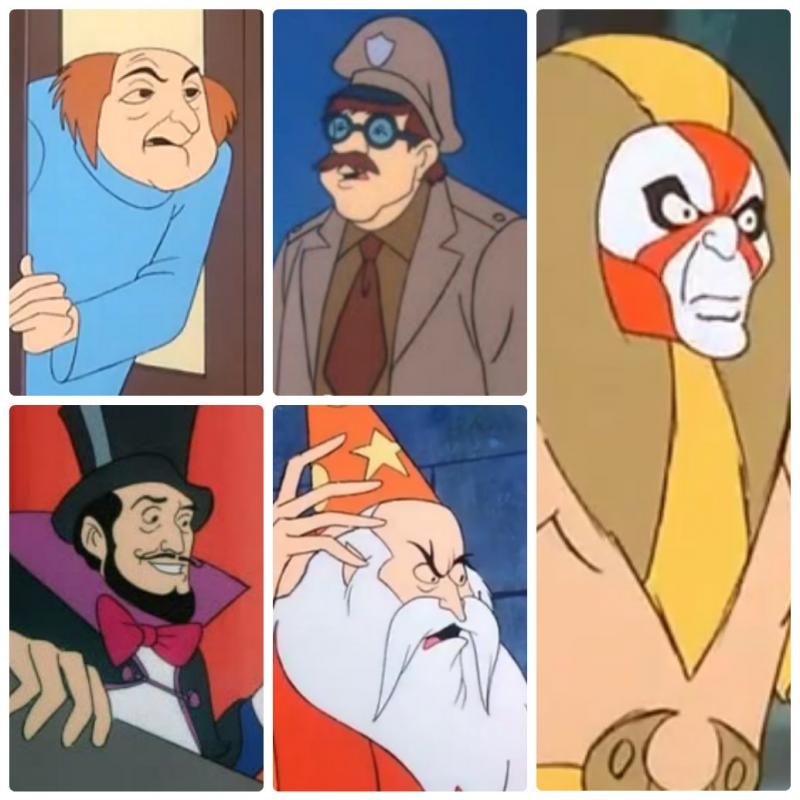
A five picture collage reveals characters largely stemming from 1976 and 1978. The creepy character in blue is Dr. Tooksbury from the episode "The Harum Scarum Sanitarium". John also provides the voice of a Canadian Mountie at the end of that episode. In the episode Scooby and the gang must solve a mystery surrounding a sanitarium and the legend of a ghostly doctor that's come back to haunt the area. Next to him is Officer Grizzly, a hard of hearing night watchman at the Ice Cream factory in "The Ghost of the Bad Humor Man". As mentioned in the previous paragraph, Stephenson also voiced the owner of the Ice Cream factory, Avery Queen. Below those characters are Zarko and Merlin from the episode "Scared a Lot in Camelot". Zarko appears near the beginning of the episode performing a magic act. Shaggy and Scooby become volunteers from the audience to participate in a magic act. The act backfires thanks to the terrified duo thinking they were really going to be cut in half...Zarko's laughed off the stage (the gang make a run for the exit in the process). Merlin appears throughout the remainder of the episode as he haunts the castle of Shaggy's uncle, Shagworthy. The larger picture is that of the leader of a gang of zombies and witch doctors (Mamba Wamba) in the pop music-inspired episode, "Mamba Wamba and the Voodoo Hoodoo". Scooby and the gang visit friends of theirs who have become rock music stars. The group perform a song about voodoo and are soon being chased by the ghost of Mamba Wamba and his henchman who are after a parchment...the real mystery is explained, of course, at episode's end.

In this collage of John Stephenson characters there's Mayor Dudley, Mr. Doherty, Mr. Prentice, The Rambling Ghost, and Mr. Grumper. These characters appear in the 1976 episodes "The 10,000 Volt Ghost", "High Rise Hair Raiser", "The Ghost That Sacked the Quarterback", and "The Spirits of '76". On a personal note, "The Ghost That Sacked the Quarterback" happened to originally air on December 4, 1976 (2 days after I was born!). In that episode the gang solves the mystery of a haunted football team and the legend of The Rambling Ghost. The team's owner is Mr. Prentice. Coinciding with America's Bicentennial celebrations in 1976, Scooby and the gang encounter ghosts at The Smithsonian Institution in form of Bendict Arnold, Major Andre, and William Demont. John voices the ill-tempered Mr. Grumper, one of the security guards. John voices a Federal Agent near the end of the episode. Mayor Dudley is John's more humorous characterization compared to the other characters. I should say the mayor comes across lighthearted. As is the case in many Scooby episodes things are not exactly as they seem.

The Red Baron, from "The Ghost of the Red Baron", appears first in this collage. The character, along with a farmer, were voiced by John Stephenson. The episode features The Three Stooges. Next to the Red Baron is the dapper Sam Crenshaw from the episode "The Frightened Hound meets Demons Underground". The bearded Albert Tross is another Stephenson-voiced character from that same episode. The irritated Mr. Dilly, co-owner of The Dilly Dally Dolly Company, appears in the episode "The No Faced Zombie Case" as does the next character in the collage, the police Lieutenant (another character similar in vocal tone to his Mr. Slate characterization). The character in the blue coat and red shirt is the Captain in "Scooby-Doo, Where's the Crew?". That was John's main character in the episode...at the end he gave voice to the rescuing officer from the Coast Guard that I mentioned earlier. 

For this seven image collage I decided to mix things up more and include an image of John Stephenson himself...from the 1950's. The six characters come from episodes that originally aired during 1976-1978. Captain Eddie, The Ghost of Juan Carlos, Uncle Leon, and the Vampire Ghost are the characters that appear on the left. The 2 characters off to the right are Professor Salari and an Indian leader, Red Harron. Captain Eddie and the Ghost of Juan Carlos (one of John's most maniacal roles in the series) come from the episode "Don't Go Near the Fortress of Fear". Professor Salari, the curator of a local museum, appears in the episode "A Menace in Venice". Red Harron appears in "Watch Out! The Willawaw!!". The Vampire ghost and Uncle Leon appear in "Vampire Bats and Scaredy Cats". In that episode, also co-starring Scooby-Dum, Scooby and the gang investigate the family legend of their friend, Lisa. It seems her late grandfather and members of the family (including her uncle) have kept a secret from her...members of the family have been known to turn into vampires!!

Lastly, I made this collage. If you notice I also included another black and white photo of John...this time laughing. The characters mostly come from 1976-1977. On the top there's back to back Viking characters, then there's Mr. Bohannon. In the second row there's a nameless pilot and next to him, from a different episode, another pilot by the name of Luis. Samson the Strongman concludes the animated character collage. The vikings come from "The Curse of Viking Lake". Mr. Bohannon comes from "Hang In There, Scooby-Doo". The nameless pilot comes from "Scooby's Night with a Snow Beast Fright". Luis comes from "Jeepers, It's the Jaguaro!". John also provided the guttural moans for the Jaguaro creature and I assume electronic enhancing created the shrilling effect (you'll hear what I mean once you see that particular episode). Samson the Strongman appears at the beginning of 1969's "Bedlam in the Big Top". As a side note, John does a great impression of Sydney Greenstreet's characterization of Nero Wolfe for the Mr. Bohannon character.

As I pointed out earlier these collages and this blog post aren't meant to be a career retrospective...just a glimpse at some of the characters John Stephenson gave voice to during his years associated with Scooby-Doo. These do not include characters from other cartoon programs, of course, or the characters he did on the Laff-a-Lympics episodes (even though the series was billed as Scooby's All-Star Laff-a-Lympics). Since that series deviated from the mystery solving concept I excluded his many vocal contributions on Laff-a-Lympics (he voiced several Really Rottens members and did a Paul Lynde impression as Mildew Wolf).

If you're interested I'd highly encourage you all to purchase the various DVD releases of the Scooby series to hear the vocalizations of John Stephenson and the other voice artists that contributed to the overall success of the franchise. Here are links to some of the DVD projects...

Scooby Doo First and Second Season DVD

Scooby Doo and Dynomutt

Scooby Doo DVD 1978 episodes

The Best of the Scooby Doo Movies

The link I call 'Scooby Doo and Dynomutt' takes you to a DVD consisting of the episodes that aired during the 1976-1977 season of the Scooby-Doo/Dynomutt Adventure Hour. I mentioned some of the episodes that featured a John Stephenson vocal characterization but I didn't get into the episodes of Dynomutt that have a Stephenson vocalization. The episodes feature their syndicated opening titles...meaning that each cartoon program airs back to back and has it's own opening and closing sequence. Some of the fans voiced their outrage at the time of the DVD's release because the episodes didn't feature the official opening sequence of the hour long series (which would have one opening and closing sequence per episode) and instead the company utilized the opening and closing sequences from the syndicated airings of each cartoon program. Regardless of the outrage from some...the episodes are intact and that's all that's important for a lot of us. It's that 1976-1977 season that contained Stephenson episodes such as "High Rise Hair Raiser", "The No Face Zombie Case", "The Spirits of '76"...

The link referring to the 1978 episodes takes you to a 2-disc release billed as Scooby-Doo, Where Are You? Season Three. Technically there isn't a season three of that series. The company that released the DVD took the 16 half hour episodes from 1978 that originally aired during the Saturday morning programs, Scooby's All-Star Laff-a-Lympics and Scooby's All-Stars, and issued those episodes as 'Season Three'. The 16 episodes found on the DVD utilize the opening sequence of The Scooby-Doo Show (it's the opening that features Scooby water skiing and having his ski's eaten by a hungry shark). It's anyone's guess as to why the 8 half hour episodes from 1977, which also follow the formula from the first 2 seasons, hadn't been released on DVD. Those, technically, could've been marketed as 'Season Three' and the 16 episodes from 1978 as 'Season Four'. The episodes "The Curse of Viking Lake", "Vampire Bats and Scaredy Cats", and "Hang In There, Scooby-Doo" that I mentioned earlier due to John Stephenson's vocal involvement originally aired in 1977 but haven't been released on DVD yet.

Scooby-Doo and 45 Years, Too...part 2...

Earlier this year I published a blog about the Scooby franchise turning 45 this year. This past Saturday (September 13, 2014) was the exact date that Scooby-Doo, Where Are You? made it's premiere on Saturday morning television...45 years to the day!

It aired on CBS-TV for 2 seasons (1969-1971) and then in reruns for another season. The gang returned in all-new episodes for the 1972-1973 season, titled The New Scooby-Doo Movies. These episodes ran roughly 45 minutes (an hour including commercials). This is the version that has the gang meeting celebrities, both fictional and non-fictional. This incarnation ran 2 seasons also (1972-1974). After 2 seasons of Saturday morning reruns on CBS, the network soon dropped the series.

According to commentary from Fred Silverman from various interviews he's given about Scooby, once CBS dropped the series he picked it up for the ABC Saturday morning schedule. Fred Silverman had been instrumental at CBS in bringing Scooby to television in the first place...and how ironic that after moving to ABC he'd be instrumental in bringing the character back to the spotlight once more in a new series in the fall of 1976. In that series Scooby shared top billing with a new character, Dynomutt (a/k/a Dog Wonder) on an hour long series called The Scooby-Doo/Dynomutt Adventure Hour. Dynomutt ineptly solved crime with his super-serious, super hero partner/master, Blue Falcon.

In the meantime, Scooby would remain an ABC staple for the rest of it's Saturday morning network run (not counting cable-TV and off-network syndicated reruns) until the removal of A Pup Named Scooby-Doo from the ABC Saturday morning line-up in the early '90s. A Pup Named Scooby-Doo had ended production of new episodes in 1991 (after having debuted in 1988). Since the mid '90s Scooby reruns have aired on various cable-TV networks and beginning in the late '90s direct-to-video Scooby animated movies started appearing for retail purchase. All new half hour television episodes returned in 2002 in the appropriately named What's New, Scooby-Doo? and that series remained in production through 2005.

A live action theatrical series of films based on the Scooby franchise became financially popular...coexisting with the direct-to-video animated movies and the TV series that aired in the latter half of the 2000s. In 2010 a more adult/romantic fan-fiction interpretation of the characters took center stage in Scooby-Doo! Mystery Incorporated. That series ran another 3 seasons (it's final episodes airing in 2013). The erratic scheduling of this series caused hat would have been a 2-season series to stretch into 3 seasons. There are 52 episodes of this incarnation (26 for season one, 26 for season two). However, Cartoon Network aired the show erratically and placed it on several hiatuses...causing significant air-date gaps (there would be a period of several months sandwiched between the airing of episodes). The final first-run episodes that aired in 2013 had actually been produced as early as 2011/2012.

Since the end of that series and the 45th anniversary date of Scooby's debut this past Saturday, the franchise lost one of it's legendary vocalists, Casey Kasem. From the debut of the series in 1969 through 1991 and once again from 2002 until 2005, Casey voiced the character of Shaggy Rogers (the most popular character on the series aside from Scooby himself). While it's a fact that Casey didn't voice Shaggy during the final two incarnations of the series (Shaggy and Scooby-Doo Get a Clue! and Scooby-Doo! Mystery Incorporated) and previously had left the role in the mid '90s during the direct-to-video animated film era (Scott Innes, among several others, took over the role in the interim), Casey nonetheless remained strongly connected to the franchise. Casey returned to the role of Shaggy in 2002 and retired from the role after What's New, Scooby-Doo? ended production. He had a recurring role as Shaggy's uncle, Dr. Albert Shaggleford, in Shaggy and Scooby-Doo Get a Clue! (2006-2008), transmitting messages/clues to Shaggy and Scooby while he was on the run.

It's interesting to point out that in several episodes throughout the history of the series there have been rich relatives of Shaggy appear and ultimately be the focal point of a mystery. My guess is because Shaggy is suppose to represent a beatnik/hippie and be turned off by material possessions, what better way to invoke comical irony than to have Shaggy come from a long line of millionaires?!?

One of the earliest episodes to feature a rich uncle of Shaggy's is "The Loch Ness Mess", a 1972 episode guest starring The Harlem Globetrotters. In the episode the gang meet up with the Globetrotters while driving through the New England countryside and they all make their way to the mansion of Shaggy's uncle, Nathaniel, and are ultimately caught up in a mystery involving a sea serpent and the ghosts of Paul Revere and his 2 partners in crime. In a 1976 episode the gang visits another rich uncle of Shaggy's, appropriately named Shagworthy. He's also described as an eccentric millionaire that had a castle imported from England to the United States stone by stone. He's gone missing and is ultimately found by Scooby and the gang. This mystery is played out in the episode "Scared a lot in Camelot" (the villains are The Black Knight and Merlin).

In the Mystery Incorporated series Casey voiced Shaggy's father, Colton Rogers, in several episodes. Casey retired from the entertainment business not long after that series and of course, as you all should know by now, he passed away several months ago at the age of 82.

The voice cast throughout the history of the Scooby series is rather large and prolific.

The original voice of Scooby, Don Messick, passed away in 1997. He had been the voice of Scooby since 1969 and he remained the voice of Scooby through the end of A Pup Named Scooby Doo in 1991.

As previously mentioned, Casey Kasem passed away this past June and he had been the voice of Shaggy the longest (1969-1991, 1995, 1997, 2002-2009).

Frank Welker's voiced the teenaged Fred since 1969. The only animated depiction of Fred that hasn't been voiced by Frank is the child version of the character on A Pup Named Scooby-Doo. Frank became the official voice of Scooby beginning in 2002...a role he continues to play.

Prior to 2002, Scooby had been voiced in animated cartoons by Scott Innes starting in 1998 (Don Messick retired in 1996 following a career ending stroke). After Frank took over as Scooby in 2002, Scott continued to voice Scooby in a series of video games through 2006. Scott had also been the voice of Shaggy following Casey's departure from the role in the mid-late '90s. Scott voiced Shaggy in video game releases through 2009. Shaggy's current voice actor is Matthew Lillard (2010-present).

The female half of the gang, Daphne and Velma, don't have as many voice actresses in their history so it won't be as confusing/convoluted as the previous paragraph might appear to some.

Daphne's voice originally was supplied by an actress named Stefanianna Christopherson during the program's first season (1969-1970). Heather North became the second voice actress of Daphne in 1970 and she held this role on various Scooby incarnations through the early 1980's. She returned to the role in 2 direct-to-video Scooby animated movies in 2003: Scooby-Doo! and the Legend of the Vampire and Scooby-Doo! and the Monster of Mexico. Kellie Martin voiced the child Daphne in A Pup Named Scooby-Doo. Mary Kay Bergman voiced Daphne in direct-to-video animated movies from 1997-2000 and her replacement, Grey DeLisle, has voiced Daphne ever since.

Velma's original voice actress is Nicole Jaffe (1969-1974). Pat Stevens became the second voice of Velma in the mid '70s (1976-1979). After this, Velma's appearances (as well as Fred and Daphne) became sporadic. Velma's next voice actress happened to be Marla Frumpkin for brief, non-recurring appearances through 1984. The child version of Velma on A Pup Named Scooby-Doo was voiced by Christina Lange. B.J. Ward became the next voice actress associated with Velma. She voiced the character in the string of direct-to-video animated movies in the late '90s (1997-2001). Mindy Cohn (Natalie from the 1979-1988 sitcom, The Facts of Life) became the next voice of Velma in 2002. She's been the voice ever since.

Aside from those that gave voice to Scooby and the four teenagers there have been other voice artists that have contributed to the franchise...one in particular, John Stephenson. I'll spotlight his contributions on the next Scooby 45th anniversary blog entry that I post later today...be on the look-out for it!!

Monday, January 13, 2014

Daws Butler and those Character Voices...

Voice Magician, Part 1

Voice Magician, Part 2

Voice Magician, Part 3

Voice Magician, Part 4

I decided not to embed the videos just in case at some future date they vanish from You Tube. Instead, each URL contains each separate installment of the 1987 documentary Daws Butler: Voice Magician. This is a special that I have been aware of for more than 15 years (or more). It originally aired in 1987 and has a running time of just under 1 hour. The one that uploaded it onto You Tube a couple of days ago broke it into 4 individual segments (each running a little more than 14 minutes each). Once you click Part 1 and you're taken to You Tube, from there you can click Parts 2 through 4 and see the entire documentary for yourselves. The guests are plenty...from voice acting side-kicks and co-stars to several legendary animation giants (Walter Lantz as well as Hanna and Barbera).

One of the thrills of the special is seeing Daws perform a lot of the cartoon characters on camera. In one scene he and Don Messick perform on camera as the voices of Yogi (Butler), Boo Boo (Messick), and Ranger Smith (Messick). Stan Freberg appears during several moments throughout the special and near the end of the documentary focus shifts to Daws' time working for Jay Ward in the Rocky and Bullwinkle series. The final minutes focus on Daws' voice acting class.

Some of the guests in the documentary are: Don Messick, Stan Freberg, June Foray, Bill Hanna, Joe Barbera, and narration provided by William Conrad.

Daws Butler: 1916-1988

Monday, April 22, 2013

Scooby Doo and the Globetrotters...

A couple of years ago I purchased this DVD and another one featuring the Scooby gang teaming up with Batman and Robin. The episodes originated from the second Scooby-Doo series titled The New Scooby-Doo Movies which first aired during the 1972-1973 season. A DVD collection gathering random episodes from that 1972 series not only features these two episodes but also a third adventure with the Harlem Globetrotters in addition to the two episodes with Batman and Robin (battling The Joker and Penguin). This Scooby meets the Harlem Globetrotters DVD contains the episodes "The Mystery of Haunted Island" and "The Loch Ness Mess". The review contains spoilers. First up is the Haunted Island episode. In it, Scooby and the gang (Shaggy, Fred, Daphne, and Velma) meet up with the Globetrotters by accident. Initially looking for assistance with the Mystery Machine while en route to fictional picnic island, Scooby and the gang realize that the deserted shack isn't as deserted as it appears. It turns out the Globetrotters are using the shack as a hide-out to practice in and get some rest. Eventually, through a series of gags, the Globetrotters and Scooby and the gang come face to face. After filling up the Mystery Machine with fuel, Meadowlark and Curly inform Scooby and the gang that they are hoping to get some rest before a big game with a team known as the Ocean City Scorpions and that the shack was a perfect spot. The gang tell the Globetrotters about picnic island and soon everyone is headed for the island for a short visit. As it turns out, that short visit doesn't pan out because as they make their way to the boating docks a pair of hands places a sign that reads Picnic Island in front of a tanker which turns out to be the Haunted Island Queen. Everyone boards the wrong ship by accident and it's not long afterward that everyone realizes the accident...they also realize that nobody else is on board and that the ship is being controlled by some supernatural force. The bulk of the story takes place inside a large mansion where traps and tricks are on full display by unseen perpetrators. Glowing hand prints and foot prints soon have everyone on a wild goose chase. A sub-plot throughout is the desire of the Globetrotters to get a good night's rest before the game with the Scorpions. Eventually the story climaxes and it's revealed whose been behind the 'haunted house' trick. The idea behind the haunted island ordeal was dreamed up by the Scorpions owner...he wanted the Globetrotters to be so tired that they'd lose the basketball game. The next day everyone shows up at the gym. The Globetrotters are walking zombies, falling over one another, yawning and snoring while the Scorpions continue to rack up dozens of points. Shaggy comes up with an idea during half-time to use ice to help keep the Globetrotters awake. As time runs out it's up to one more final shot...does the ball go in? Do the Globetrotters win?

In the second episode on the DVD, "The Loch Ness Mess", the gang is on their way to Uncle Nat's place, specifically, Shaggy's uncle. Going by the directions on Shaggy's map they all find themselves lost. They meet up with the Globetrotters while the team was in the middle of a cookout. Shaggy's nose for food led the gang in that direction. After everyone meets and greets, Shaggy insists that the Globetrotters come with them and stay at his uncle's mansion. Fred had Shaggy do the driving...which leads to disaster as on their way a ghost appears in the area warning them to get lost. Shaggy, in a panic, starts to drive wildly in the Mystery Machine and eventually comes to a wild stop near a covered bridge. Recollecting that he doesn't remember this bridge, a light shines on the face of a local...it turns out to be Uncle Nat. At the mansion Nat tells everyone about the ghosts. When it's revealed that the gang and the Globetrotters are all going to go Scuba Diving, Nat warns them about the sea serpent. This causes Velma to sarcastically comment that not only is the area haunted by a ghost of Paul Revere but now they have to put up with a local loch ness monster. At the marina they're denied access, at first, to scuba equipment when one of the workers (Winslow) states that they're closed even though it's obvious that the business is open. After Shaggy and others threaten to go to the police, a man revealed to have the name of Morgan reluctantly allows them to go scuba diving. 

Long time Hanna-Barbera voice actor, John Stephenson, had given voice to the owner of the Scorpions in the previous episode with the Globetrotters. In the Loch Ness episode, Stephenson is heard as Morgan as well as Winslow. Fans of old-time radio, particularly the Fred Allen show, will perhaps notice that Winslow's voice is patterned after Titus Moody, a New England farmer character played by Parker Fennelly on Fred Allen's radio program in addition to a string of television commercials for Pepperidge Farms.

Meanwhile, as most of the gang are scuba diving they encounter a sea serpent. Some of the Globetrotters stayed behind with Velma and Daphne. While Scooby, Shaggy, Fred, Meadowlark, and Curly were investigating the cove, the others spent the idle time playing basketball.

The plot by Morgan soon unravels, though, as Winslow and another co-hort, Selby, turn out to be two of the three ghosts that are haunting the area. The ghost with the lantern, which appears on the DVD cover, turns out to be Morgan. Winslow reveals that Morgan found a chest full of gold under the water and was using the sea serpent to keep people away from the spot until they could take the gold. Uncle Nat gets enjoyment from all of this and laughs about the entire thing for he knows that the gold is fake and was used as a prop in a pirate movie that was filmed there several years ago.

I have since put in an order for the Best of the Scooby-Doo Movies DVD collection. The collection had been around for a number of years and was always too expensive. Even though it's still a bit pricey I felt that the current selling price would probably be the cheapest that it'll ever become and so I went ahead and ordered it. Once it arrives and I watch it thoroughly I'll write about it on this blog. It should arrive by the end of this week and so more than likely I'll watch it this coming Saturday if it arrives by then.

Monday, November 28, 2011

Classic Cartoons on DVD...

Over the course of the last several months quite a few Hanna-Barbera cartoons of the '60s and '70s have finally saw their release on DVD. The only catch is the discs are DVD-R's but I'm pretty sure the discs will play in any brand name DVD player. I've got some DVD-R discs that play in my DVD player and so I feel confident that there will be no problems.

I haven't placed an order for any of the collections, yet. I'm waiting on the holiday season to pass and then place my order(s) in the new year. However, I may slip in an order next month for one of the collections as an early Christmas present for myself. The collections are for sale at various on-line stores. Amazon is where I purchase things and so that's where the following links will take you...

The Herculoids: This series features the adventures Zandor, Tara, and Dorno who battle a different enemy in each episode. They're aided by Igoo, Tundra, Zok, Gloop, and Gleep. Mike Road and Don Messick provided a bulk of the voices.

Frankenstein Jr. and the Impossibles: This series deals with a kid named Buzz and a flying robot patterned after the Frankenstein monster. The second segment stars a rock band that doubles as a crime fighting trio. Fluid Man, Multi-Man, and Coil Man each have distinct powers and in many of the episodes there's spoofs of pop culture. Ted Cassidy voices Frankenstein Jr. while Dick Beals voices Buzz. Don Messick, Paul Frees, and Hal Smith voice Multi-Man, Fluid Man, and Coil Man respectively.

Moby Dick and The Mighty Mightor: This series deals with the whale, Moby Dick, acting as a guardian/protector of two kids. Along side this trio is the kid's pet seal, named Scooby! Typically the kids get into trouble and the seal acts as a messenger of sorts...escaping the latest trap and getting Moby to come to the kid's rescue. The Mighty Mightor segments are a lot like another series, Young Samson, although in this series the teenager named Tor uses a club to turn into his alter-ego, Mighty Mightor. In Young Samson the teenager clings his two gold bracelets together.

Jabberjaw: This series from Hanna-Barbera came along during the mid '70s. The previous collections all originate in the mid and late '60s. Unlike the emphasis on realistic science fiction and adventure in the mid '60s cartoons, Jabberjaw is light and patterned after the mystery solving format. Jabberjaw was a shark, who had a voice like Curly from The Three Stooges, and he played drums and doubled as the mascot for the show's teenage rock band, The Neptunes. This group consists of leader, Biff, easily annoyed Shelley, scatterbrained Bubbles, and cowardly Clamhead. Although it's often referred to as a Scooby-Doo clone given the teenage mystery solving format it has much more in common with Josie and the Pussycats. Shelley has similar facial expressions with Alexandra but Clamhead could pass as Shaggy's long-lost brother.

Speed Buggy: In this series we see the adventures of three teenagers and their talking race car, Speed Buggy. The teens this time around are named Mark, Debbie, and Tinker. Michael Bell, a frequent voice on cartoons, is the voice of Mark while face actress Arlene Golonka is Debbie. Phil Luther, Jr. does the voice of Tinker while Mel Blanc is Speed Buggy. In later years Tinker would be voiced by Frank Welker (Laff-a-Lympics, specifically).

Those are just 6 of the DVD releases that have come up for sale during the last several months focusing on classic Hanna-Barbera cartoon series. One of the long-time voice actors at the studio, John Stephenson, can be heard in many of those programs. He was typically cast as villains, policemen, scientists, and sometimes he'd do vocal effects, too. He had a varied career in radio and TV drama as well...I found this clip on You Tube the other day and it's John Stephenson acting in a daytime soap called Morning Star in 1966. John's natural voice will immediately be recognizable to Hanna-Barbera cartoon fans because he used his natural voice a lot in addition to doing celebrity impressions. In the soap he plays the part of Stan Manning and he has a substantial role in this particular episode, too. His scene starts at the 6 minute, 2 second mark:

Thursday, December 30, 2010

41 years of Scooby-Doo...

Last summer I wrote about an up-coming new series of Scooby-Doo cartoons that were to hit the airwaves beginning in the fall of 2009. No doubt, over a year later, those familiar with all things Scooby are well aware that the series didn't exactly make it on the air until the fall of 2010. That series, Scooby-Doo: Mystery Inc., initially aired in April 2010 but didn't debut on a regular basis until July 2010. The program's home, Cartoon Network, continues to air the program...an entry into the series that's like nothing seen before. In this particular version the familiar concept of solving mysteries is still there but there's a much more realistic approach to each of the characters that was lacking in all versions of the program, except perhaps the original run during 1969-1971. In fact, publicity centered around the idea that this latest series was to be a continuation of the 1969-1971 era when the four teenagers were treated as teenagers instead of as adults in teenage clothing.

In the latest version there's a romantic overtone that was lacking in other versions...and I think this romantic element being inserted into the series is a direct result of the internet culture where people, for whatever reason, romantically link Fred and Daphne as well as Shaggy and Velma. There was always this romantic connection between Fred and Daphne, going back to the original 1969 episodes...what with Fred typically more concerned whenever Daphne would get into trouble or vanish. In an episode from 1976 titled "The Frightened Hound meets Demons Underground" Daphne is taken prisoner by one of the demons. Upon realizing this seconds later, Fred shouts out something like: "Daphne!!?! Quick...we gotta find her!!". So, yes, there was always a subtle hint that Fred and Daphne were boyfriend and girlfriend...but it was never an in-your-face distraction.

This sort of romantic insertion, personally speaking, was always troubling to me because it shown irreverence toward the crux of the series: mystery solving. Those familiar with all the different versions of the series will certainly get a shock when they see Scooby-Doo: Mystery Inc. for the first time...the series has it's great moments, though, but I find the romantic edge a distraction which plays more to a fan-fiction crowd than anything else. I prefer the traditional story of ghosts, monsters, goblins, and other assorted demons terrorizing the area and the teenagers, and Scooby, stumbling onto the mystery and solving it. This isn't to say that there's no mystery solving in the latest series...as I remarked, there's plenty of it...but having the romantic overtone is the equivalent of eating ice cream topped with pencil shavings (something Scooby and Shaggy may find incredibly appetizing). There's an on-going sub-plot in this series where the gang continues to find clues as to the whereabouts of another gang of four mystery solving teenagers and their dog who've long since disappeared.

In a rating scale of 5 stars, with 5 being great, I give the series 4 and a half. If the romantic element would be dropped I'd give it 5 stars.

This is the 11th individual series based on the original Scooby-Doo: Where Are You? concept. As the title of this blog entry suggests this is also the 41st year of Scooby-Doo. Here is a look at the various Scooby-related programs that have been on the air since 1969. This list doesn't include the home video/DVD market which have issued direct-to-video movies regularly since 1998...

1. Scooby-Doo, Where Are You?; 1969-1971
2. The New Scooby-Doo Movies; 1972-1973
3. The Scooby-Doo Show; 1976-1978
4. The Scooby-Doo and Scrappy-Doo Show; 1979-1980**
5. The Scooby-Doo and Scrappy-Doo Show; 1980-1982**
6. The New Scooby and Scrappy-Doo Show/The New Scooby-Doo Mysteries; 1983-1984***
7. The 13 Ghosts of Scooby-Doo; 1985
8. A Pup Named Scooby-Doo; 1988-1991
9. What's New, Scooby-Doo?; 2002-2005
10. Shaggy and Scooby-Doo: Get a Clue!; 2006-2008
11. Scooby-Doo: Mystery Incorporated; 2010-present

**- there were 99 seven minute episodes produced and they aired as part of the package shows, The Richie Rich/Scooby-Doo Show and The Scooby and Scrappy-Doo/Puppy Hour. 34 hour programs {21 of the former, 13 of the latter} were produced altogether. In the second series there was a segment that featured Scrappy-Doo and new characters, Yabba-Doo and Deputy Dusty, solving cases with a western setting.

***- this series featured Scooby, Scrappy, Shaggy, and Daphne. There were 52 eleven minute episodes produced...2 eleven minute episodes aired per half hour...26 half hour episodes were produced altogether, 13 each season. The series went under the name of The New Scooby and Scrappy-Doo Show in 1983 and The New Scooby-Doo Mysteries in 1984.

Frank Welker voices Fred in all of the incarnations of the series except for A Pup Named Scooby-Doo in which the characters were all small kids...even though Casey Kasem returned as Shaggy and Don Messick resumed his role as Scooby for that series. Casey was the voice of Shaggy in all incarnations of the series except Shaggy and Scooby-Doo: Get a Clue! and the latest, Scooby-Doo: Mystery Incorporated. Don Messick was the voice of Scooby in all incarnations of the series through 1991. Don retired in 1996 following a stroke and passed away in 1997 and since then the character had been voiced, first by Scott Innes from 1998-2001, and then by Frank Welker starting in 2002. Innes was also the voice of Shaggy during 1999-2001, prior to Casey returning to the role. The Scott Innes characterizations are found on the various home video/DVD/video game releases since there was no television series in production at the time. Heather North, the second voice of Daphne but the actress who held the position the longest, joined in 1970 and remained with the series on and off through 1997. The original voice of Daphne was an actress with the unique name of Stefanianna Christopherson during the initial 1969-1970 season. Mary Kay Bergman held the role from 1998-2000. The current voice is Grey DeLisle...she took over the role in 2001. Velma has had several voice actresses through the years...most notable are Nicole Jaffe, Pat Stevens, and B.J. Ward. The current voice, since 2002, is Mindy Cohn, the face actress known by millions as Natalie on the 1979-1988 TV series, Facts of Life.

Saturday, March 28, 2009

Oh, those Smurfs!!


Like them or not, The Smurfs was a mainstay on Saturday morning television as well as late afternoon syndication for a period of years. The characters were created by an artist named Peyo over-seas and the Hanna-Barbera studio adapted the characters for American audiences. Schtroumpf is the word that was used overseas and it was translated into "Smurf" for America...and it is the Americanized characters of which this blog is about. NBC was the network that aired the program.

The characters, the core line-up, each had distinct character traits...each one was somewhat predictable in terms of what would happen within the story. A lot of the characters interacted with one another peacefully but there were several episodes where there was anything but peace among the village. Usually at the heart of most arguments and the cause of most annoyance was Brainy Smurf. He was the brainiac of the group but often in the stories he'd use his "brains" in a condescending way...as a sort of know-it-all. This characterization allowed him to be at the receiving end of a lot of anger directed at him by others...including the usually gentle, Papa Smurf.

Papa Smurf was the leader of the group. He was never really said to be the father of every single Smurf but a lot of fans and critics seem to suggest it. Some say the "papa" name is just a word that's used to show respect for an older, wiser adult. Smurfette, for years and years the only female Smurf, was created by the wizard Gargamel in one of his schemes to capture the Smurfs.

Gargamel was an evil wizard who lived in a run-down castle/hut who was constantly hatching schemes to capture the Smurfs for his magic potions. He could never find the Smurfs hidden village on his own...but sometimes he was led into the village by accident or just in sheer luck he stumbled onto it all on his own. The running joke was that Gargamel could never find the village once he was tricked into leaving...for example, he could be five steps away from the village but he couldn't find his way back. This irritation prompted him to look at his cat, Azrael, and scream something like: "I almost had them!!! Where is the village...come on...we gotta find it!!! AZRAEL!!!!". In most episodes, as Gargamel and his cat are roaming all over the countryside in search for the Smurf village and getting farther and farther away, you can hear him throwing a fit as the camera shows the Smurfs gathered around laughing as the scene fades to black.

Clumsy Smurf was an accident prone Smurf, always at the receiving end of Brainy's wrath for being "dumb". Clumsy looked up to Brainy but would often out-smart Brainy in his own unique way by using a simple approach to handle a situation within the story which differed greatly from a complex approach from Brainy. A typical exchange would find the two of them standing on the outside of a locked door and Brainy would become the "teacher" and go on to tell Clumsy how to proceed with climbing through the window, giving him step by step instructions, quite certain that the door is locked...only for Clumsy to walk over to the door, turn the knob and say something like: "Gosh, Brainy...we don't have to climb through the window...the door's unlocked." Brainy would look into the camera and slap his forehead or roll his eyes.

Vanity Smurf is just as his name implies...vain. He carried a mirror and wore a pink flower in his hat...often commenting on the state of the plants in his mushroom. All of the Smurf's lived in mushroom houses. He'd also react to the exaggerated macho behavior of Hefty Smurf. Jokey Smurf liked to play practical jokes. Sleepy Smurf was typically dozing off all the time. Grouchy Smurf was a grouch. Farmer Smurf was the village's farmer...looking over the garden. The Smurf's had several allies...Mother Nature was their biggest. She often helped Papa Smurf and gave him advice on all sorts of situations. Johan and Peewit were also allies of the Smurfs...as the series became even more popular they added Baby Smurf and a few more female Smurfs and Grandpa Smurf...with a wooden cane and a longer beard...perhaps Papa Smurf's father!? Hogatha, Big Mouth, Scruple are just three of the secondary villains of the series...they, like Gargamel, have this shared hatred for the Smurfs.


The Smurfs ran for an incredible nine years, 1981-1990. The characters spoke English pretty much...and they had their own slang phrases as well. They'd incorporate the word "smurf" into nearly everything they said. "Have a smurfy day!" or "Holy smurfs!!" or "That's smurfy!". Another phrase "i'll be smurfed!" was often said in place of "i'll be darned". "Great Smurf!!" was used in place of "Great scott!!". There was a Smurfs comic book issued on Marvel. There was also a Smurfs cereal...very smurf-a-licious!

The ratings of the series had declined by the late 1980's but the ratings weren't abysmal by any means...but the series went out of production in 1990 simply because NBC wanted to expand their news program on Saturday morning and it ate into a lot of the air-time for animated cartoons on that network. I believe NBC was the second network to rid it's Saturday morning line-up of cartoons and replace it with news programs and live-action teen programs. I think CBS was the first and ABC was the last to rid it's line-up of wall to wall cartoons. Whatever network came first, all three of them plus the Children's Television Act, helped end Saturday morning TV as people in my age group and older remember it. Now, of course, there's a few programs aimed at children that air on Saturday morning but it's nothing like it once was...with every network airing cartoons for nearly 5 hours on Saturday mornings...that'll never happen on network TV again.

In total there were 256 episodes...and because several episodes would contain 2 separate stories, there were in reality 421 stories spread out over those 256 air-dates.

After the show ended production in 1990 it continued to air in syndication in the late afternoons for a period of years until quite a few cartoon franchises became property of Ted Turner in the early to mid 1990's. He purchased the Hanna-Barbera library and as a result all of the syndicated cartoons from that company that were in reruns on network TV suddenly departed network for cable-TV...specifically airing on his Cartoon Network, a 24 hour cable network that would air cartoons from the Hanna-Barbera library. Soon, Cartoon Network became a major cable network and as things are likely to do it started to change. The network became more about original programming instead of airing vintage cartoons. The Warner Brothers cartoons became Turner's property as well during the 1990's. Boomerang was launched to provide a network for the classic cartoons so Turner and company could use Cartoon Network for original programming. Turner owns, partially owns, or at one time owned just about everything...the Hanna-Barbera cartoon library; the Ruby-Spears cartoon library; the MGM library; the Warner Brothers cartoon library. He created the cartoon character, "Captain Planet". Turner's non-animation networks include TBS, TNT, Turner Classic Movies, and CNN...so the 1990's were a time of severe change in the Saturday morning business...


Behind the scenes of The Smurfs the main voice artists for this series were Don Messick. He gave voice to Papa Smurf as well as Dreamy Smurf and the hisses of Azrael and other sound effects. Paul Winchell was on hand as Gargamel...using the voice he gave to Dick Dastardly. Lucille Bliss was the voice of Smurfette. June Foray voiced Jokey Smurf and Mother Nature. Alan Young was the voice of Farmer Smurf and Miner Smurf. Danny Goldman was the voice of Brainy Smurf. Frank Welker provided the voice of a lot of minor characters in addition to semi-regulars Hefty Smurf and Poet Smurf. Michael Bell voices Grouchy and Handy Smurf while William Callaway voices Painter Smurf and Clumsy Smurf. Hamilton Camp gave voice to Greedy Smurf. I believe there were something like 99 Smurfs in all...

This series utilized the talents of Alan Oppenheimer...he was on hand to voice Vanity Smurf, Father Time, and Homnibus. Jonathan Winters voiced Grandpa Smurf. I think that covers pretty much the main Smurfs that made the most frequent appearances on each episode. Johan and Peewit were voiced by Michael Bell and Frank Welker. Michael Bell voiced a lot of characters and his most popular role is Zan, half of the Wonder Twins, on the late 1970's and 1980's version of Superfriends. Search through my various blog entries to read more about Frank Welker and a lot of these voice artist's.

The series has become available on DVD. It airs on Boomerang, the vintage cartoon network. The series is still popular, or infamous, depending on your viewpoint, some 19 years after it's last first-run episode aired.