Showing posts with label kornfield kounty. Show all posts

Sunday, February 5, 2017

Gordie Tapp: 1922-2016

On December 18, 2016 the entertainment/comedy world lost the talents of Gordie Tapp at the age of 94. Born Gordon Tapp on June 4, 1922 in London, Ontario, Canada he became a starring attraction on Canadian television in the mid 1950s but before that he had a lengthy career on Canadian radio. He hosted a radio series titled What's on Tapp? as early as 1946. Another series, Main Street Jamboree, hit CHML radio in November 1952 (hosted by Tapp) and it moved to television via CHCH in 1954. A lot of the technical information comes from research easily obtained on any social media biography site but to distinguish my memorial blog posts from the numerous tribute blogs out there in cyberspace I tend to personalize the blog posts with my own commentary and remembrances...so that it doesn't come off as a list of credits. I'd say the series that made him a superstar in Canada happened to be a program called Country Hoedown which hit the air in 1956 on CBC television. In the previous programs Gordie often appeared as a rural character named 'Cousin Clem'. Gordie hosted Country Hoedown for a period of 9 years (10 television seasons) from 1956 to 1965. A couple of titans in Canadian entertainment, Tommy Hunter and Gordon Lightfoot, were members of the cast during the course of the 10 season run. Eventually Tommy Hunter became the legendary emcee of his own self-titled program (which crossed over into America in the 1980s via The Nashville Network) and Gordon Lightfoot became a hugely successful pop singer in both Canada and the United States. Tommy began his program on radio in 1960 and it moved to television in 1965.

Are you looking for some irony? Tommy's self-titled series replaced Gordie's Country Hoedown on the CBC schedule.

From there Gordie's next accomplishment came along in the most uncertain of fashions in the summer of 1969...not on Canadian television but on American television. CBS had recently canceled a controversial series hosted by The Smothers Brothers. That series remained on the CBS schedule, in reruns, until June 8, 1969. All during this chaotic time a series designed to be a country music/rural America answer to Rowan and Martin's Laugh-In and Lawrence Welk was in the works. After the Smothers Brothers program received it's abrupt cancellation in April of 1969 (several weeks after it had been picked up for another season, 1969-1970) the producers/writers of this upcoming series had at least 2 months in order to be ready to hit the air on June 15, 1969. In this short span of time everything had to be taped in batches and then edited together (music performances, cast and guest introductions, comedy sketches, etc.). That summer series, titled Hee Haw, ran on CBS from June 15, 1969 until September 7, 1969.

Gordie Tapp happened to be tapped as one of the program's writers and stars from the beginning. The program's creators, Frank Peppiatt and John Ayelsworth, were Canadians. The program's production company happened to be named Yongesteet Productions, named after a street in Toronto. Another of the main cast-members and one of it's writers, Don Harron, had a career that nearly mirrored that of Gordie Tapp. He and Gordie happened to be Canadian entertainment legends prior to their association with Hee Haw. The show's producer and casting director, Sam Lovullo, had ties within the television industry and had been involved with "The Jonathan Winters Show". (Note: Sam Lovullo, sadly, passed away last month at the age of 88 on January 3rd). I'll post some sort of memorial blog in the future. I had planned on posting one for Sam Lovullo but I couldn't bring myself to do it and I'll explain more in the blog post that I'll eventually write.

In the meantime, after the summer run of Hee Haw ended on September 7, 1969, all of the cast members and it's co-hosts (Roy Clark and Buck Owens) thought they were finished with the series and it would fade away in the memories of television viewers by the fall and be remembered by almost nobody...but not so fast. CBS picked up the series as a mid-season replacement and more episodes had to be constructed by it's next air-date: December 17, 1969. This second run of Hee Haw on the CBS schedule ended on April 8, 1970.

CBS then picked the series up for a more conventional fall debut. On September 15, 1970 the series returned for a third season on CBS. By this time the unique Hee Haw production method had become a fixture. The production of the series was constructed in bits and pieces from material recorded during 2 production periods per year. In the summer production cycle the cast and crew gathered together to tape enough material for the first 13 episodes of the season. In the fall this practice was repeated and viola there you'd have the 26 episodes needed (plus the 26 repeats) to complete a 52 week calendar year. The series aired what turned out to be it's final episode on the national CBS schedule on February 23, 1971. Later in the year CBS canceled all of it's rural programs. Once again the cast and crew of the series didn't know the future of the program and like times past some of the cast opted to move on to other things. Behind the scenes, however, the series producer, Sam Lovullo, embarked on attempting to sell the program in syndication. The series gained a list of local television affiliates and advertisers and by the fall of 1971 Hee Haw, once again, hit the air. This fourth season (it's debut in first-run syndication) began on September 18, 1971 and the series eventually became the #1 nationally syndicated program on television and in it's peak it aired on more than 250 local television stations across the United States. The series made the Canadian legends, Gordie Tapp and Don Harron, major stars on American television. The syndicated run of Hee Haw ran uninterrupted for 21 more seasons...airing it's final first-run episode on May 30, 1992...and Gordie happened to be a cast-member from start to finish.

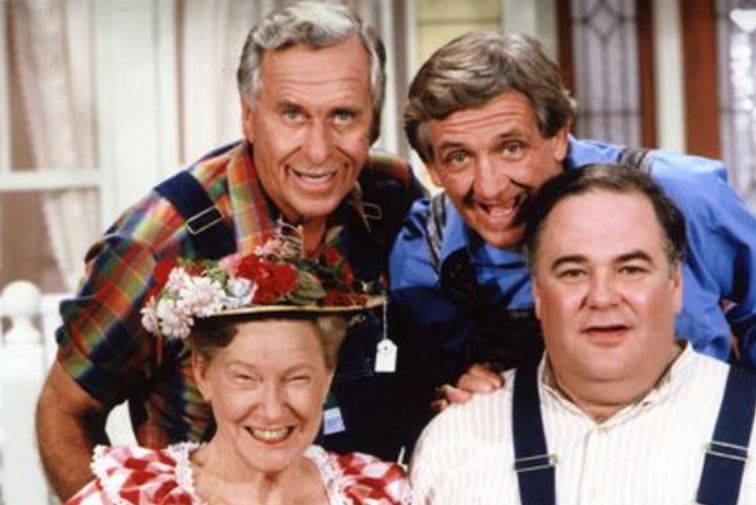
Gordie Tapp, Junior Samples, Grandpa Jones, Lulu Roman

In these earliest of episodes Gordie appeared as Cousin Clem in both one-liner material and as a member of The Culhanes, a recurring sketch featuring Gordie, Grandpa Jones, Lulu Roman, and Junior Samples. The premise of the sketch, a spoof of radio soap operas complete with organ intro and off-camera announcer, happened to center around each character having a conversation but each family member spoke a line at a time...and in monotone...for example...

Cousin Clem: "How's the weather outside, Cousin Grandpa?".
Cousin Grandpa: "Awful...it's terrible...".
Cousin Lulu: "Cousin Junior wants a flea collar...".
Cousin Junior: "That's right...it's raining cats and dogs.".

At the conclusion of the sketch and the utterance of an intentionally bad, but sometimes clever one-liner, you'd hear the sting of the organ and everyone would take turns looking at the family member that said the bad joke before the fade out to another sketch or to a commercial break. 

In addition to the Cousin Clem role he had another recurring character, Samuel B. Sternwheeler (visually a Mark Twain spoof). In this guise he'd walk out of the door of a house and deliver brief editorials about life and his thoughts on everything he witnessed in his day to day life. He'd deliver the messages in a better-than-you condescending tone, typically ending with a bad one-liner, upon at which time he was punished for the joke by getting hit over the head, or on the side of the head, with a rubber chicken. This character would later morph into Col. Daddy in a series of sketches also starring Marianne Rogers as his spoiled rich daughter. Those particular sketches aired in the late '70s and into the mid '80s. Eventually Gordie's character no longer appeared in the sketches but was referenced to by his spoiled daughter in almost every sketch.

One couldn't properly recap the career of Gordie Tapp without spotlighting the lovable loser, Laverne Nagger. This character became one of Gordie's most popular on Hee Haw. A lot of the charm of the sketch tended to be his rude one-liners and of course the sparring with his wife, Ida Lee, played by Roni Stoneman, happened to be the highlight of the sketch. The sparring, or nagging, is actually the inspiration for the character's last names. Each one constantly nagged at the other over bills, money, her family, his drinking, etc. This sketch, in it's earliest incarnation, had a very dark overtone but was comical and combative at the same time. Ida Lee typically hit Laverne with a rolling pin or threatened to throw her iron at him many times during an argument. Each sketch began the same: you'd hear a dreary guitar note and then Ida Lee screams "Laverne!!!" usually because he's either asleep in his bowl of food or in a daze with an ever present moonshine jug in hand. The couple lived in a shack and in later episodes they're joined by a son, Elrod, played by Kenny Price and in later installments Ida Lee's mother appears in the sketches (played by one of the program's backup singers, Wendy Suits).

Gordie and Archie Campbell (another of the show's main writers) popularized the sketch referred to as "Pffft...You Was Gone!". Each sketch included a performance of the aforementioned song starting off with the lyrics "where, oh where, are you tonight...". Gordie often appeared with his back to the camera, sometimes he'd appear asleep with a hat over his face, or he'd be standing in profile looking at Archie as he sang the opening verse. As the song reached it's chorus Archie would elbow Gordie who would then jolt into action and join Archie in the singing of the song's chorus. As the series became increasingly popular a lot of the country music and non-country music guest stars wanted to sing the song and so usually 2 sketches appeared per show. In the first half hour Archie or Gordie would be joined by one of the special guests and in the second half hour another guest star would perform the sketch with either Archie or Gordie. In the 1980s George Lindsey often performed the sketch with one of the guest stars that week.

Another of Gordie's long running characters happened to be Mr. Gordon...the owner of the Kornfield Kounty General Store. For this character Gordie essentially played himself. The sketch, in it's earliest incarnation, comically exaggerated the frugality of rural customers and it often created opportunities to do consumer/retail industry jokes but it didn't really take off, in my opinion, until Gailard Sartain joined the series and the subsequent creation of the Maynard character. The friction that existed between the stern and serious Mr. Gordon and the overly anxious and eager to please, but usually clumsy and moronic, Maynard, created a comical dynamic lacking in the earlier sketches.

In the 1980s some of the long established cast members were passing away and it impacted some of the sketches that Gordie appeared in. Junior Samples died in 1983 and The Culhanes added Mike Snider in the role once played by Junior. After the 1985-1986 season came to a close the producers let go most of it's cast (including Buck Owens, Don Harron, and Roni Stoneman among many others); both Archie Campbell and Kenny Price died in 1987. In 1989 Gordie no longer was credited as one of the show's writers and several other long-time writers for the series like Bud Wingard and Barry Adleman ceased writing for the series in 1989. Gordie, however, remained on the series and even appeared in a new sketch which also starred Phil Campbell (one of Archie's sons). This sketch featured the duo as a pair of police. The sketch title happened to be Kornfield Kops. Steve Campbell, another son of Archie, became one of the new writers in 1989.

In 1990 Gordie was inducted into the Canadian Country Music Hall of Fame.

In mid 1991 another cast shake-up happened which resulted in nearly all of the cast-members, except for a handful of long-time regulars, being let go. Gordie, fortunately, happened to be among those that were kept under contract and he returned to the series later that year to tape episodes in an urban setting and with hardly any rural, rustic decor in sight. Since Hee Haw was going through a visual make-over, as well as a major cast change following it's final first run episode of the 1990-1991 season, the production of new episodes didn't begin until the fall of 1991. The taping sessions for the series had always taken place during the months of June and October of each year but since there wasn't a taping session in June 1991 that meant when September 1991 rolled around there weren't any new episodes ready to air to kick-off the new television season. So, with that, the 1991-1992 season began with repeats from previous seasons until new episodes were ready to air.

The first episode of the 1991-1992 season finally hit the air in January 1992...and the backlash happened almost immediately. The series, for whatever reason, had also changed it's official title to The Hee Haw Show. The jokes/one-liners remained intentionally bad and corny but the graphics and set designs changed big time. I think if the setting remained rural and everyone continued appearing in the cornfield and the haystacks remained prominent the 1992 episodes may have gone over a little bit better even with the casting changes...but it's hard to tell. The cast, staff, and crew nevertheless did an incredible job...pulling off 22 episodes in less than half a year's time.


After Hee Haw ended production Gordie settled into a post-Hee Haw life as did everybody else connected to the series. He remained active and in 1998 received the Order of Canada for humanitarian efforts. In 1999 he received the Order of Ontario. He often appeared at Hee Haw events/reunions and remained one of the biggest supporters of the series and spoke highly of it and seemed grateful for it's impact on his life and career. Reruns of Hee Haw aired on The Nashville Network during a four year period (1993-1997). After the reruns became property of RFD-TV in 2008 several surviving cast-members delivered commercials promoting the reruns.

On January 6, 2012 RFD-TV aired a tribute to the series called "Salute to the Kornfield" in which it's producers attempted to reunite every surviving cast-member of the series. They succeeded in rounding up the core surviving members of the cast and they even enlisted the talents of Barbi Benton, a cast-member for several years in the 1970s, but she departed the series for a Hollywood career. Gordie happened to tape a commercial for RFD during the Salute festivities. It used to be on YouTube but it's been removed. There happened to be well over 500 episodes of Hee Haw...and for some reason or another obituary and memorial sites have mistakenly credited him with appearing in 90 episodes. As a series regular from start to finish Gordie appeared in every episode.

A photo from it's final rural-themed season, 1990-1991. Gordie, George Lindsey, Gailard Sartain, and Minnie Pearl stand in front of one of the props, a southern house used as a background set for the various country music performances that took place during this point in the show's history. He published his life story in 2007 and portions of it can be read on-line. It's called What's on Tapp?: The Gordie Tapp Story.

Gordie had been married to a woman named Constance (often referred to by her middle name, Helen) for more than 70 years at the time of his death in December 2016. As it's likely to happen in marriages that last so long once a spouse passes away the surviving spouse often follows soon after and that's just what happened several days ago. His widow passed away on January 29, 2017 at the age of 94.

The Canadian news organization, CBC, did a great look back at Gordie's career and I'm providing the link HERE. It's a fascinating memorial and includes a lot of inside information that only those that worked in Canadian television and radio could share and that's how I'd like to conclude this blog entry on Gordie Tapp and his impact on Canadian television but especially here in America through his involvement in Hee Haw.
Gordie Tapp: 1922-2016

Wednesday, April 25, 2012

Hee-Haw: 1969-1992, Part Fourteen...

Well, good Wednesday afternoon!! I came across an article about Hee-Haw that was published on February 27th this year...it's a lengthy, respectful write-up/article about the show as a whole. The article, as I found out when I read the entire thing, was originally written in early January of 2011, though! It's still a good article. I didn't research my previous Hee-Haw blog entries to see if I'd posted a link to that particular article or not and so I'm going to post the link in this blog entry. The article appears on a site called thislandpress and the article's written by an author named Jeff Martin.

You can read the article here: Why Hee Haw Still Matters.

I hesitate to embed Hee-Haw videos on my blog pages due to the ever-changing availability of them through the course of time. I did a blog entry a couple of years back and embedded quite a few You Tube videos of the show...only to visit the blog several weeks later to find the videos unavailable for play-back. Either the video's uploader had removed them from public display (disabling the embedding feature) or they were taken down by the uploader for whatever reason. When this happens it creates a void for any blog entry that embeds a video clip...once the centerpiece of a blog entry is removed (such as an embedded video) then the blog entry itself makes little sense.

Anyway...that's a big reason why I don't embed too many videos anymore in my blogs. However, I'm going to break my unwritten rule on today's blog entry and embed a video clip from the late '80s era of the show. As many blog readers of mine are aware of, I grew up watching Hee-Haw every Saturday evening in the '80s...and when it was moved to Saturday afternoons, to make way for the Saturday evening additions of a couple of game shows, I'd catch it often. So I was raised on the '80s and early '90s installments of the show. The Cowboy Quartet didn't gain as much commercial popularity as The Hee-Haw Gospel Quartet did but nevertheless The Cowboy Quartet had a recurring segment on the show in the late '80s. I came across a newer video clip of this quartet and the content is below...


As you can see from the video, this is one of the final episodes of the rural format. I have no idea, though, when it was originally aired but I see that Jeff Smith is among the singers. At the start of the clip you'll see the last few seconds of a Gailard Sartain sketch where he played an owner of a flea market ever trying to break into the music business...but the camera would always pull away every time he'd whip out his guitar. Cathy Baker introduces the Quartet. Judging by the appearances of the cast-members (physical appearances, hairstyles) it looks as if this clip comes from the 1989-1990 or 1990-1991 season.

As I commented on in the previous Hee-Haw blog entries I've written, the reruns that TNN and later, CMT, aired of the show were mostly from the '80s and a precious few from the final 1990-1991 rural season. TNN once aired the Alan Jackson episode...at the time it was one of the few latter-day episodes of the series to be re-aired. The reason why I like to spotlight the show's mid '80s and early '90s run as much as possible is because #1 that's the era of the program I grew up seeing every weekend. I'll always have a fondness for those episodes. The second reason I like to spotlight those episodes is because I think, sometimes, those particular episodes get a bad wrap because they don't feature the core line-up as they're referred to by many, many fans of the show. That core line-up that's usually referred to often contained comics/entertainers that were no longer among the living by the late '80s: Archie Campbell, Junior Samples, Jimmy Riddle, and Kenny Price. Stringbean, one of the show's most popular earlier cast-members, was murdered in November 1973. His episodes were still airing each weekend (all of his segments had been taped in the late summer of 1973). On the show, which he'd been on since it's 1969 debut, he appeared in many banjo musical numbers and had a recurring sketch where he'd read a "letter from home". Also, he appeared as the scarecrow in the Kornfield joke segment, offering one-liners about how miserable he was having to listen to all the corny jokes. A black crow puppet was perched over his shoulder. After his murder, the new shows from 1974 onward featured a scarecrow in the Kornfield as a memorial. The black crow puppet continued to appear as before. Those earliest episodes which feature Stringbean currently air on RFD-TV.  

Meanwhile...getting back to the mid '80s...co-host Buck Owens had left the program after the 1985-1986 season wrapped up...on top of that there was what the show's producer, Sam Lovullo, refers to as the great cast shake-up of 1986 which saw the exits of quite a few long-time cast-members.

When the show returned in the fall of 1986 it was considerably different, cast-wise, but there were still a lot of familiar faces as well: Roy Clark, Gordie Tapp, Gunilla Hutton, Grandpa Jones, Lulu Roman, George Lindsey, Gailard Sartain, etc. etc.  Also, the guest co-host position was introduced at the start of the 1986-1987 season. This was a popular addition but it was ultimately phased out by the start of the 1990-1991 season. In it's final season, of rural decor, Roy Clark was the sole host of the program. He was back as the host when the series returned in January 1992 in the urbanized setting under the slightly different name, The Hee-Haw Show. This was the format that aired until May 1992...which ultimately lead to the program going out of production that summer. Hee-Haw Silver premiered in the fall of 1992 and it ran through the spring of 1993. Afterwards reruns of the show began airing on The Nashville Network in the fall of 1993. Reruns continued to air on TNN on a consistent basis through 1996...and occasionally through 1997. They aired on CMT infrequently after that before the series left the airwaves entirely...popping up in a series of DVD's from Time-Life. The program returned to the airwaves, in rerun form, in 2008 on RFD-TV where it's been airing ever since.

Monday, November 21, 2011

Hee-Haw: 1969-1992, Part Twelve...

In this particular Hee-Haw blog entry I'm focusing on an upcoming salute to the series that'll air in January 2012 on RFD-TV. The special is titled Salute to the Kornfield...at the moment I have no idea the running time of the special. I can't wait to see it...it'll feature recent interviews with a lot of the surviving cast-members of the show and I imagine there will be a lot of remembrances and memorials/tributes given to those who've passed away.

Before anyone can say "Great...but I don't get RFD-TV!!!" the great news is there's going to be a mammoth DVD collection which will feature the program that airs in January 2012 in addition to footage that didn't make it on the air. The DVD collection will cost a person a little more than $80.00 but it'll be well worth it not only for the interviews and memories but for it's historical value in the years to come.

Information about the DVD collection, which contains 5 discs in all, can be found by clicking the RFD-TV link. 4 discs will be housed in a standard DVD case while the 5th disc called Backstage will be housed in a separate case. You'll see the look and design and the price after you click the above link.

The reruns of the show that air on RFD-TV, in a lot of ways, is responsible for this reunion. Word of mouth and social media have created awareness for the reruns and in a lot of cases the program was discovered by younger audiences, too, who weren't even born when Hee-Haw aired it's last episode in 1992.

The program originally aired on CBS-TV for 2 and a half seasons, 1969-1971, and in syndication for 22 more seasons, 1971-1992. When the show ceased production of new episodes in 1992, at the end of it's 24th season, the program returned later that year as Hee-Haw Silver to commemorate it's 25 seasons on the air. That program was a retrospective series airing flashbacks of older episodes which ran through 1993...concluding it's 25 year run.

I find it thrilling that the program still has such a strong fan-base...but it's not surprising. Practically anything associated with Hee-Haw has turned a profit or helped networks increase their ratings. In the '90s The Nashville Network aired reruns of the show for nearly 5 years straight starting in 1993...months after Hee-Haw Silver concluded it's syndicated run.

One example of it's profitability being the series of Time Life DVD collections spread out over a period of several years. Those DVD's, I think, filled the void left when The Nashville Network abruptly stopped airing the reruns and the DVD releases increased the demand for more episodes. I say the DVD successes eventually led to the program's rerun debut on the RFD-TV network in 2008...where it's been airing ever since. The network is currently airing the 1972-1973 season.

Once again...the reunion of Hee-Haw will air in January 2012 and the DVD counterpart is available for pre-order at the web-link I posted up in the third paragraph.

Monday, December 27, 2010

Hee-Haw: 1969-1992, Part Six...

This Life in the Kornfield book was released in 1996 and as far as I know it was never re-issued and so the only way an abundance of people were to get this book is if they bought it brand new at the time. It's available on the Amazon marketplace and it may be available on eBay...but it's long been out of print. 2011 will mark the book's 15th anniversary...it would be nice if the book were to get re-released in 2011 and have additional chapters focusing on Sam and the cast's thoughts about the success of the DVD's that Time-Life released in the mid 2000's and the thrill of the show getting a TV Land award a few years ago...in addition to the program's re-airing on RFD-TV...exposing the show to yet another generation. This book has a few flaws, though...those who get bent out of shape if a song might be referred to with a slightly different title or if 100% accuracy is a must you may find the book inferior. A slight inaccuracy is mistakenly crediting Gunilla Hutton as being a former cast-member of "Green Acres" instead of "Petticoat Junction". This sort of inaccuracy, though, would only be caught by those who are devoted fans of those two shows or know Gunilla's career history. The general public always mix-up those two shows because they both take place in the same town and have the same ensemble supporting cast...so, to all the nit-pickers, cut Sam some slack, okay?

This book contains an episode-by-episode breakdown...it's always been a fascinating part of the book...reading the names of all the celebrities that appeared from 1969 through 1992. This feature has added significance with RFD-TV airing the show in chronological order...now we can see ahead of time when one of our favorite singers are to make an appearance. Last night's rerun on RFD was from 1972 and it featured Jeannie C. Riley and Johnny Bench. That particular episode originally aired February 5, 1972. Looking in the episode breakdown I know that next Sunday night's rerun on January 2, 2011 will feature Porter Wagoner and Dolly Parton. The episode originally aired on February 12, 1972 of course.

The Hee-Haw 10th Anniversary celebration took place in 1978 as a 2-hour special that aired separately from it's weekly time-slot. This special was taped at the Opry, with a jam-packed audience, and it featured the cast and a lot of country singers stopping by giving their thoughts and memories of the show in addition to performing their current hits. One of the recurring features of the special was to air earlier clips of the cast prior to their current appearance. Tammy Wynette was saluted in a series of clips that spotlighted her various hair styles. Loretta Lynn appeared via video-tape and discussed her fondness for the show and they aired several clips of her and later she introduced Conway Twitty. All in all it was a fun celebration...and it included exclusive sketches performed live for the audience. They did a 20th Anniversary special in 1988 but for whatever reason it was never issued on DVD. In hindsight Time-Life should have issued the 1978 and 1988 anniversary specials together on one DVD. There were a few serious moments on the special...Grandpa Jones was featured sitting alone with a home made fishing pole discussing the murder of fellow cast-member, Dave "Stringbean" Akeman, which led into a video tribute of Stringbean's contributions to the show. Grandpa and Stringbean were close friends in real life. In another tribute, Buck Owens did a medley of his own hit songs as a salute to Don Rich, the leader of the Buckaroos band and an important figure in Buck's career. Don appeared on Hee-Haw every week as part of the Buckaroos band until his 1974 death at the age of 32.

Hee-Haw: 1969-1992.

Friday, March 5, 2010

Hee-Haw: 1969-1992, Part Five

Given that this is the fifth installment of my Hee-Haw blog it shouldn't come to nobody's surprise that I love the show! I can't really give an opinion of it's 24th season in 1992 because I've never really seen it but judging by things I've read through the years it wasn't what the doctor ordered...the overhaul of the show's image and the termination of long-running sketches and cast members...it was a mistake. The thing that made the show was it's look...as well as the corny jokes...also, the energetic banter among the cast and whatever guest stars were on the show that week. When the show debuted in 1969 it was met with a lot of harsh criticism not only from big city television critics but also music critics within country music. The country music industry was wanting to push the label of 'Country and Western' which sounded more marketable. Hee-Haw stood in sharp contrast to that marketing idea because of it's heavy use of haybales, farmer's daughter wardrobes, bib overalls and other rural imagery that pushed the 'Hillbilly' image that the country music big-wigs on Music Row were wanting to distance itself from. The enormous success of the show meant that the program would continue to air; and after it's cancellation by CBS in 1971, it went into first-run syndication and would remain a syndicated program for the rest of it's life-span. 

 Season One: June 15, 1969 - September 7, 1969 
Season Two: December 17, 1969 - April 8, 1970 
Season Three: September 15, 1970 - February 23, 1971 
Season Four: September 18, 1971 - April 1, 1972 
Season Five: September 16, 1972 - March 24, 1973 
Season Six: September 15, 1973 - March 23, 1974 
Season Seven: September 14, 1974 - March 8, 1975 
Season Eight: September 17, 1975 - March 13, 1976 
Season Nine: September 18, 1976 - March 26, 1977 
Season Ten: September 17, 1977 - March 25, 1978 
Season Eleven: September 16, 1978 - March 24, 1979 
Season Twelve: September 15, 1979 - March 22, 1980 
Season Thirteen: September 13, 1980 - March 21, 1981 
Season Fourteen: September 12, 1981 - March 30, 1982 
Season Fifteen: September 11, 1982 - March 19, 1983 
Season Sixteen: September 17, 1983 - March 17, 1984 
Season Seventeen: September 22, 1984 - March 16, 1985 
Season Eighteen: September 21, 1985 - March 15, 1986 
Season Nineteen: September 20, 1986 - March 28, 1987* 
Season Twenty: September 19, 1987 - May 21, 1988** 
Season Twenty-One: October 1, 1988 - May 20, 1989** 
Season Twenty-Two: September 16, 1989 - March 24, 1990 
Season Twenty-Three: September 15, 1990 - February 23, 1991*** 
Season Twenty-Four: January 4, 1992 - May 30, 1992^^ 
Season Twenty-Five: September 1992 - April 1993**** 

 *-beginning with the 19th season, Roy Clark was joined each week by a different guest co-host. 

 **-There were no episodes that aired during the month of March during these production cycles. As a result, the season expanded further into the spring, to make up for the loss of air-dates. 

 ^^-After the rural/backwoods version of the show was canceled in February 1991, the show went on a hiatus while producers/advertisers behind the scenes were plotting a new urban twist to the show. The new citified version of the show began in January 1992, the show's 24th season. The outcry from fans was so severe that the show went out of production in May upon the conclusion of it's 24th season. 

 ***-Roy Clark became the solo host beginning with season 23. 

 ****-This is the season known as Hee-Haw Silver to commemorate the program's 25th season in syndication. Roy Clark gave intro's for each rerun while Cathy Baker appeared with new recordings of her sign-off line, "That's All!!". After the Silver series wrapped up in the spring of 1993 reruns began to surface on The Nashville Network for a period of time. A lot of the reruns that TNN aired were the late 1970's and early 1980's episodes. At one point in time TNN's Saturday night line-up was must-see television: Hee-Haw from 7-8pm; Opry Backstage from 8pm to 8:30pm; The Grand Ole Opry from 8:30pm-9pm; and the Statler Brothers show from 9pm-10pm. After the reruns left TNN they began to air infrequently on CMT. 

There was never a serious effort on CMT's part to air the show and as a fan I felt insulted by the way CMT treated the program by not airing it on any consistent basis. TNN eventually ended it's run of country music oriented programming in 2000. It was renamed The National Network and consisted of reruns of mostly 1980's television programs. Later on the network was renamed again to Spike TV. Hee-Haw currently airs Sunday nights at 8pm eastern on RFD-TV. The episode replays on Monday mornings at 10am eastern. The reruns that air are typically the earliest of episodes from 1969-1971. I've yet to see an episode on RFD-TV from the late '70s or the 1980's. I hope they start to air those episodes, too.