In my recurring quest to find video footage of the late voice actor, John Stephenson, I came across a video last month on YouTube that I have yet to spotlight in a blog entry...but that's being taken care of in this blog. Video surfaced last month of BotCon2001...which is notable, for me at least, as being the edition of that event in which John Stephenson made a rare public appearance. He was part of a three person panel discussing not only their careers in animated cartoons but their time spent on the Transformers series of the 1980s. Michael Bell and Gregg Berger are the other voice artists on the panel. BotCon is the name of the convention celebrating all things Transformers.
If you know your classic Hanna-Barbera history then you'll know that both Michael Bell and John Stephenson worked on the animated series, Super Friends, at different points in that program's history. John was actually part of the first season of that series in the role of Col. Wilcox. He would also lend his voice to a villain, Sculpin, in a second season episode. Michael Bell became a cast member of that series beginning with Season Two in the roles of both Zan and Gleek.
As soon as John begins speaking you should recognize the voice immediately. He used his natural speaking voice in a lot of the cartoons because it lent itself perfectly to characters of authority. He voiced all kinds of policemen, doctors, scientists, and military officials...but he could also deliver evil versions of those professions, too...with just a growl or snarl of the voice. In the opposite extreme he could be silly, too. In Wacky Races he voiced Luke and the forever whining Blubber Bear. He did impressions of Paul Lynde's voice, for example. A lot of internet sites mistakenly credit Paul Lynde as the voice of Mildew Wolf in the 1977 animated series, Scooby's All Star Laff-a-Lympics, but in fact it was John Stephenson voicing that character. The confusion arises from Paul Lynde having originally voiced the character in an animated series called It's The Wolf, a segment of the animated Cattanooga Cats series. Mildew Wolf appears as a co-host on the 1977 Scooby series so I guess a lot of people just assume Paul Lynde voiced the character in that series, too. Several years later John resurrected the Paul Lynde vocal impression for another wolf...this time Wilfred Wolf on Tex Avery's Kwicky Koala series. Tex passed away in 1980 during the development/production of the series and didn't see it hit the airwaves in 1981. Wilfred's catchphrase is "Gotcha!!" whenever he goes to capture the quick-to-vanish koala. Kwicky twitches his ears in order to disappear from Wilfred's clutches. In the Top Cat series John could be heard as the suave Fancy-Fancy as well as Officer Dibble's superior in the police precinct. John's most publicized role is Mr. Slate in The Flintstones. When watching the video keep alert for John's Mel Blanc story, his recollections about voice director Wally Burr, Joe Barbera, and later in the clip John informally re-creates the cries of Blubber Bear while telling a story of his bleeding hand...oh, and John does a roar of a Dinosaur. He referenced a series, not by name, in which he was vocally cast as a Dinosaur and in the clip he demonstrates a roar!
This is my off-topic blog area. I discuss mostly cartoons and TV programs and some politics, too.
Showing posts with label Scooby Doo. Show all posts
Saturday, August 1, 2020
Sunday, April 19, 2020
The New Scooby Doo Movies: The Almost Complete Collection...
| Me and the Scooby Doo Movies; 2020 |
The purists are furious because it doesn't feature The Addams Family and as a result, infuriating them anymore, the opening title sequence is an alternate version...not the one that originally aired. The audio/vocal track heard in the alternate opening sequence is the same and some of the animated sequences featuring the main characters from the series remain intact from the original 1972-1974 broadcasts but notably missing are the images of the guest stars. As the years went on and copyright ownership constantly changed hanged due to business acquisitions it meant that television reruns of The New Scooby Doo Movies as the 1980s and early 1990s came and went were limited to showing only the episodes that were approved by a legal team representing the celebrities who lent their voice and likeness to the series. Episodes of the series reran in 2 parts rather than air in an hour long format as they did when they originally aired on Saturday mornings in the early '70s. Anyway, by the latter half of 2018 the rights were secured to 8 remaining episodes of the series and so in the summer of 2019 along came this DVD of 23 of the 24 episodes.
Now then...here are the episodes that appear on this 2019 collection:
Disc One:
1. The Ghastly Ghost Town (with The Three Stooges)
2. The Dynamic Scooby Doo Affair (with Batman and Robin)
3. The Frickert Fracas (with Jonathan Winters)
4. Guess Who's Knott Coming To Dinner (with Don Knotts)
Disc Two:
1. A Good Medium is Rare (with Phyllis Diller)
2. Sandy Duncan's Jekyll and Hyde (with Sandy Duncan)
3. The Secret of Shark Island (with Sonny and Cher)
4. The Spooky Fog (with Don Knotts)
Disc Three:
1. The Ghost of Bigfoot (with Laurel and Hardy)
2. The Ghost of the Red Baron (with The Three Stooges)
3. The Ghostly Creep from the Deep (with The Harlem Globetrotters)
4. The Haunted Horseman of Hagglethorn Hall (with Davy Jones)
Disc Four:
1. The Phantom of the Country Music Hall (with Jerry Reed)
2. The Caped Crusader Caper (with Batman and Robin)
3. The Loch Ness Mess (with The Harlem Globetrotters)
4. The Mystery of Haunted Island (with The Harlem Globetrotters)
Disc Five:
1. The Haunted Showboat (with the cast from Josie and the Pussycats)
2. Mystery in Persia (with the cast from Jeannie)
3. The Spirited Spooked Sports Show (with Tim Conway)
4. The Exterminator (with Don Adams)
Disc Six:
1. The Weird Winds of Winona (with the cast of Speed Buggy)
2. The Haunted Candy Factory (with Cass Elliot)
3. The Haunted Carnival (with Dick Van Dyke)
When you look at those hour long episodes and the wide variety of special guest stars you'll see that some celebrities made multiple vocal appearances. You'll also notice that in some cases Scooby Doo and the gang meet celebrities mostly representative of a by-gone era. The Three Stooges, by 1972, were still hugely popular on television through repeated play of their classic live action short subject films. There were comic book adaptations and animated cartoons depicting The Three Stooges along side the television airings of their Columbia Studios films during the 1960s (they made 190 short subject comedy films for the studio). The Stooges themselves, however, professionally retired in 1970. By this time the third stooge was Joe DeRita, who went by the stage name Curly Joe. The vocalization for Moe Howard was supplied by Pat Harrington, Jr. while Daws Butler supplied the vocals for Larry Fine and Curly Joe. The irony is Daws incorporated a few 'nyuk, nyuk' catchphrases associated with the original Curly (played by Moe's brother) which weren't part of the 'Curly Joe' character. Larry Fine and Moe Howard died in 1975.
Laurel and Hardy are an iconic comical duo and it's safe to assume that in 1972 their likeness and name were still synonymous with classic film comedy, as were The Three Stooges. However, by the time The New Scooby Doo Movies came along in 1972 both of those comic icons had passed away. Stan Laurel, born in 1890, died in 1965 (74 years old) while Oliver Hardy, born in 1892, died in 1957 (65 years old). Nevertheless the iconic comedy duo were still popular and so they, too, made an appearance on this 1972 animated series. The voice of Oliver Hardy was performed by Jim MacGeorge while Stan Laurel's voice was performed by Larry Harmon. The two voice actors had previously provided the vocals for Laurel and Hardy in a syndicated cartoon series which aired during the 1966-1967 season. There were 156 five minute adventures produced. In the 1980s Jim MacGeorge, who visually looks like Stan Laurel, appeared in live action commercials as Laurel along side Chuck McCann as Hardy.
In addition to the episodes guest starring The Three Stooges (2 episodes) and Laurel and Hardy (1 episode) there are guest appearances by characters who had appeared on animated series of their own. The cast of Josie and the Pussycats guest star in an episode. The cast of Speed Buggy guest stars and then there's an episode featuring the cast of Jeannie (Jeannie, Cory, Henry, and Babu). Animated versions of The Harlem Globetrotters had been depicted on television prior to this 1972 Scooby Doo series but the exhibition basketball team known for their tricks and skills hold the record for most appearances on this series...three episodes. The real-life Globetrotters didn't provide their voices for the animated appearances. Scatman Crothers, most notably, provided the voice of Meadowlark Lemon and Eddie "Rochester" Anderson voiced Bobby Joe Mason. Batman and Robin appear as guests in two episodes. Their animated history dates back to 1967 when the Filmation Studio released The Superman/Batman Hour of Adventure. The voice of Batman was supplied by legendary radio and television character actor, Olan Soule. Robin was voiced by disc jockey Casey Kasem...several years before taking on the role of Shaggy in the Scooby Doo cartoons in 1969 and eventually becoming nationally and internationally famous as the host of American Top-40 beginning in 1970. In the two Scooby Doo episodes guest starring Batman and Robin both Olan and Casey reunited as the Caped Crusaders. Ted Knight returned as the voice of Penguin and Joker. Olan and Casey would continue to voice the Dynamic Duo on ABC Television's Super Friends series (produced by Hanna-Barbera) throughout the rest of the 1970s and into the mid 1980s.
The rest of the episodes in the 1972 Scooby series feature the actual celebrities voicing their animated versions. The main vocal performers are Don Messick (Scooby Doo; Sebastian; additional voices); Casey Kasem (Shaggy; Robin; Alexander Cabot II; additional voices); Frank Welker (Fred; additional voices); Nicole Jaffe (Velma); and Heather North (Daphne). This series would mark the final time Nicole Jaffe voiced Velma on a regular basis. She reprised the role several decades later in a direct-to-video animated Scooby film but as far as the television episodes are concerned this 1972 series was her last as Velma. John Stephenson, a vocal legend for Hanna-Barbera, was on hand for this Scooby series providing vocals for an assortment of villains and an occasional good guy.
A modern-day version of this series is the most recent incarnation of the Scooby Doo franchise. That series is called Scooby Doo and Guess Who?. I'm not into modern-day celebrities or contemporary television productions (beyond news and sports programs) and so I've never watched too many episodes of that current Scooby series but my guess is it captures the essence of the 1972 series but places it squarely into modern times.
Monday, March 2, 2020
Scooby Doo and the Mysteriously Missing Eight...
| 1976 Scooby Doo episodes |
| 1978 Scooby Doo episodes |
1. The Curse of Viking Like
2. Vampire Bats and Scaredy Cats
3. Hang in There, Scooby Doo
4. The Creepy Heap from the Deep
5. The Chiller Diller Movie Thriller
6. The Spooky Case of the Grand Prix Race
7. The Ozark Witch Switch
8. Creepy Cruise
Those eight episodes have never appeared together in any DVD release, to date. Episodes 2, 3, and 7 have made appearances on select compilation DVD releases of the Scooby series but never has their been an official DVD release spotlighting all 8 episodes. It would be great if someday all 40 episodes produced from 1976 to 1978 would become available in one multi-disc DVD release.
In 1978 Scooby's All-Star Laff-a-Lympics was shortened from 2 hours to 90 minutes and given a new title, Scooby's All-Stars. In the meantime all-new Scooby Doo episodes had been produced and were airing on Saturday morning under the 1969 title of Scooby Doo, Where Are You?. When ABC removed that series from the line-up after the airing of 9 all-new Scooby episodes the remaining 7 episodes from 1978 aired as a segment of Scooby's All-Stars. Those 1978 episodes, as mentioned earlier, make up the content of the DVD titled Season Three of Scooby Doo, Where Are You?. The voice cast was large and varied when you take the time to look at all three seasons of Scooby Doo cartoons that were produced during 1976, 1977, and 1978 but the main vocal cast were: Don Messick as Scooby, Casey Kasem as Shaggy, Frank Welker as Fred, Heather North as Daphne, Pat Stevens as Velma, and John Stephenson was often heard as the villains, scientists, policemen, and other supporting roles. Series regulars Don Messick, Casey Kasem, and Frank Welker could also be heard in supporting roles, too. In the 1976 Dynomutt series you had Gary Owens as Blue Falcon, Frank Welker as Dynomutt, Larry McCormick as the Mayor, and Ron Feinberg as Focus One. John Stephenson, Don Messick, Casey Kasem, and Frank Welker could be heard in an assortment of supporting roles as cops, doctors, or criminals. The series was produced by Hanna-Barbera and based on characters created by Joe Ruby and Ken Spears.
Labels:
1969,
1976,
1977,
1978,
casey kasem,
don messick,
frank welker,
hanna-barbera,
Heather North,
john stephenson,
Pat Stevens,
Scooby Doo
Friday, September 8, 2017
Don Messick on camera...
Hello all...there are several video clips on YouTube that feature the late Don Messick on camera. There have been uploads of the sitcom, "The Duck Factory", which Don co-starred in as Wally Wooster. There's a clip of him and Daws Butler performing primarily as Boo Boo and Yogi Bear (plus Ranger Smith)...and then there's a video clip I came across yesterday while searching YouTube. Don's birthday happened to be yesterday (born September 7, 1926) and so I did some video searching. I came across this video clip (uploaded a couple of weeks ago) from 1982 (I think). Don mentions a couple of times that he'd been working for Hanna-Barbera for 25 years and given that Bill Hanna and Joe Barbera started their studio in 1957 that means the video clip is from 1982...or possibly early 1983. The video is an interview which lasts a little over 8 minutes.
If you're a dedicated fan of classic cartoons and are familiar with Don Messick's work you'll definitely get a kick out of seeing him perform some characters on-camera. The figurine of the Smurf character in the screen shot is Jokey Smurf (a character June Foray gave voice to) that the interviewer mistook for Papa Smurf. Remember...the interviewers aren't necessarily what you'd call die hard fans of cartoons...but they gave Don a grand opportunity to display his incredible vocal talents. I wish he would've performed the voice of Klunk on camera...I'd love to have seen Don's facial contortions as he spoke in that character's voice. If you're not familiar you'll have to look up video clips of a cartoon called "Dastardly and Muttley in Their Flying Machines". Don voices Muttley, Zilly, and Klunk in addition to providing the opening narration which sets the scene. Klunk has a very distinctive vocalization.
Don Messick: September 7, 1926 - October 24, 1997.
If you're a dedicated fan of classic cartoons and are familiar with Don Messick's work you'll definitely get a kick out of seeing him perform some characters on-camera. The figurine of the Smurf character in the screen shot is Jokey Smurf (a character June Foray gave voice to) that the interviewer mistook for Papa Smurf. Remember...the interviewers aren't necessarily what you'd call die hard fans of cartoons...but they gave Don a grand opportunity to display his incredible vocal talents. I wish he would've performed the voice of Klunk on camera...I'd love to have seen Don's facial contortions as he spoke in that character's voice. If you're not familiar you'll have to look up video clips of a cartoon called "Dastardly and Muttley in Their Flying Machines". Don voices Muttley, Zilly, and Klunk in addition to providing the opening narration which sets the scene. Klunk has a very distinctive vocalization.
Don Messick: September 7, 1926 - October 24, 1997.
Labels:
Boo Boo Bear,
don messick,
impressionists,
Papa Smurf,
Ranger Smith,
Scooby Doo
Friday, December 18, 2015
Be Cool, Scooby Doo...
Let's have a show of hands...has anybody seen the most recent revival of the Scooby Doo franchise? It's a series titled "Be Cool, Scooby Doo" and it airs in the United States on Cartoon Network. It debuted back on October 4th in the United Kingdom and Ireland and then October 5th in America and then on October 8th in Canada. It's the 12th incarnation of the Scooby franchise and much like the last couple of previous incarnations it offers something a bit different than the franchise's original premise. In this particular series the gang's all here: Scooby, Shaggy, Fred, Velma, and Daphne...as is the Mystery Machine. The characters have all been redesigned and some of the character traits have been altered slightly.
Fred's returned to being the all-American leader rather than being the clueless, oblivious moron that recent incarnations have cast him as being even though there are moments that see Fred revert to his clueless demeanor. Daphne, this time around, is portrayed as the goofy character...and that only adds to the mix given that Shaggy and Scooby remain goofy, nervous, frightened, and hungry. Velma is the one constant...although in this series the character gets a different voice actress, Kate Micucci. The previous voice actress, Mindy Cohn, continues to voice Velma in the direct-to-DVD animated projects and the video games but she doesn't reprise the role in this series. Matthew Lillard returns as the voice of Shaggy. Grey Griffin (formerly billed as Grey DeLisle) is once more on hand as Daphne...and the vocal God, Frank Welker, is on hand as Fred and Scooby.
Be on the lookout for monsters and villains that carry similarities with iconic monsters and villains from past episodes. In "All Paws on Deck" the gang is terrorized by a monster resembling the Beast from a late '70s episode titled "The Beast is Awake in Bottomless Lake". In the 2015 episode Velma has hydrophobia...something that isn't consistent with her history...for in several episodes in the franchise's history she clearly enjoyed being in large bodies of water and scuba-diving and so the need for Velma's hydrophobia is a plot-device. In addition to having similar looking monsters and villains there is the inclusion of the much iconic chase scene...something that appeared in the classic episodes (1969-1973) and in some of the other installments but mostly the chase scenes are identified as a hallmark of the original programs...each episode features a chase scene.
The publicity surrounding this series hyped the existence of 26 half hour episodes already completed...14 of those 26 have since aired on Cartoon Network. The last first-run episode to air occurred on October 28th. As you can see it's a daily series...having aired half of season 1 in a month's time span already. Ordinarily this is why a 13 episode half-season airs weekly for 13 weeks...that way it gives people plenty of time to get used to the series, enables promoters to advertise and hype the series, or for potential audiences to discover it during the 13 week rerun cycle. An episode of the series aired on-line on October 30th...but according to on-line sources it shouldn't have aired and it has since been removed (an episode titled "If You Can't Scooby Doo the Time, Don't Scooby Doo the Crime").
It has never, to date, aired on television yet but you can search for it on-line...I'm sure it's available for viewing somewhere out there.
On December 10th a first-run episode finally emerged...titled "Scary Christmas". Technically this is episode 15 of the 26 that have already been completed (episode 14 has never aired) but in broadcast chronology the December 10th airing is listed as episode 14. The series is set to debut in other parts of the world on December 28th and so if it isn't airing locally in your geographic's then chances are it'll begin airing later this month.
Once I'm able to catch a full episode for myself I'll be a bit more detailed in my opinions. At the moment I'm going by the clips that have been posted on YouTube and those are just too brief to form an educated opinion. I could be like so many others and just say "yuck! ick! I hate it, hate it!!!" or "these can't compare to the originals...I hate it!!". I've never been that sort of reviewer and so I'll gather my thoughts and post more detailed about this series at a future date. Who knows, by that time, a DVD of Season 1 may be available for Amazon purchase!?!!
Fred's returned to being the all-American leader rather than being the clueless, oblivious moron that recent incarnations have cast him as being even though there are moments that see Fred revert to his clueless demeanor. Daphne, this time around, is portrayed as the goofy character...and that only adds to the mix given that Shaggy and Scooby remain goofy, nervous, frightened, and hungry. Velma is the one constant...although in this series the character gets a different voice actress, Kate Micucci. The previous voice actress, Mindy Cohn, continues to voice Velma in the direct-to-DVD animated projects and the video games but she doesn't reprise the role in this series. Matthew Lillard returns as the voice of Shaggy. Grey Griffin (formerly billed as Grey DeLisle) is once more on hand as Daphne...and the vocal God, Frank Welker, is on hand as Fred and Scooby.
Be on the lookout for monsters and villains that carry similarities with iconic monsters and villains from past episodes. In "All Paws on Deck" the gang is terrorized by a monster resembling the Beast from a late '70s episode titled "The Beast is Awake in Bottomless Lake". In the 2015 episode Velma has hydrophobia...something that isn't consistent with her history...for in several episodes in the franchise's history she clearly enjoyed being in large bodies of water and scuba-diving and so the need for Velma's hydrophobia is a plot-device. In addition to having similar looking monsters and villains there is the inclusion of the much iconic chase scene...something that appeared in the classic episodes (1969-1973) and in some of the other installments but mostly the chase scenes are identified as a hallmark of the original programs...each episode features a chase scene.
The publicity surrounding this series hyped the existence of 26 half hour episodes already completed...14 of those 26 have since aired on Cartoon Network. The last first-run episode to air occurred on October 28th. As you can see it's a daily series...having aired half of season 1 in a month's time span already. Ordinarily this is why a 13 episode half-season airs weekly for 13 weeks...that way it gives people plenty of time to get used to the series, enables promoters to advertise and hype the series, or for potential audiences to discover it during the 13 week rerun cycle. An episode of the series aired on-line on October 30th...but according to on-line sources it shouldn't have aired and it has since been removed (an episode titled "If You Can't Scooby Doo the Time, Don't Scooby Doo the Crime").
It has never, to date, aired on television yet but you can search for it on-line...I'm sure it's available for viewing somewhere out there.
On December 10th a first-run episode finally emerged...titled "Scary Christmas". Technically this is episode 15 of the 26 that have already been completed (episode 14 has never aired) but in broadcast chronology the December 10th airing is listed as episode 14. The series is set to debut in other parts of the world on December 28th and so if it isn't airing locally in your geographic's then chances are it'll begin airing later this month.
Once I'm able to catch a full episode for myself I'll be a bit more detailed in my opinions. At the moment I'm going by the clips that have been posted on YouTube and those are just too brief to form an educated opinion. I could be like so many others and just say "yuck! ick! I hate it, hate it!!!" or "these can't compare to the originals...I hate it!!". I've never been that sort of reviewer and so I'll gather my thoughts and post more detailed about this series at a future date. Who knows, by that time, a DVD of Season 1 may be available for Amazon purchase!?!!
Labels:
1969,
2015,
Mystery Machine,
Scooby Doo,
Scooby Snacks,
Shaggy,
teenagers solving mysteries,
Velma
Monday, July 20, 2015
John Stephenson: 1923-2015
I hadn't put together a memorial blog for John Stephenson because of the limited resources available regarding his personal life and the lack of information surrounding his timeline. I've posted several blogs over the years focusing on Stephenson's under-rated career and the last one I posted centered around Scooby Doo's 45th anniversary last year. In that particular blog entry it features the numerous collage's I created that spotlighted the various characters that John Stephenson voiced during his association with the Scooby franchise. Little did anyone (outside of his family) really know at that time that John Stephenson was battling a serious disease.
You can take a look at that particular Scooby Doo/John Stephenson blog entry I wrote last year by clicking HERE.
Rumors of John's 'death' had circulated numerous times on the internet...one such rumor that gained traction not too long ago eventually was proven to be false.
According to reports John Stephenson died of Alzheimer's Disease at a nursing home on May 15th at the age of 91. The articles I'd read never mentioned how long he'd been diagnosed with the disease but it couldn't have been too long because his last screen credit arrived in a bit part in 2010 on a Scooby Doo project. I've heard the audio and he seemed to be in fine voice but the role, generically referred to as The Sheriff, is super brief but the vocal is immediately recognizable. It could have been an archived recording and placed in the animated film as a salute to him but I don't think we'd ever know.
He had a reputation of avoiding the media...giving very little to no interviews for any publication or television broadcast...but you could hear his voice on numerous radio broadcasts and see him pop up as a guest star in television dramas of the '50s and '60s. One of his most visual roles happened to be his participation in Johnny Carson's 1950s comedy program. In that series Stephenson portrayed a fictional news reporter usually reading absurd stories in a serious tone and in each scenario it set up a forthcoming sketch that Carson and other members of the cast participated in.
In the Carson series John Stephenson acted out his part as a stressed news anchor. Only a couple of clips of Carson's mid '50s program exists on YouTube. I have some of those episodes on DVD but unfortunately the disc's must have been made by an inferior company because they stopped playing several weeks after I purchased them and I hadn't been able to play them since. It's a shame, too, because those fictional newsbreaks helped set up various Carson sketches; more than one "Catch Up with the News" segment aired in a single episode but YouTube only has clips of the mid '50s program and so there's not many to see on-line. The program aired on CBS for a single season, 1955-1956, and there happened to be 10 kinescopes of the program issued on DVD in 2007. More than likely those are the same programs that I have on a admittedly low-budget compilation DVD of assorted comedy programs from the early days of television (the DVD that stopped playing). Hopefully those episodes of Carson's mid '50s program become available on a better quality DVD project.
In addition to the visibility John Stephenson experienced as a part of Johnny Carson's CBS series he also gained some visibility in the sitcom The People's Choice starring Jackie Cooper. In that particular sitcom, running from 1955 to 1958 and producing 108 episodes, Cooper portrays a character named Socrates Miller...called "Sock" for short. He marries a woman named Mandy Peoples...she happens to be the daughter of the local Mayor. The running gag for most of the episodes stems from Sock and Mandy's attempts to keep their marriage a secret from her father (Sock and Mandy eloped in Nevada). John Stephenson portrays the program's resident antagonist, Roger Crutcher, on a recurring basis. A capture from one of Stephenson's scenes has him looking on as Patricia Breslin (Mandy) and Jackie Cooper (Sock) are in the middle of some sort of comical revelation.
If one happens to visit the Internet Movie Data Base or other on-line sources in the search for "John Stephenson + actor" you're going to be hit with a lot of television credits. Stephenson appeared in several episodes of Perry Mason, Hogan's Heroes, The Beverly Hillbillies, and Gomer Pyle, USMC just to name a couple and he appeared as a semi-regular in the soap opera, Morning Star. Yes, for an actor that shunned the media and didn't grant interviews he certainly appeared on a number of programs during the early years of television...but given the lack of publicity surrounding his vast amount of work he didn't get the recognition or rightful attention he deserved.
John Stephenson's greatest impact exists in cartoon voice overs.
Many a villain in the Scooby Doo franchise have Stephenson to thank for providing a voice. Also many a red herring (someone suspected of being a bad guy but ends up being innocent) also have Stephenson's voice to thank. In the blog entry I provided a link to you can gaze upon the many characters that John Stephenson gave voice to...but I left off characters that weren't a part of Scooby's various cartoon mystery programs of the '70s and '80s. Some may find it interesting that Stephenson voiced Col. Wilcox in the first season of Super Friends and then returned later to provide incidental voices...most notably The Sculpin in a 1977 episode featuring Superman and Aquaman. In that first season of Super Friends the overall narration came from Ted Knight...reprising a role he previously held for Filmation in the mid-late '60s on their run of superhero cartoons.
In a series called Scooby's All-Star Laff-a-Lympics (not a mystery cartoon) Stephenson provided the voices for a series of characters. The late '70s series spoofed the Olympics, Battle of the Network Stars, and ABC sports. Three teams of "athletes" composed of The Yogi Yahooeys, The Scooby Doobies, and the Really Rottens competed in Olympic-style events.
A talented mimic he provided a Paul Lynde impression for the character Mildew Wolf (co-host of Laff-a-Lympics). Lynde had originally voiced the character in the late 1960s but didn't reprise the role for the Scooby series and so Stephenson did an impression. John's mimicry is also on full display as The Great Fondoo, an inept magician of The Really Rottens team. Fondoo's voice is highly reminiscent of Bela Lugosi. A good guy character from The Yogi Yahooeys team, Doggy Daddy, is Stephenson's impression of Jimmy Durante. Stephenson returned to the character in several animated specials in the 1980s.
The human leader of The Really Rottens, Dread Baron, is another Stephenson vocalization...not exactly an impression of any celebrity in particular but it's apparent it's his vocal characterization of a slick, con-artist type complete with the sort of "nya, ha ha" sinister laugh that harkens back to 1930s and 1940s melodramas.
Stephenson's vocal impressions of Boris Karloff, Bela Lugosi, Paul Lynde, and Joe Flynn played a vital part in a lot of his voice-over performances in an assortment of cartoons throughout the '60s and into the early '90s. Stephenson's natural speaking voice being pretty great, too, enabled him to act in his natural voice or in an affected voice with equal proficiency. If you're familiar with the late '60s version of Dragnet you could hear John Stephenson's natural voice at the end of every episode providing the lead-up and the details of the outcome of that episode's unseen court trial. A typical line went like this: "On Saturday August 4th trial was held in Los Angeles for the State of California...in a moment the results of that trial". After the commercial break you'd hear Stephenson giving the details of the conviction or the acquittal.
In the mid-late '70s era Stephenson provided voices for an assortment of villains in The Dynomutt, Dog Wonder series including The Red Vulture, The Blimp, Eric von Flick, The Glob, and at various times the Chief of police (sometimes referred to as Chief Grimsley and other times as Chief Wiggins).
In the Inch High Private Eye series Stephenson could be heard in a variety of roles but his main role happened to be the irascible Mr. Finkerton (Stephenson doing his Joe Flynn impression). In another cartoon, using the same Joe Flynn impression, Stephenson gave voice to Mr. Peevely in Help! It's the Hair Bear Bunch series. The high nasal Joe Flynn impression apparently became a favored, go-to voice because Stephenson used it a couple of other times for different but similar characters. In Galaxy Goof-Ups the Flynn inflection infected the commanding officer, Captain Snerdley. In the Inspector Mumbly series of cartoons Stephenson gave the Flynn impression to the antagonistic Officer Schnooker. The highlight of those characters happened to be the inevitable explosion of anger that built under the surface. Popularly referred to as "slow burn", these characters would work themselves up into a state of bombastic stress before blowing their top in a comedic kind of way. In the opening minutes of this episode of Galaxy Goof-Ups titled "Whose Zoo" you'll hear what I mean. As is the case in a lot of Hanna-Barbera cartoons the voice actors and actresses often provided the voices for multiple characters within an episode. This one is no different. Not only is John Stephenson voicing his regular character, Captain Snerdley, but he's also the voice of the villain monster bent on poaching the planet of animals. You'll hear and see that character first along with the sidekick.
In the video's image below there's Captain Snerdley on the monitor giving a harsh lecture to Huckleberry Hound (Daws Butler) and Quack-Up (Mel Blanc).
As far as longevity goes, arguably, John Stephenson's greatest impact in cartoon voice overs is in the role of Mr. Slate in numerous episodes of The Flintstones. From the debut of Mr. Slate in the 1960s and lasting into the 1990s virtually every animated appearance of Mr. Slate had a voice provided by John Stephenson. Promos for Cartoon Network included Stephenson being recruited to deliver a line or two as Slate in that distinctive John Stephenson voice. The ultimate event in Flintstones lore is the release of The Jetsons Meet The Flintstones on November 7, 1987
The reason that the Jetsons received top billing is because their series happened to be in first-run production and the plot of the animated movie deals with Elroy Jetson inventing a time machine...and during a moment of harmless experimenting all of the other Jetsons (George, Jane, Judy, and their talking dog, Astro) decided to humor Elroy and pretend that they were headed to the future. However, much to their horror and disbelief the time machine ended up working...taking the Jetsons into the past rather than into the future. Eventually the Flintstones get zapped into the future and they meet Rosie, Henry, and Spacely while the Jetsons, themselves, remain stuck in Bedrock.
John Stephenson returned to his familiar role as Mr. Slate. Ironically, George Jetson's emergence in Bedrock creates an economical boost to whatever business aligns itself with the stranger's futuristic gadgets. Jetson ends up working for Slate while Fred ends up working for Mr. Spacely in the future. Fred's car becomes a huge hit. Barney becomes a spokesperson for Spacely's competitor, Cogswell. Unfortunately neither Mr. Slate nor Mr. Spacely come face to face considering Slate remained in Bedrock and Spacely remained in the Jetson's futuristic universe.
Some of Stephenson's 1980's work can be heard in various episodes of The Transformers and G.I. Joe and various cartoon specials from Hanna-Barbera requiring him to revive classic characters such as Mr. Slate and Doggie Daddy.
John Stephenson's contributions to animated cartoons from Hanna-Barbera had a major impact on generations of people and they are going to continue getting discovered as the years go by. John Stephenson's voice was immediately recognizable and a familiar presence for generations of cartoon fans.
I made a special collage just for this blog entry...the larger picture is the Chief from the Dynomutt series. The other remaining seven characters are Col. Wilcox, zoo keeper Mr. Peevly, Mr. Finkerton, Mr. Slate, Captain Leech, Col. Fuzzby, and Chief Wenchly. I'll more than likely make another collage because I have other characters saved on my computer that John Stephenson gave voice to.
John Stephenson: August 9, 1923-May 15, 2015.
You can take a look at that particular Scooby Doo/John Stephenson blog entry I wrote last year by clicking HERE.
Rumors of John's 'death' had circulated numerous times on the internet...one such rumor that gained traction not too long ago eventually was proven to be false.
According to reports John Stephenson died of Alzheimer's Disease at a nursing home on May 15th at the age of 91. The articles I'd read never mentioned how long he'd been diagnosed with the disease but it couldn't have been too long because his last screen credit arrived in a bit part in 2010 on a Scooby Doo project. I've heard the audio and he seemed to be in fine voice but the role, generically referred to as The Sheriff, is super brief but the vocal is immediately recognizable. It could have been an archived recording and placed in the animated film as a salute to him but I don't think we'd ever know.
He had a reputation of avoiding the media...giving very little to no interviews for any publication or television broadcast...but you could hear his voice on numerous radio broadcasts and see him pop up as a guest star in television dramas of the '50s and '60s. One of his most visual roles happened to be his participation in Johnny Carson's 1950s comedy program. In that series Stephenson portrayed a fictional news reporter usually reading absurd stories in a serious tone and in each scenario it set up a forthcoming sketch that Carson and other members of the cast participated in.
In the Carson series John Stephenson acted out his part as a stressed news anchor. Only a couple of clips of Carson's mid '50s program exists on YouTube. I have some of those episodes on DVD but unfortunately the disc's must have been made by an inferior company because they stopped playing several weeks after I purchased them and I hadn't been able to play them since. It's a shame, too, because those fictional newsbreaks helped set up various Carson sketches; more than one "Catch Up with the News" segment aired in a single episode but YouTube only has clips of the mid '50s program and so there's not many to see on-line. The program aired on CBS for a single season, 1955-1956, and there happened to be 10 kinescopes of the program issued on DVD in 2007. More than likely those are the same programs that I have on a admittedly low-budget compilation DVD of assorted comedy programs from the early days of television (the DVD that stopped playing). Hopefully those episodes of Carson's mid '50s program become available on a better quality DVD project.
In addition to the visibility John Stephenson experienced as a part of Johnny Carson's CBS series he also gained some visibility in the sitcom The People's Choice starring Jackie Cooper. In that particular sitcom, running from 1955 to 1958 and producing 108 episodes, Cooper portrays a character named Socrates Miller...called "Sock" for short. He marries a woman named Mandy Peoples...she happens to be the daughter of the local Mayor. The running gag for most of the episodes stems from Sock and Mandy's attempts to keep their marriage a secret from her father (Sock and Mandy eloped in Nevada). John Stephenson portrays the program's resident antagonist, Roger Crutcher, on a recurring basis. A capture from one of Stephenson's scenes has him looking on as Patricia Breslin (Mandy) and Jackie Cooper (Sock) are in the middle of some sort of comical revelation.
If one happens to visit the Internet Movie Data Base or other on-line sources in the search for "John Stephenson + actor" you're going to be hit with a lot of television credits. Stephenson appeared in several episodes of Perry Mason, Hogan's Heroes, The Beverly Hillbillies, and Gomer Pyle, USMC just to name a couple and he appeared as a semi-regular in the soap opera, Morning Star. Yes, for an actor that shunned the media and didn't grant interviews he certainly appeared on a number of programs during the early years of television...but given the lack of publicity surrounding his vast amount of work he didn't get the recognition or rightful attention he deserved.
John Stephenson's greatest impact exists in cartoon voice overs.
Many a villain in the Scooby Doo franchise have Stephenson to thank for providing a voice. Also many a red herring (someone suspected of being a bad guy but ends up being innocent) also have Stephenson's voice to thank. In the blog entry I provided a link to you can gaze upon the many characters that John Stephenson gave voice to...but I left off characters that weren't a part of Scooby's various cartoon mystery programs of the '70s and '80s. Some may find it interesting that Stephenson voiced Col. Wilcox in the first season of Super Friends and then returned later to provide incidental voices...most notably The Sculpin in a 1977 episode featuring Superman and Aquaman. In that first season of Super Friends the overall narration came from Ted Knight...reprising a role he previously held for Filmation in the mid-late '60s on their run of superhero cartoons.
In a series called Scooby's All-Star Laff-a-Lympics (not a mystery cartoon) Stephenson provided the voices for a series of characters. The late '70s series spoofed the Olympics, Battle of the Network Stars, and ABC sports. Three teams of "athletes" composed of The Yogi Yahooeys, The Scooby Doobies, and the Really Rottens competed in Olympic-style events.
A talented mimic he provided a Paul Lynde impression for the character Mildew Wolf (co-host of Laff-a-Lympics). Lynde had originally voiced the character in the late 1960s but didn't reprise the role for the Scooby series and so Stephenson did an impression. John's mimicry is also on full display as The Great Fondoo, an inept magician of The Really Rottens team. Fondoo's voice is highly reminiscent of Bela Lugosi. A good guy character from The Yogi Yahooeys team, Doggy Daddy, is Stephenson's impression of Jimmy Durante. Stephenson returned to the character in several animated specials in the 1980s.
The human leader of The Really Rottens, Dread Baron, is another Stephenson vocalization...not exactly an impression of any celebrity in particular but it's apparent it's his vocal characterization of a slick, con-artist type complete with the sort of "nya, ha ha" sinister laugh that harkens back to 1930s and 1940s melodramas.
Stephenson's vocal impressions of Boris Karloff, Bela Lugosi, Paul Lynde, and Joe Flynn played a vital part in a lot of his voice-over performances in an assortment of cartoons throughout the '60s and into the early '90s. Stephenson's natural speaking voice being pretty great, too, enabled him to act in his natural voice or in an affected voice with equal proficiency. If you're familiar with the late '60s version of Dragnet you could hear John Stephenson's natural voice at the end of every episode providing the lead-up and the details of the outcome of that episode's unseen court trial. A typical line went like this: "On Saturday August 4th trial was held in Los Angeles for the State of California...in a moment the results of that trial". After the commercial break you'd hear Stephenson giving the details of the conviction or the acquittal.
In the mid-late '70s era Stephenson provided voices for an assortment of villains in The Dynomutt, Dog Wonder series including The Red Vulture, The Blimp, Eric von Flick, The Glob, and at various times the Chief of police (sometimes referred to as Chief Grimsley and other times as Chief Wiggins).
In the Inch High Private Eye series Stephenson could be heard in a variety of roles but his main role happened to be the irascible Mr. Finkerton (Stephenson doing his Joe Flynn impression). In another cartoon, using the same Joe Flynn impression, Stephenson gave voice to Mr. Peevely in Help! It's the Hair Bear Bunch series. The high nasal Joe Flynn impression apparently became a favored, go-to voice because Stephenson used it a couple of other times for different but similar characters. In Galaxy Goof-Ups the Flynn inflection infected the commanding officer, Captain Snerdley. In the Inspector Mumbly series of cartoons Stephenson gave the Flynn impression to the antagonistic Officer Schnooker. The highlight of those characters happened to be the inevitable explosion of anger that built under the surface. Popularly referred to as "slow burn", these characters would work themselves up into a state of bombastic stress before blowing their top in a comedic kind of way. In the opening minutes of this episode of Galaxy Goof-Ups titled "Whose Zoo" you'll hear what I mean. As is the case in a lot of Hanna-Barbera cartoons the voice actors and actresses often provided the voices for multiple characters within an episode. This one is no different. Not only is John Stephenson voicing his regular character, Captain Snerdley, but he's also the voice of the villain monster bent on poaching the planet of animals. You'll hear and see that character first along with the sidekick.
In the video's image below there's Captain Snerdley on the monitor giving a harsh lecture to Huckleberry Hound (Daws Butler) and Quack-Up (Mel Blanc).
As far as longevity goes, arguably, John Stephenson's greatest impact in cartoon voice overs is in the role of Mr. Slate in numerous episodes of The Flintstones. From the debut of Mr. Slate in the 1960s and lasting into the 1990s virtually every animated appearance of Mr. Slate had a voice provided by John Stephenson. Promos for Cartoon Network included Stephenson being recruited to deliver a line or two as Slate in that distinctive John Stephenson voice. The ultimate event in Flintstones lore is the release of The Jetsons Meet The Flintstones on November 7, 1987
The reason that the Jetsons received top billing is because their series happened to be in first-run production and the plot of the animated movie deals with Elroy Jetson inventing a time machine...and during a moment of harmless experimenting all of the other Jetsons (George, Jane, Judy, and their talking dog, Astro) decided to humor Elroy and pretend that they were headed to the future. However, much to their horror and disbelief the time machine ended up working...taking the Jetsons into the past rather than into the future. Eventually the Flintstones get zapped into the future and they meet Rosie, Henry, and Spacely while the Jetsons, themselves, remain stuck in Bedrock.
John Stephenson returned to his familiar role as Mr. Slate. Ironically, George Jetson's emergence in Bedrock creates an economical boost to whatever business aligns itself with the stranger's futuristic gadgets. Jetson ends up working for Slate while Fred ends up working for Mr. Spacely in the future. Fred's car becomes a huge hit. Barney becomes a spokesperson for Spacely's competitor, Cogswell. Unfortunately neither Mr. Slate nor Mr. Spacely come face to face considering Slate remained in Bedrock and Spacely remained in the Jetson's futuristic universe.
Some of Stephenson's 1980's work can be heard in various episodes of The Transformers and G.I. Joe and various cartoon specials from Hanna-Barbera requiring him to revive classic characters such as Mr. Slate and Doggie Daddy.
John Stephenson's contributions to animated cartoons from Hanna-Barbera had a major impact on generations of people and they are going to continue getting discovered as the years go by. John Stephenson's voice was immediately recognizable and a familiar presence for generations of cartoon fans.
I made a special collage just for this blog entry...the larger picture is the Chief from the Dynomutt series. The other remaining seven characters are Col. Wilcox, zoo keeper Mr. Peevly, Mr. Finkerton, Mr. Slate, Captain Leech, Col. Fuzzby, and Chief Wenchly. I'll more than likely make another collage because I have other characters saved on my computer that John Stephenson gave voice to.
John Stephenson: August 9, 1923-May 15, 2015.
Monday, September 15, 2014
Scooby-Doo and John Stephenson, Too...
Hello all...this is part 3 of my Scooby blog series spotlighting the 45th anniversary (1969-present) of the franchise. I posted part 2 earlier this morning and I posted the initial entry (referred to as part 1) back in March of this year.
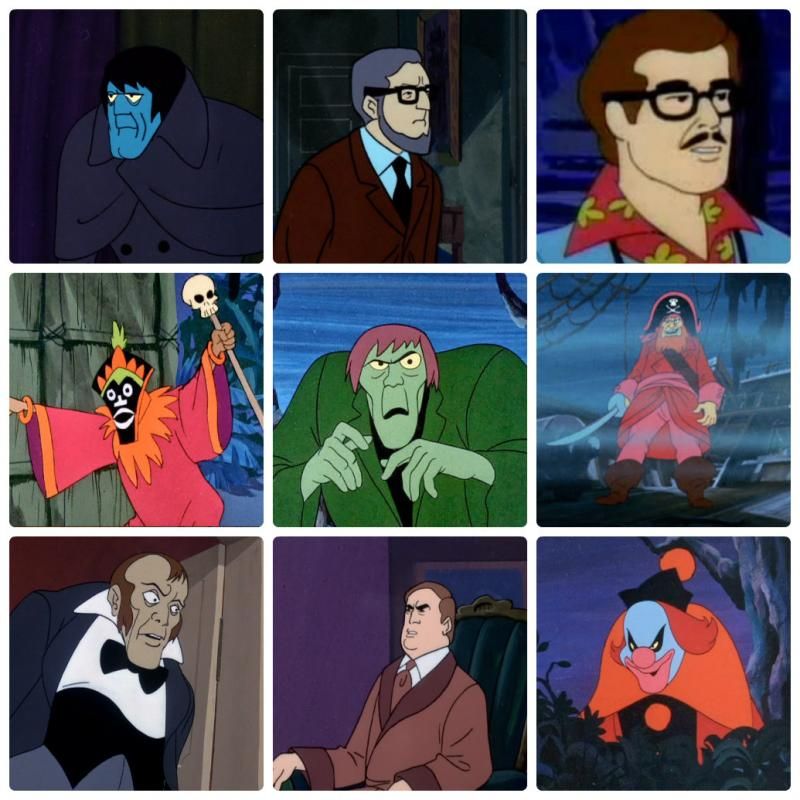
This particular entry simply shines the light on the various characters that were voiced by John Stephenson during the program's various incarnations...imagery from the first 8 years, specifically (1969-1978). I created 8 collage's of John Stephenson's characters and I'm going to post them as a salute to his contributions to the Scooby franchise. You can click on each collage and see the bigger image. I'll be sharing 8 collage's...this should be interesting...
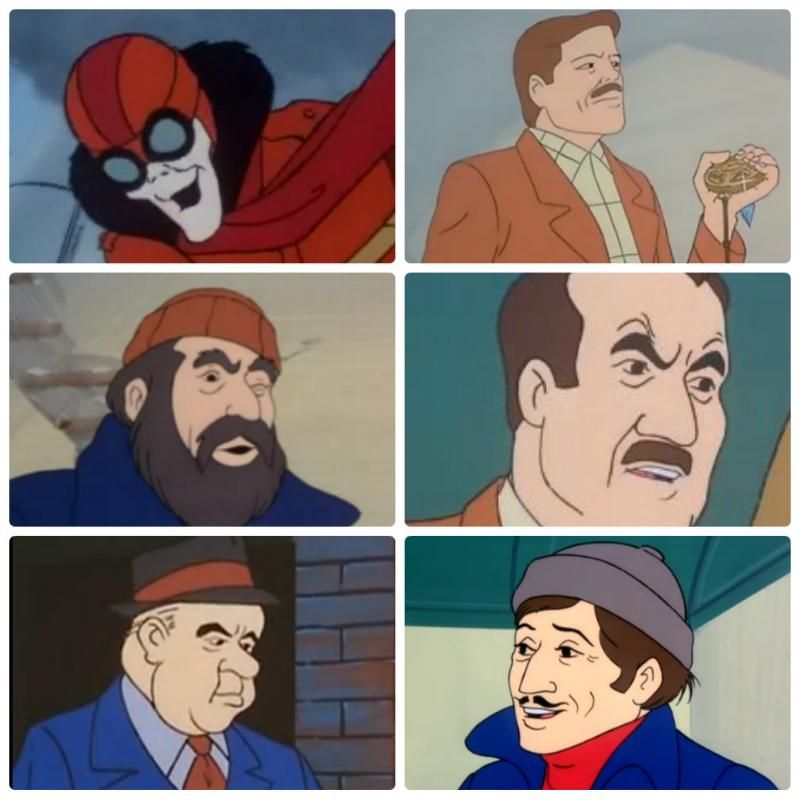
In this collage of 9 pictures, they originate from the first 2 seasons of the program. The character names are Elias Kingston, Uncle Stuart, Mr. Sims, Mano Tiki Tia, The Creeper, Redbeard the Pirate, the Magnus Butler, C.L. Magnus, and The Ghost Clown. As I've mentioned in previous Scooby blogs, many of the episodes had titles filled with alliteration and rhyming. Those 9 characters come from the following episodes: What The Hex Going On?; A Tiki Scare is No Fair; Jeepers, It's the Creeper; Go Away Ghost Ship; and Bedlam in the Big Top. The Kingston Manor, depicted in What the Hex Going On?, appears in the opening credits of the first season...it's also referred to as the black castle with the bats flying around. Also, scenes from that episode appear more times in the opening sequence of the first season than the other episodes. It's also worth pointing out, since this is a John Stephenson character salute blog entry, that his first roles in the Scooby cartoons occurred on the What the Hex Going On? episode.The Magnus Butler is one of several characterizations from Stephenson vocally based on Boris Karloff.
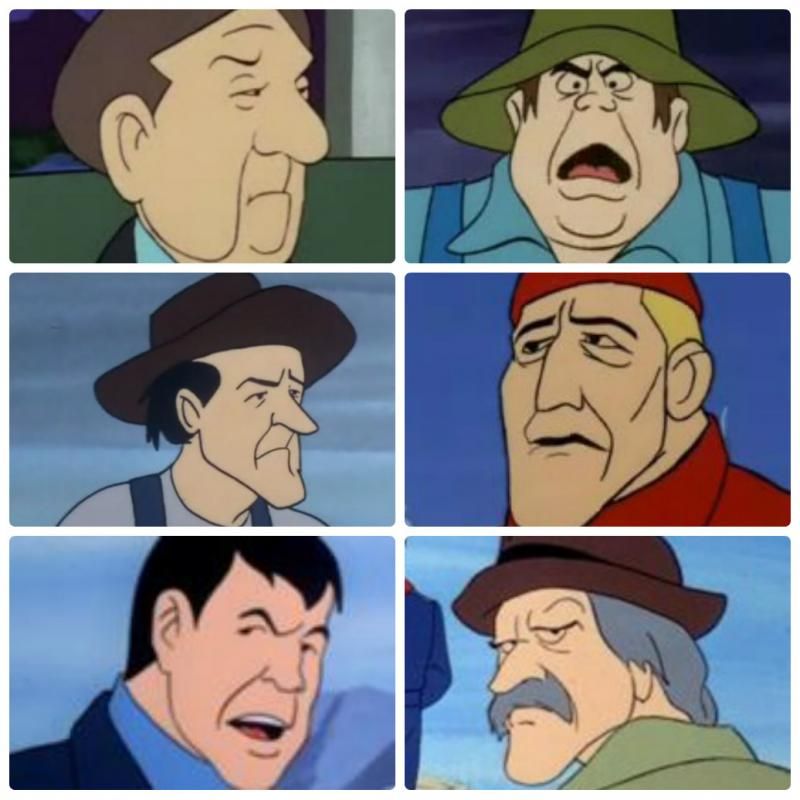
In this collage of 6 pictures I took a look at some of the characters that John voiced in the 1972-1974 series, The New Scooby Doo Movies. The 2 at the top of the collage come from the episode "The Frickert Fracas" (guest starring Jonathan Winters as himself and Maude Frickert). John voiced the characters Simon Shakely and Vernon Crow. In the third box there's the farmer character from the episode "The Ghost of the Red Baron" (guest starring The Three Stooges). It's one of the only characters John voiced in the Scooby cartoons that comes close to sounding like his most famous character, Mr. Slate (from The Flintstones). The fourth picture is Hans Eitherwise, a German-American ski instructor in the episode guest starring Laurel and Hardy, "The Ghost of Big Foot". The bottom 2 sinister looking cut-throats are Morgan and Winslow from the episode "The Loch Ness Mess" (guest starring The Harlem Globetrotters). John, as Winslow, does an impression of Titus Moody (a character from Fred Allen's radio programs and Pepperidge Farm television commercials played by Parker Fennelly).
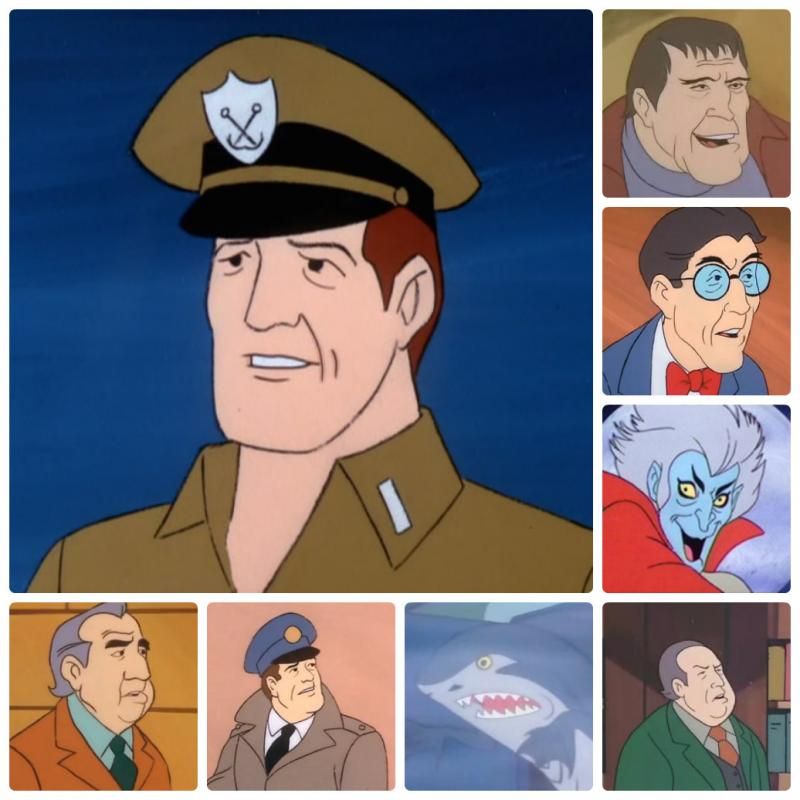
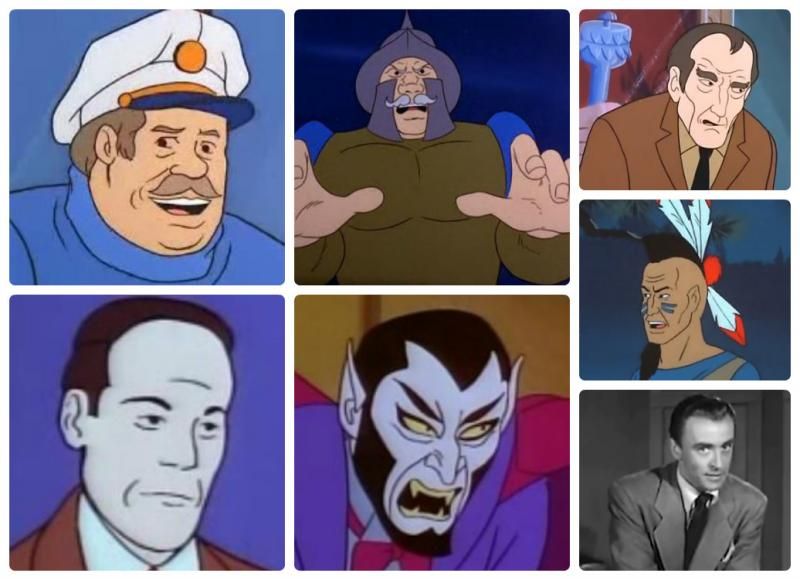
These 8 images represent characters voiced by John Stephenson during the mid-late '70s episodes, roughly 1976-1978. The big image is that of a Coast Guard employee that appears near the end of the episode "Scooby-Doo, Where's the Crew?". Off to the right are Mr. Wells, Mr. Speck, The Specter, Elwood Crane, The Demon Shark, a Customs Agent, and Avery Queen. Mr. Wells, the Demon Shark, and the Customs Agent all come from the episode "There's a Demon Shark in the Foggy Dark". In that episode John roars and growls as the Demon Shark and speaks in a gravelly voice for Mr. Wells. Elwood Crane comes from the episode "The Headless Horseman of Halloween". In the episode he's referred to as Cousin Elwood. John also voiced the Headless Horseman character but I didn't post an image of him...these collage's aren't meant to be a career defining project...just a sampling of his character roles through the various Scooby episodes. Scooby-Dum makes an appearance in that episode...and Janet Waldo voices one of the guest characters, Beth Crane. The Specter and Mr. Speck come from the episode "High Rise Hair Raiser". Avery Queen comes from the episode "The Ghost of the Bad Humor Man".
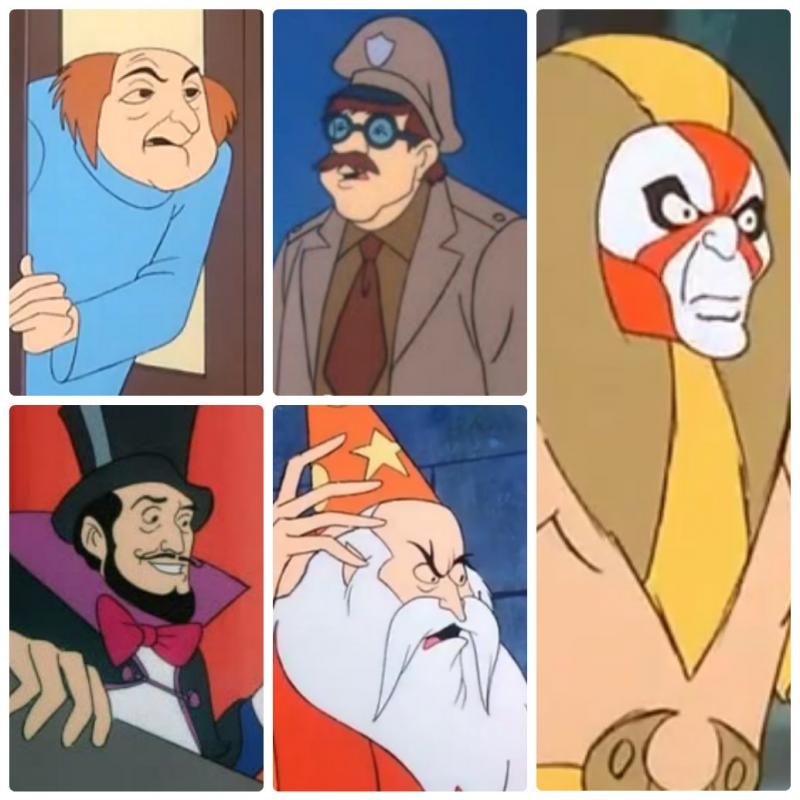
A five picture collage reveals characters largely stemming from 1976 and 1978. The creepy character in blue is Dr. Tooksbury from the episode "The Harum Scarum Sanitarium". John also provides the voice of a Canadian Mountie at the end of that episode. In the episode Scooby and the gang must solve a mystery surrounding a sanitarium and the legend of a ghostly doctor that's come back to haunt the area. Next to him is Officer Grizzly, a hard of hearing night watchman at the Ice Cream factory in "The Ghost of the Bad Humor Man". As mentioned in the previous paragraph, Stephenson also voiced the owner of the Ice Cream factory, Avery Queen. Below those characters are Zarko and Merlin from the episode "Scared a Lot in Camelot". Zarko appears near the beginning of the episode performing a magic act. Shaggy and Scooby become volunteers from the audience to participate in a magic act. The act backfires thanks to the terrified duo thinking they were really going to be cut in half...Zarko's laughed off the stage (the gang make a run for the exit in the process). Merlin appears throughout the remainder of the episode as he haunts the castle of Shaggy's uncle, Shagworthy. The larger picture is that of the leader of a gang of zombies and witch doctors (Mamba Wamba) in the pop music-inspired episode, "Mamba Wamba and the Voodoo Hoodoo". Scooby and the gang visit friends of theirs who have become rock music stars. The group perform a song about voodoo and are soon being chased by the ghost of Mamba Wamba and his henchman who are after a parchment...the real mystery is explained, of course, at episode's end.
In this collage of John Stephenson characters there's Mayor Dudley, Mr. Doherty, Mr. Prentice, The Rambling Ghost, and Mr. Grumper. These characters appear in the 1976 episodes "The 10,000 Volt Ghost", "High Rise Hair Raiser", "The Ghost That Sacked the Quarterback", and "The Spirits of '76". On a personal note, "The Ghost That Sacked the Quarterback" happened to originally air on December 4, 1976 (2 days after I was born!). In that episode the gang solves the mystery of a haunted football team and the legend of The Rambling Ghost. The team's owner is Mr. Prentice. Coinciding with America's Bicentennial celebrations in 1976, Scooby and the gang encounter ghosts at The Smithsonian Institution in form of Bendict Arnold, Major Andre, and William Demont. John voices the ill-tempered Mr. Grumper, one of the security guards. John voices a Federal Agent near the end of the episode. Mayor Dudley is John's more humorous characterization compared to the other characters. I should say the mayor comes across lighthearted. As is the case in many Scooby episodes things are not exactly as they seem.
The Red Baron, from "The Ghost of the Red Baron", appears first in this collage. The character, along with a farmer, were voiced by John Stephenson. The episode features The Three Stooges. Next to the Red Baron is the dapper Sam Crenshaw from the episode "The Frightened Hound meets Demons Underground". The bearded Albert Tross is another Stephenson-voiced character from that same episode. The irritated Mr. Dilly, co-owner of The Dilly Dally Dolly Company, appears in the episode "The No Faced Zombie Case" as does the next character in the collage, the police Lieutenant (another character similar in vocal tone to his Mr. Slate characterization). The character in the blue coat and red shirt is the Captain in "Scooby-Doo, Where's the Crew?". That was John's main character in the episode...at the end he gave voice to the rescuing officer from the Coast Guard that I mentioned earlier.
For this seven image collage I decided to mix things up more and include an image of John Stephenson himself...from the 1950's. The six characters come from episodes that originally aired during 1976-1978. Captain Eddie, The Ghost of Juan Carlos, Uncle Leon, and the Vampire Ghost are the characters that appear on the left. The 2 characters off to the right are Professor Salari and an Indian leader, Red Harron. Captain Eddie and the Ghost of Juan Carlos (one of John's most maniacal roles in the series) come from the episode "Don't Go Near the Fortress of Fear". Professor Salari, the curator of a local museum, appears in the episode "A Menace in Venice". Red Harron appears in "Watch Out! The Willawaw!!". The Vampire ghost and Uncle Leon appear in "Vampire Bats and Scaredy Cats". In that episode, also co-starring Scooby-Dum, Scooby and the gang investigate the family legend of their friend, Lisa. It seems her late grandfather and members of the family (including her uncle) have kept a secret from her...members of the family have been known to turn into vampires!!
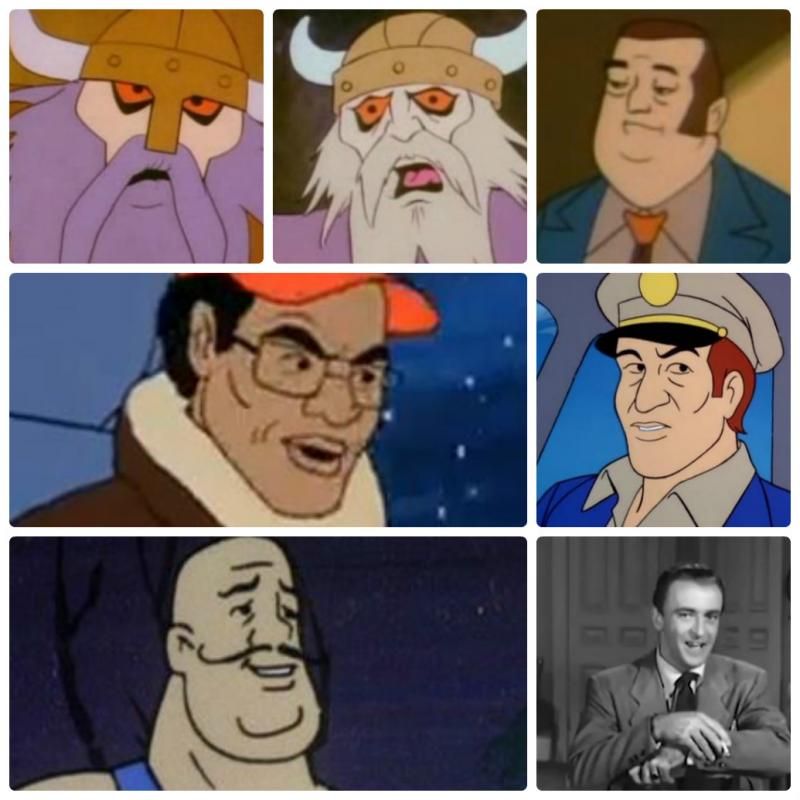
Lastly, I made this collage. If you notice I also included another black and white photo of John...this time laughing. The characters mostly come from 1976-1977. On the top there's back to back Viking characters, then there's Mr. Bohannon. In the second row there's a nameless pilot and next to him, from a different episode, another pilot by the name of Luis. Samson the Strongman concludes the animated character collage. The vikings come from "The Curse of Viking Lake". Mr. Bohannon comes from "Hang In There, Scooby-Doo". The nameless pilot comes from "Scooby's Night with a Snow Beast Fright". Luis comes from "Jeepers, It's the Jaguaro!". John also provided the guttural moans for the Jaguaro creature and I assume electronic enhancing created the shrilling effect (you'll hear what I mean once you see that particular episode). Samson the Strongman appears at the beginning of 1969's "Bedlam in the Big Top". As a side note, John does a great impression of Sydney Greenstreet's characterization of Nero Wolfe for the Mr. Bohannon character.
As I pointed out earlier these collages and this blog post aren't meant to be a career retrospective...just a glimpse at some of the characters John Stephenson gave voice to during his years associated with Scooby-Doo. These do not include characters from other cartoon programs, of course, or the characters he did on the Laff-a-Lympics episodes (even though the series was billed as Scooby's All-Star Laff-a-Lympics). Since that series deviated from the mystery solving concept I excluded his many vocal contributions on Laff-a-Lympics (he voiced several Really Rottens members and did a Paul Lynde impression as Mildew Wolf).
If you're interested I'd highly encourage you all to purchase the various DVD releases of the Scooby series to hear the vocalizations of John Stephenson and the other voice artists that contributed to the overall success of the franchise. Here are links to some of the DVD projects...
Scooby Doo First and Second Season DVD
Scooby Doo and Dynomutt
Scooby Doo DVD 1978 episodes
The Best of the Scooby Doo Movies
The link I call 'Scooby Doo and Dynomutt' takes you to a DVD consisting of the episodes that aired during the 1976-1977 season of the Scooby-Doo/Dynomutt Adventure Hour. I mentioned some of the episodes that featured a John Stephenson vocal characterization but I didn't get into the episodes of Dynomutt that have a Stephenson vocalization. The episodes feature their syndicated opening titles...meaning that each cartoon program airs back to back and has it's own opening and closing sequence. Some of the fans voiced their outrage at the time of the DVD's release because the episodes didn't feature the official opening sequence of the hour long series (which would have one opening and closing sequence per episode) and instead the company utilized the opening and closing sequences from the syndicated airings of each cartoon program. Regardless of the outrage from some...the episodes are intact and that's all that's important for a lot of us. It's that 1976-1977 season that contained Stephenson episodes such as "High Rise Hair Raiser", "The No Face Zombie Case", "The Spirits of '76"...
The link referring to the 1978 episodes takes you to a 2-disc release billed as Scooby-Doo, Where Are You? Season Three. Technically there isn't a season three of that series. The company that released the DVD took the 16 half hour episodes from 1978 that originally aired during the Saturday morning programs, Scooby's All-Star Laff-a-Lympics and Scooby's All-Stars, and issued those episodes as 'Season Three'. The 16 episodes found on the DVD utilize the opening sequence of The Scooby-Doo Show (it's the opening that features Scooby water skiing and having his ski's eaten by a hungry shark). It's anyone's guess as to why the 8 half hour episodes from 1977, which also follow the formula from the first 2 seasons, hadn't been released on DVD. Those, technically, could've been marketed as 'Season Three' and the 16 episodes from 1978 as 'Season Four'. The episodes "The Curse of Viking Lake", "Vampire Bats and Scaredy Cats", and "Hang In There, Scooby-Doo" that I mentioned earlier due to John Stephenson's vocal involvement originally aired in 1977 but haven't been released on DVD yet.
This particular entry simply shines the light on the various characters that were voiced by John Stephenson during the program's various incarnations...imagery from the first 8 years, specifically (1969-1978). I created 8 collage's of John Stephenson's characters and I'm going to post them as a salute to his contributions to the Scooby franchise. You can click on each collage and see the bigger image. I'll be sharing 8 collage's...this should be interesting...
In this collage of 9 pictures, they originate from the first 2 seasons of the program. The character names are Elias Kingston, Uncle Stuart, Mr. Sims, Mano Tiki Tia, The Creeper, Redbeard the Pirate, the Magnus Butler, C.L. Magnus, and The Ghost Clown. As I've mentioned in previous Scooby blogs, many of the episodes had titles filled with alliteration and rhyming. Those 9 characters come from the following episodes: What The Hex Going On?; A Tiki Scare is No Fair; Jeepers, It's the Creeper; Go Away Ghost Ship; and Bedlam in the Big Top. The Kingston Manor, depicted in What the Hex Going On?, appears in the opening credits of the first season...it's also referred to as the black castle with the bats flying around. Also, scenes from that episode appear more times in the opening sequence of the first season than the other episodes. It's also worth pointing out, since this is a John Stephenson character salute blog entry, that his first roles in the Scooby cartoons occurred on the What the Hex Going On? episode.The Magnus Butler is one of several characterizations from Stephenson vocally based on Boris Karloff.
In this collage of 6 pictures I took a look at some of the characters that John voiced in the 1972-1974 series, The New Scooby Doo Movies. The 2 at the top of the collage come from the episode "The Frickert Fracas" (guest starring Jonathan Winters as himself and Maude Frickert). John voiced the characters Simon Shakely and Vernon Crow. In the third box there's the farmer character from the episode "The Ghost of the Red Baron" (guest starring The Three Stooges). It's one of the only characters John voiced in the Scooby cartoons that comes close to sounding like his most famous character, Mr. Slate (from The Flintstones). The fourth picture is Hans Eitherwise, a German-American ski instructor in the episode guest starring Laurel and Hardy, "The Ghost of Big Foot". The bottom 2 sinister looking cut-throats are Morgan and Winslow from the episode "The Loch Ness Mess" (guest starring The Harlem Globetrotters). John, as Winslow, does an impression of Titus Moody (a character from Fred Allen's radio programs and Pepperidge Farm television commercials played by Parker Fennelly).
These 8 images represent characters voiced by John Stephenson during the mid-late '70s episodes, roughly 1976-1978. The big image is that of a Coast Guard employee that appears near the end of the episode "Scooby-Doo, Where's the Crew?". Off to the right are Mr. Wells, Mr. Speck, The Specter, Elwood Crane, The Demon Shark, a Customs Agent, and Avery Queen. Mr. Wells, the Demon Shark, and the Customs Agent all come from the episode "There's a Demon Shark in the Foggy Dark". In that episode John roars and growls as the Demon Shark and speaks in a gravelly voice for Mr. Wells. Elwood Crane comes from the episode "The Headless Horseman of Halloween". In the episode he's referred to as Cousin Elwood. John also voiced the Headless Horseman character but I didn't post an image of him...these collage's aren't meant to be a career defining project...just a sampling of his character roles through the various Scooby episodes. Scooby-Dum makes an appearance in that episode...and Janet Waldo voices one of the guest characters, Beth Crane. The Specter and Mr. Speck come from the episode "High Rise Hair Raiser". Avery Queen comes from the episode "The Ghost of the Bad Humor Man".
A five picture collage reveals characters largely stemming from 1976 and 1978. The creepy character in blue is Dr. Tooksbury from the episode "The Harum Scarum Sanitarium". John also provides the voice of a Canadian Mountie at the end of that episode. In the episode Scooby and the gang must solve a mystery surrounding a sanitarium and the legend of a ghostly doctor that's come back to haunt the area. Next to him is Officer Grizzly, a hard of hearing night watchman at the Ice Cream factory in "The Ghost of the Bad Humor Man". As mentioned in the previous paragraph, Stephenson also voiced the owner of the Ice Cream factory, Avery Queen. Below those characters are Zarko and Merlin from the episode "Scared a Lot in Camelot". Zarko appears near the beginning of the episode performing a magic act. Shaggy and Scooby become volunteers from the audience to participate in a magic act. The act backfires thanks to the terrified duo thinking they were really going to be cut in half...Zarko's laughed off the stage (the gang make a run for the exit in the process). Merlin appears throughout the remainder of the episode as he haunts the castle of Shaggy's uncle, Shagworthy. The larger picture is that of the leader of a gang of zombies and witch doctors (Mamba Wamba) in the pop music-inspired episode, "Mamba Wamba and the Voodoo Hoodoo". Scooby and the gang visit friends of theirs who have become rock music stars. The group perform a song about voodoo and are soon being chased by the ghost of Mamba Wamba and his henchman who are after a parchment...the real mystery is explained, of course, at episode's end.
In this collage of John Stephenson characters there's Mayor Dudley, Mr. Doherty, Mr. Prentice, The Rambling Ghost, and Mr. Grumper. These characters appear in the 1976 episodes "The 10,000 Volt Ghost", "High Rise Hair Raiser", "The Ghost That Sacked the Quarterback", and "The Spirits of '76". On a personal note, "The Ghost That Sacked the Quarterback" happened to originally air on December 4, 1976 (2 days after I was born!). In that episode the gang solves the mystery of a haunted football team and the legend of The Rambling Ghost. The team's owner is Mr. Prentice. Coinciding with America's Bicentennial celebrations in 1976, Scooby and the gang encounter ghosts at The Smithsonian Institution in form of Bendict Arnold, Major Andre, and William Demont. John voices the ill-tempered Mr. Grumper, one of the security guards. John voices a Federal Agent near the end of the episode. Mayor Dudley is John's more humorous characterization compared to the other characters. I should say the mayor comes across lighthearted. As is the case in many Scooby episodes things are not exactly as they seem.
The Red Baron, from "The Ghost of the Red Baron", appears first in this collage. The character, along with a farmer, were voiced by John Stephenson. The episode features The Three Stooges. Next to the Red Baron is the dapper Sam Crenshaw from the episode "The Frightened Hound meets Demons Underground". The bearded Albert Tross is another Stephenson-voiced character from that same episode. The irritated Mr. Dilly, co-owner of The Dilly Dally Dolly Company, appears in the episode "The No Faced Zombie Case" as does the next character in the collage, the police Lieutenant (another character similar in vocal tone to his Mr. Slate characterization). The character in the blue coat and red shirt is the Captain in "Scooby-Doo, Where's the Crew?". That was John's main character in the episode...at the end he gave voice to the rescuing officer from the Coast Guard that I mentioned earlier.
For this seven image collage I decided to mix things up more and include an image of John Stephenson himself...from the 1950's. The six characters come from episodes that originally aired during 1976-1978. Captain Eddie, The Ghost of Juan Carlos, Uncle Leon, and the Vampire Ghost are the characters that appear on the left. The 2 characters off to the right are Professor Salari and an Indian leader, Red Harron. Captain Eddie and the Ghost of Juan Carlos (one of John's most maniacal roles in the series) come from the episode "Don't Go Near the Fortress of Fear". Professor Salari, the curator of a local museum, appears in the episode "A Menace in Venice". Red Harron appears in "Watch Out! The Willawaw!!". The Vampire ghost and Uncle Leon appear in "Vampire Bats and Scaredy Cats". In that episode, also co-starring Scooby-Dum, Scooby and the gang investigate the family legend of their friend, Lisa. It seems her late grandfather and members of the family (including her uncle) have kept a secret from her...members of the family have been known to turn into vampires!!
Lastly, I made this collage. If you notice I also included another black and white photo of John...this time laughing. The characters mostly come from 1976-1977. On the top there's back to back Viking characters, then there's Mr. Bohannon. In the second row there's a nameless pilot and next to him, from a different episode, another pilot by the name of Luis. Samson the Strongman concludes the animated character collage. The vikings come from "The Curse of Viking Lake". Mr. Bohannon comes from "Hang In There, Scooby-Doo". The nameless pilot comes from "Scooby's Night with a Snow Beast Fright". Luis comes from "Jeepers, It's the Jaguaro!". John also provided the guttural moans for the Jaguaro creature and I assume electronic enhancing created the shrilling effect (you'll hear what I mean once you see that particular episode). Samson the Strongman appears at the beginning of 1969's "Bedlam in the Big Top". As a side note, John does a great impression of Sydney Greenstreet's characterization of Nero Wolfe for the Mr. Bohannon character.
As I pointed out earlier these collages and this blog post aren't meant to be a career retrospective...just a glimpse at some of the characters John Stephenson gave voice to during his years associated with Scooby-Doo. These do not include characters from other cartoon programs, of course, or the characters he did on the Laff-a-Lympics episodes (even though the series was billed as Scooby's All-Star Laff-a-Lympics). Since that series deviated from the mystery solving concept I excluded his many vocal contributions on Laff-a-Lympics (he voiced several Really Rottens members and did a Paul Lynde impression as Mildew Wolf).
If you're interested I'd highly encourage you all to purchase the various DVD releases of the Scooby series to hear the vocalizations of John Stephenson and the other voice artists that contributed to the overall success of the franchise. Here are links to some of the DVD projects...
Scooby Doo First and Second Season DVD
Scooby Doo and Dynomutt
Scooby Doo DVD 1978 episodes
The Best of the Scooby Doo Movies
The link I call 'Scooby Doo and Dynomutt' takes you to a DVD consisting of the episodes that aired during the 1976-1977 season of the Scooby-Doo/Dynomutt Adventure Hour. I mentioned some of the episodes that featured a John Stephenson vocal characterization but I didn't get into the episodes of Dynomutt that have a Stephenson vocalization. The episodes feature their syndicated opening titles...meaning that each cartoon program airs back to back and has it's own opening and closing sequence. Some of the fans voiced their outrage at the time of the DVD's release because the episodes didn't feature the official opening sequence of the hour long series (which would have one opening and closing sequence per episode) and instead the company utilized the opening and closing sequences from the syndicated airings of each cartoon program. Regardless of the outrage from some...the episodes are intact and that's all that's important for a lot of us. It's that 1976-1977 season that contained Stephenson episodes such as "High Rise Hair Raiser", "The No Face Zombie Case", "The Spirits of '76"...
The link referring to the 1978 episodes takes you to a 2-disc release billed as Scooby-Doo, Where Are You? Season Three. Technically there isn't a season three of that series. The company that released the DVD took the 16 half hour episodes from 1978 that originally aired during the Saturday morning programs, Scooby's All-Star Laff-a-Lympics and Scooby's All-Stars, and issued those episodes as 'Season Three'. The 16 episodes found on the DVD utilize the opening sequence of The Scooby-Doo Show (it's the opening that features Scooby water skiing and having his ski's eaten by a hungry shark). It's anyone's guess as to why the 8 half hour episodes from 1977, which also follow the formula from the first 2 seasons, hadn't been released on DVD. Those, technically, could've been marketed as 'Season Three' and the 16 episodes from 1978 as 'Season Four'. The episodes "The Curse of Viking Lake", "Vampire Bats and Scaredy Cats", and "Hang In There, Scooby-Doo" that I mentioned earlier due to John Stephenson's vocal involvement originally aired in 1977 but haven't been released on DVD yet.
Scooby-Doo and 45 Years, Too...part 2...
Earlier this year I published a blog about the Scooby franchise turning 45 this year. This past Saturday (September 13, 2014) was the exact date that Scooby-Doo, Where Are You? made it's premiere on Saturday morning television...45 years to the day!
It aired on CBS-TV for 2 seasons (1969-1971) and then in reruns for another season. The gang returned in all-new episodes for the 1972-1973 season, titled The New Scooby-Doo Movies. These episodes ran roughly 45 minutes (an hour including commercials). This is the version that has the gang meeting celebrities, both fictional and non-fictional. This incarnation ran 2 seasons also (1972-1974). After 2 seasons of Saturday morning reruns on CBS, the network soon dropped the series.
According to commentary from Fred Silverman from various interviews he's given about Scooby, once CBS dropped the series he picked it up for the ABC Saturday morning schedule. Fred Silverman had been instrumental at CBS in bringing Scooby to television in the first place...and how ironic that after moving to ABC he'd be instrumental in bringing the character back to the spotlight once more in a new series in the fall of 1976. In that series Scooby shared top billing with a new character, Dynomutt (a/k/a Dog Wonder) on an hour long series called The Scooby-Doo/Dynomutt Adventure Hour. Dynomutt ineptly solved crime with his super-serious, super hero partner/master, Blue Falcon.
In the meantime, Scooby would remain an ABC staple for the rest of it's Saturday morning network run (not counting cable-TV and off-network syndicated reruns) until the removal of A Pup Named Scooby-Doo from the ABC Saturday morning line-up in the early '90s. A Pup Named Scooby-Doo had ended production of new episodes in 1991 (after having debuted in 1988). Since the mid '90s Scooby reruns have aired on various cable-TV networks and beginning in the late '90s direct-to-video Scooby animated movies started appearing for retail purchase. All new half hour television episodes returned in 2002 in the appropriately named What's New, Scooby-Doo? and that series remained in production through 2005.
A live action theatrical series of films based on the Scooby franchise became financially popular...coexisting with the direct-to-video animated movies and the TV series that aired in the latter half of the 2000s. In 2010 a more adult/romantic fan-fiction interpretation of the characters took center stage in Scooby-Doo! Mystery Incorporated. That series ran another 3 seasons (it's final episodes airing in 2013). The erratic scheduling of this series caused hat would have been a 2-season series to stretch into 3 seasons. There are 52 episodes of this incarnation (26 for season one, 26 for season two). However, Cartoon Network aired the show erratically and placed it on several hiatuses...causing significant air-date gaps (there would be a period of several months sandwiched between the airing of episodes). The final first-run episodes that aired in 2013 had actually been produced as early as 2011/2012.
Since the end of that series and the 45th anniversary date of Scooby's debut this past Saturday, the franchise lost one of it's legendary vocalists, Casey Kasem. From the debut of the series in 1969 through 1991 and once again from 2002 until 2005, Casey voiced the character of Shaggy Rogers (the most popular character on the series aside from Scooby himself). While it's a fact that Casey didn't voice Shaggy during the final two incarnations of the series (Shaggy and Scooby-Doo Get a Clue! and Scooby-Doo! Mystery Incorporated) and previously had left the role in the mid '90s during the direct-to-video animated film era (Scott Innes, among several others, took over the role in the interim), Casey nonetheless remained strongly connected to the franchise. Casey returned to the role of Shaggy in 2002 and retired from the role after What's New, Scooby-Doo? ended production. He had a recurring role as Shaggy's uncle, Dr. Albert Shaggleford, in Shaggy and Scooby-Doo Get a Clue! (2006-2008), transmitting messages/clues to Shaggy and Scooby while he was on the run.
It's interesting to point out that in several episodes throughout the history of the series there have been rich relatives of Shaggy appear and ultimately be the focal point of a mystery. My guess is because Shaggy is suppose to represent a beatnik/hippie and be turned off by material possessions, what better way to invoke comical irony than to have Shaggy come from a long line of millionaires?!?
One of the earliest episodes to feature a rich uncle of Shaggy's is "The Loch Ness Mess", a 1972 episode guest starring The Harlem Globetrotters. In the episode the gang meet up with the Globetrotters while driving through the New England countryside and they all make their way to the mansion of Shaggy's uncle, Nathaniel, and are ultimately caught up in a mystery involving a sea serpent and the ghosts of Paul Revere and his 2 partners in crime. In a 1976 episode the gang visits another rich uncle of Shaggy's, appropriately named Shagworthy. He's also described as an eccentric millionaire that had a castle imported from England to the United States stone by stone. He's gone missing and is ultimately found by Scooby and the gang. This mystery is played out in the episode "Scared a lot in Camelot" (the villains are The Black Knight and Merlin).
In the Mystery Incorporated series Casey voiced Shaggy's father, Colton Rogers, in several episodes. Casey retired from the entertainment business not long after that series and of course, as you all should know by now, he passed away several months ago at the age of 82.
The voice cast throughout the history of the Scooby series is rather large and prolific.
The original voice of Scooby, Don Messick, passed away in 1997. He had been the voice of Scooby since 1969 and he remained the voice of Scooby through the end of A Pup Named Scooby Doo in 1991.
As previously mentioned, Casey Kasem passed away this past June and he had been the voice of Shaggy the longest (1969-1991, 1995, 1997, 2002-2009).
Frank Welker's voiced the teenaged Fred since 1969. The only animated depiction of Fred that hasn't been voiced by Frank is the child version of the character on A Pup Named Scooby-Doo. Frank became the official voice of Scooby beginning in 2002...a role he continues to play.
Prior to 2002, Scooby had been voiced in animated cartoons by Scott Innes starting in 1998 (Don Messick retired in 1996 following a career ending stroke). After Frank took over as Scooby in 2002, Scott continued to voice Scooby in a series of video games through 2006. Scott had also been the voice of Shaggy following Casey's departure from the role in the mid-late '90s. Scott voiced Shaggy in video game releases through 2009. Shaggy's current voice actor is Matthew Lillard (2010-present).
The female half of the gang, Daphne and Velma, don't have as many voice actresses in their history so it won't be as confusing/convoluted as the previous paragraph might appear to some.
Daphne's voice originally was supplied by an actress named Stefanianna Christopherson during the program's first season (1969-1970). Heather North became the second voice actress of Daphne in 1970 and she held this role on various Scooby incarnations through the early 1980's. She returned to the role in 2 direct-to-video Scooby animated movies in 2003: Scooby-Doo! and the Legend of the Vampire and Scooby-Doo! and the Monster of Mexico. Kellie Martin voiced the child Daphne in A Pup Named Scooby-Doo. Mary Kay Bergman voiced Daphne in direct-to-video animated movies from 1997-2000 and her replacement, Grey DeLisle, has voiced Daphne ever since.
Velma's original voice actress is Nicole Jaffe (1969-1974). Pat Stevens became the second voice of Velma in the mid '70s (1976-1979). After this, Velma's appearances (as well as Fred and Daphne) became sporadic. Velma's next voice actress happened to be Marla Frumpkin for brief, non-recurring appearances through 1984. The child version of Velma on A Pup Named Scooby-Doo was voiced by Christina Lange. B.J. Ward became the next voice actress associated with Velma. She voiced the character in the string of direct-to-video animated movies in the late '90s (1997-2001). Mindy Cohn (Natalie from the 1979-1988 sitcom, The Facts of Life) became the next voice of Velma in 2002. She's been the voice ever since.
Aside from those that gave voice to Scooby and the four teenagers there have been other voice artists that have contributed to the franchise...one in particular, John Stephenson. I'll spotlight his contributions on the next Scooby 45th anniversary blog entry that I post later today...be on the look-out for it!!
It aired on CBS-TV for 2 seasons (1969-1971) and then in reruns for another season. The gang returned in all-new episodes for the 1972-1973 season, titled The New Scooby-Doo Movies. These episodes ran roughly 45 minutes (an hour including commercials). This is the version that has the gang meeting celebrities, both fictional and non-fictional. This incarnation ran 2 seasons also (1972-1974). After 2 seasons of Saturday morning reruns on CBS, the network soon dropped the series.
According to commentary from Fred Silverman from various interviews he's given about Scooby, once CBS dropped the series he picked it up for the ABC Saturday morning schedule. Fred Silverman had been instrumental at CBS in bringing Scooby to television in the first place...and how ironic that after moving to ABC he'd be instrumental in bringing the character back to the spotlight once more in a new series in the fall of 1976. In that series Scooby shared top billing with a new character, Dynomutt (a/k/a Dog Wonder) on an hour long series called The Scooby-Doo/Dynomutt Adventure Hour. Dynomutt ineptly solved crime with his super-serious, super hero partner/master, Blue Falcon.
In the meantime, Scooby would remain an ABC staple for the rest of it's Saturday morning network run (not counting cable-TV and off-network syndicated reruns) until the removal of A Pup Named Scooby-Doo from the ABC Saturday morning line-up in the early '90s. A Pup Named Scooby-Doo had ended production of new episodes in 1991 (after having debuted in 1988). Since the mid '90s Scooby reruns have aired on various cable-TV networks and beginning in the late '90s direct-to-video Scooby animated movies started appearing for retail purchase. All new half hour television episodes returned in 2002 in the appropriately named What's New, Scooby-Doo? and that series remained in production through 2005.
A live action theatrical series of films based on the Scooby franchise became financially popular...coexisting with the direct-to-video animated movies and the TV series that aired in the latter half of the 2000s. In 2010 a more adult/romantic fan-fiction interpretation of the characters took center stage in Scooby-Doo! Mystery Incorporated. That series ran another 3 seasons (it's final episodes airing in 2013). The erratic scheduling of this series caused hat would have been a 2-season series to stretch into 3 seasons. There are 52 episodes of this incarnation (26 for season one, 26 for season two). However, Cartoon Network aired the show erratically and placed it on several hiatuses...causing significant air-date gaps (there would be a period of several months sandwiched between the airing of episodes). The final first-run episodes that aired in 2013 had actually been produced as early as 2011/2012.
Since the end of that series and the 45th anniversary date of Scooby's debut this past Saturday, the franchise lost one of it's legendary vocalists, Casey Kasem. From the debut of the series in 1969 through 1991 and once again from 2002 until 2005, Casey voiced the character of Shaggy Rogers (the most popular character on the series aside from Scooby himself). While it's a fact that Casey didn't voice Shaggy during the final two incarnations of the series (Shaggy and Scooby-Doo Get a Clue! and Scooby-Doo! Mystery Incorporated) and previously had left the role in the mid '90s during the direct-to-video animated film era (Scott Innes, among several others, took over the role in the interim), Casey nonetheless remained strongly connected to the franchise. Casey returned to the role of Shaggy in 2002 and retired from the role after What's New, Scooby-Doo? ended production. He had a recurring role as Shaggy's uncle, Dr. Albert Shaggleford, in Shaggy and Scooby-Doo Get a Clue! (2006-2008), transmitting messages/clues to Shaggy and Scooby while he was on the run.
It's interesting to point out that in several episodes throughout the history of the series there have been rich relatives of Shaggy appear and ultimately be the focal point of a mystery. My guess is because Shaggy is suppose to represent a beatnik/hippie and be turned off by material possessions, what better way to invoke comical irony than to have Shaggy come from a long line of millionaires?!?
One of the earliest episodes to feature a rich uncle of Shaggy's is "The Loch Ness Mess", a 1972 episode guest starring The Harlem Globetrotters. In the episode the gang meet up with the Globetrotters while driving through the New England countryside and they all make their way to the mansion of Shaggy's uncle, Nathaniel, and are ultimately caught up in a mystery involving a sea serpent and the ghosts of Paul Revere and his 2 partners in crime. In a 1976 episode the gang visits another rich uncle of Shaggy's, appropriately named Shagworthy. He's also described as an eccentric millionaire that had a castle imported from England to the United States stone by stone. He's gone missing and is ultimately found by Scooby and the gang. This mystery is played out in the episode "Scared a lot in Camelot" (the villains are The Black Knight and Merlin).
In the Mystery Incorporated series Casey voiced Shaggy's father, Colton Rogers, in several episodes. Casey retired from the entertainment business not long after that series and of course, as you all should know by now, he passed away several months ago at the age of 82.
The voice cast throughout the history of the Scooby series is rather large and prolific.
The original voice of Scooby, Don Messick, passed away in 1997. He had been the voice of Scooby since 1969 and he remained the voice of Scooby through the end of A Pup Named Scooby Doo in 1991.
As previously mentioned, Casey Kasem passed away this past June and he had been the voice of Shaggy the longest (1969-1991, 1995, 1997, 2002-2009).
Frank Welker's voiced the teenaged Fred since 1969. The only animated depiction of Fred that hasn't been voiced by Frank is the child version of the character on A Pup Named Scooby-Doo. Frank became the official voice of Scooby beginning in 2002...a role he continues to play.
Prior to 2002, Scooby had been voiced in animated cartoons by Scott Innes starting in 1998 (Don Messick retired in 1996 following a career ending stroke). After Frank took over as Scooby in 2002, Scott continued to voice Scooby in a series of video games through 2006. Scott had also been the voice of Shaggy following Casey's departure from the role in the mid-late '90s. Scott voiced Shaggy in video game releases through 2009. Shaggy's current voice actor is Matthew Lillard (2010-present).
The female half of the gang, Daphne and Velma, don't have as many voice actresses in their history so it won't be as confusing/convoluted as the previous paragraph might appear to some.
Daphne's voice originally was supplied by an actress named Stefanianna Christopherson during the program's first season (1969-1970). Heather North became the second voice actress of Daphne in 1970 and she held this role on various Scooby incarnations through the early 1980's. She returned to the role in 2 direct-to-video Scooby animated movies in 2003: Scooby-Doo! and the Legend of the Vampire and Scooby-Doo! and the Monster of Mexico. Kellie Martin voiced the child Daphne in A Pup Named Scooby-Doo. Mary Kay Bergman voiced Daphne in direct-to-video animated movies from 1997-2000 and her replacement, Grey DeLisle, has voiced Daphne ever since.
Velma's original voice actress is Nicole Jaffe (1969-1974). Pat Stevens became the second voice of Velma in the mid '70s (1976-1979). After this, Velma's appearances (as well as Fred and Daphne) became sporadic. Velma's next voice actress happened to be Marla Frumpkin for brief, non-recurring appearances through 1984. The child version of Velma on A Pup Named Scooby-Doo was voiced by Christina Lange. B.J. Ward became the next voice actress associated with Velma. She voiced the character in the string of direct-to-video animated movies in the late '90s (1997-2001). Mindy Cohn (Natalie from the 1979-1988 sitcom, The Facts of Life) became the next voice of Velma in 2002. She's been the voice ever since.
Aside from those that gave voice to Scooby and the four teenagers there have been other voice artists that have contributed to the franchise...one in particular, John Stephenson. I'll spotlight his contributions on the next Scooby 45th anniversary blog entry that I post later today...be on the look-out for it!!
Labels:
1969,
2014,
casey kasem,
don messick,
hanna-barbera,
meddling kids,
Mystery Machine,
Scooby Doo,
Shaggy
Wednesday, July 2, 2014
Another John Stephenson video clip...
I'm often on the look for video of voice actor, John Stephenson, and once I come across something I share it. I came across this YouTube video clip the other day...in several of his biographies it makes mention that he hosted an early outdoors series titled Bold Journey. I don't know why I never thought to look up videos of the series until recently but I came across several episodes but only one, so far, did I come across featuring John Stephenson as host and here it is...
Some of the film/audio at the beginning jumps around a little...but it's watchable. John appears on camera introducing that episode's guest and then he appears again near the end after the guest is finished describing his nature film.
I post this because of John's largely obscure early career on TV. He appeared on many episodic television programs of the '50s and '60s...often in dramatic anthology programs and occasionally on sitcoms...but it's often impossible to find the specific episodes of television programs that he actually appeared on. Sometimes one will pop up on-line. If you've seen any of the late '60s episodes of Dragnet, you'll hear John Stephenson's voice often reading the results of the trial.
If you're familiar or a fan at all of a certain cartoon franchise it's impossible to separate that voice from many, many, many Scooby-Doo cartoons (1969-1991). I often cite that series first but he had been providing voices for Hanna-Barbera since at least 1960...that's the year The Flintstones debuted...and John Stephenson voiced Mr. Slate and other authority figures. In the middle part of the '60s he became one of the regular voice artists in the Hanna-Barbera circle providing vocals for authority figures and villains. His natural speaking voice, as you hear in the video clip, is heard often in those cartoons but he would also elevate it into a higher or lower tone (depending on the character's personality) for various other characters. Very seldom did he have 2 characters speaking to one another...unless the vocalizations happened to be drastically different from one another...given the distinction of his natural voice sprinkling through his characterizations.
Most often his characters were interchangeable given their authoritative demeanor.
In one series for Hanna-Barbera in the mid '60s spotlighting characters by the name of Breezly Bruin and Sneezly Seal, Stephenson provided the voice of additional characters but his main role happened to be that of Col. Fusby...always fussing about Breezly's mayhem and rule breaking at a military camp. Howard Morris voiced the Bruin and Mel Blanc, in a cold in the nose vocal, played the Seal. In another series, Squiddly Diddly, Stephenson voiced the perpetually put upon Chief Winchley of the tourist attraction, Bubble Land, and Paul Frees provided the voice of the starring character. One of John Stephenson's truly vicious, evil, snarling, and amoral characters happened to be Captain Leech in the cartoon series, The Adventures of Gulliver. He not only had the distinction of voicing the evil Captain Leech but the scatterbrained King Pomp. There are several episodes of that series on YouTube.
In another series, Arabian Knights, John provided the voice of the comical genie, Fariek, and the evil Bakaar. That animated series is also on YouTube. I'm embedding this one, specifically, due to John Stephenson having some pretty hefty vocal work in this particular episode.
You'll also hear the vocals of Jay North, Sherry Lewis, Henry Corden, Frank Gerstie, Don Messick, and Paul Frees...
Later on, in various Scooby-Doo episodes, John Stephenson demonstrated his skilled mimicry of Boris Karloff, Bela Lugosi, and Joe Flynn. Still later he did impressions of Paul Lynde (Scooby's All-Star Laff-a-Lympics) in the role of co-host, Mildew Wolf. Lynde had originated the vocal performance in an earlier cartoon series (a segment called "It's the Wolf!!" on the Cattanooga Cats series) but he didn't return for the Laff-a-Lympics series. In the same Laff-a-Lympics series, Stephenson did a Jimmy Durante impression...becoming the new voice of Doggy Daddy (a character that Hanna-Barbera originally produced in the early '60s and voiced by Doug Young). Around the same point in time (mid '70s), Stephenson began voicing numerous villains and secondary characters in the Dynomutt, Dog Wonder series. One such villain, The Blimp, allowed Stephenson to do a vocal impression of Alfred Hitchcock.
I hope you all continue to enjoy the marvelous work of the elusive legend, John Stephenson!!
Some of the film/audio at the beginning jumps around a little...but it's watchable. John appears on camera introducing that episode's guest and then he appears again near the end after the guest is finished describing his nature film.
I post this because of John's largely obscure early career on TV. He appeared on many episodic television programs of the '50s and '60s...often in dramatic anthology programs and occasionally on sitcoms...but it's often impossible to find the specific episodes of television programs that he actually appeared on. Sometimes one will pop up on-line. If you've seen any of the late '60s episodes of Dragnet, you'll hear John Stephenson's voice often reading the results of the trial.
If you're familiar or a fan at all of a certain cartoon franchise it's impossible to separate that voice from many, many, many Scooby-Doo cartoons (1969-1991). I often cite that series first but he had been providing voices for Hanna-Barbera since at least 1960...that's the year The Flintstones debuted...and John Stephenson voiced Mr. Slate and other authority figures. In the middle part of the '60s he became one of the regular voice artists in the Hanna-Barbera circle providing vocals for authority figures and villains. His natural speaking voice, as you hear in the video clip, is heard often in those cartoons but he would also elevate it into a higher or lower tone (depending on the character's personality) for various other characters. Very seldom did he have 2 characters speaking to one another...unless the vocalizations happened to be drastically different from one another...given the distinction of his natural voice sprinkling through his characterizations.
Most often his characters were interchangeable given their authoritative demeanor.
In one series for Hanna-Barbera in the mid '60s spotlighting characters by the name of Breezly Bruin and Sneezly Seal, Stephenson provided the voice of additional characters but his main role happened to be that of Col. Fusby...always fussing about Breezly's mayhem and rule breaking at a military camp. Howard Morris voiced the Bruin and Mel Blanc, in a cold in the nose vocal, played the Seal. In another series, Squiddly Diddly, Stephenson voiced the perpetually put upon Chief Winchley of the tourist attraction, Bubble Land, and Paul Frees provided the voice of the starring character. One of John Stephenson's truly vicious, evil, snarling, and amoral characters happened to be Captain Leech in the cartoon series, The Adventures of Gulliver. He not only had the distinction of voicing the evil Captain Leech but the scatterbrained King Pomp. There are several episodes of that series on YouTube.
In another series, Arabian Knights, John provided the voice of the comical genie, Fariek, and the evil Bakaar. That animated series is also on YouTube. I'm embedding this one, specifically, due to John Stephenson having some pretty hefty vocal work in this particular episode.
You'll also hear the vocals of Jay North, Sherry Lewis, Henry Corden, Frank Gerstie, Don Messick, and Paul Frees...
Later on, in various Scooby-Doo episodes, John Stephenson demonstrated his skilled mimicry of Boris Karloff, Bela Lugosi, and Joe Flynn. Still later he did impressions of Paul Lynde (Scooby's All-Star Laff-a-Lympics) in the role of co-host, Mildew Wolf. Lynde had originated the vocal performance in an earlier cartoon series (a segment called "It's the Wolf!!" on the Cattanooga Cats series) but he didn't return for the Laff-a-Lympics series. In the same Laff-a-Lympics series, Stephenson did a Jimmy Durante impression...becoming the new voice of Doggy Daddy (a character that Hanna-Barbera originally produced in the early '60s and voiced by Doug Young). Around the same point in time (mid '70s), Stephenson began voicing numerous villains and secondary characters in the Dynomutt, Dog Wonder series. One such villain, The Blimp, allowed Stephenson to do a vocal impression of Alfred Hitchcock.
I hope you all continue to enjoy the marvelous work of the elusive legend, John Stephenson!!
Labels:
Captain Leech,
Col. Fusby,
john stephenson,
Mr. Slate,
Scooby Doo,
The Flintstones
Tuesday, June 24, 2014
Casey Kasem: 1932-2014
I later seen Casey on the Jerry Lewis MDA telethon. However, aside from Shaggy, the biggest impact Casey had on my youth came throughout the 1990's. He hosted the annual Nick-at-Nite Rerun Countdown each New Year's Eve for many years. Later, as the Super Friends cartoons started to air in reruns again, I learned that Casey voiced Robin...and in many episodes Casey voiced the Justice League computer. I had assumed that Casey had voiced Robin only once in the Scooby Doo meets Batman special...but little did I know that Casey's involvement in voicing Robin went back further...to the late 1960's! It didn't take me long to figure out that Casey was just as busy voicing cartoon characters as he was on the radio. Years later I discovered that he had once hosted a long running syndicated TV series. It never aired in my area...otherwise I may have found it...but it was called American Top-10. I posted a clip of him hosting the series in my previous blog. It ran for 12 years (1980-1992). In addition to that he also voiced promotional advertisements for NBC-TV's line-up of programming. Ernie Anderson and Danny Dark (the latter the voice of Superman in the Super Friends cartoons) did voice over promo's during the same era.
So, yes, Casey Kasem had his greatest impact on me by way of cartoons. I've long since learned about his vast career in radio and TV and each Saturday and Sunday morning I listen to the classic AT40 countdowns. On Saturday mornings it's AT40 Flashback: The '80s and on Sunday mornings it's AT40 Flashback: The '70s. Since his death on June 15th I don't know if those programs will continue for much longer or if they'll continue to air as a lasting memorial to his radio legacy. I hope they continue to air. Each program aired this past weekend (June 21 and June 22) and if they air this coming weekend I'll make the assumption that the programs are here to stay...for the time being.
Casey Kasem: 1932-2014
Labels:
2014,
American Top 10,
American Top 40,
casey kasem,
countdowns,
pop music,
Scooby Doo
Wednesday, May 14, 2014
The Mystery of the Missing Casey Kasem...
For those that have visited this blog expecting to see commentary from me about the current situation regarding Casey Kasem, I've not posted such comments yet.
I noticed that a blog I wrote a couple years ago about his retirement from radio (July 2009) has gotten several visits and so I'm assuming people have been re-directed there from other sites because of the 'Casey Kasem' headline in that blog post.
You can read that 2009 blog HERE.
I've made some commentary here and there on a couple of social media sites about Casey's ordeal but I hadn't put together a blog post about it until today. Casey's going through a debilitating disease and it's something that's speculated to have been in it's early stages for the last several years. Since the announcement of his medical condition there's been a long, sad, and baffling family feud that's taken place regarding visitation rights for Casey's children, among other things...
You can read about it HERE.
I just happened to come across that article today and since it's the most recent, as of 3pm, I decided to provide a link to it. In other articles I've seen it's long been said he's in the advanced stages of Parkinson's Disease...in that article above it mentions a different, although similar, disease. Regardless of the actual disease he has, it's seemed to have become secondary to the family feud.
Casey's been "missing" for a couple of days. His children nor a local Judge have any information on his location. Rumors are spreading like fire in a windstorm.
It's almost like a Scooby-Doo episode.
There's a mystery as to his whereabouts and at some point today there's suppose to be a missing person's report filed and according to the article it'll get the FBI involved. Like all of you, I'm curious about Casey's whereabouts and hope there's some sort of information given that'll satisfy everyone.
A brief synopsis of his entertainment career:
Casey Kasem had a long career in radio, locally, before becoming the nationally recognized host of radio's American Top-40 in 1970. A year earlier he began his career as the voice of Shaggy in the Scooby-Doo cartoons. Even before the arrival of Shaggy in 1969 came the role of Robin in The Adventures of Batman, an animated series from the Filmation studio in the late '60s.
These cartoon adventures will be released on DVD in their entirety on June 3, 2014.
Each Batman and Robin adventure lasted roughly 13 minutes during Season 1 (2 segments lasting around 6 and a half minutes each) and for Season 2 the adventures had been reduced to 6 and a half minutes and as you could tell that called for some super quick detective work and criminal catching!! 34 individual installments were produced altogether (17 episodes per season). These short episodes aired alongside Superman in an hour long series called The Batman/Superman Hour. It's the first animated series to feature Batman and Robin. Olan Soule voiced Batman and Casey Kasem voiced Robin. The 34 segments aired originally from September 1968 through January 1969. Casey voiced Robin on various projects until 1985. In Josie and the Pussycats, Casey voiced Alexander Cabbott, III. Casey later gave voice to several Transformers characters in the 1980's series and provided voice-overs for NBC-TV.
In addition to radio and cartoons, Casey had a long running television series that aired for more than 10 years in syndication. The series, America's Top-10, spotlighted the Top-10 of various weekly album and singles charts and inserted music videos (if available) of recent hit songs from the Top-10. It's on this TV series that the visual image of Casey has long since been immortalized and playfully mimicked by impressionists of the era. You can find a lot of clips of Casey from his TV series on You Tube. It began in 1980 and lasted until the early '90s.
Also, each year, Casey counted down the top 25 reruns of the year on Nick-at-Nite.
The Nick-at-Nite Rerun Countdown originally began on the last day of December in 1989 and it played the top 25 reruns from 25 to 1 as determined by a popularity call-in vote from viewers. The #1 rerun of the year would then kick off the brand new year at Midnight. The only catch was...the TV series obviously had to be a part of the current line-up and it had to have been an episode that had aired in the last 12 months.
As the years went by the marathon was broken into several individual specials rather than presented as a single 20+ hour event. The title changed at some point to Classic TV Countdown and it was spread out over a series of nights with the last remaining reruns airing in the hours leading up to Midnight. Casey was on hand every single year from 1989 through 1998. One of the highlights happened to be the special guest celebrities that might drop by...and given the New Year's Eve concept the guests would appear drunk or slightly intoxicated while being 'interviewed' by the stern and serious mannered Casey.
An edited clip of America's Top-10 is featured below. The person that uploaded it edited out the music performances. I decided on this one because it's one of his last installments plus it aired on April 18, 1992. That date may not be important to a lot of people but April 18th is my brother's birth date and I got a kick out of seeing the music and movies in the Top-10 for the week ending April 18, 1992. I shown him the clip several years ago.
The sound needs fixing, though...it's not too loud...so adjust your speakers...
I noticed that a blog I wrote a couple years ago about his retirement from radio (July 2009) has gotten several visits and so I'm assuming people have been re-directed there from other sites because of the 'Casey Kasem' headline in that blog post.
You can read that 2009 blog HERE.
I've made some commentary here and there on a couple of social media sites about Casey's ordeal but I hadn't put together a blog post about it until today. Casey's going through a debilitating disease and it's something that's speculated to have been in it's early stages for the last several years. Since the announcement of his medical condition there's been a long, sad, and baffling family feud that's taken place regarding visitation rights for Casey's children, among other things...
You can read about it HERE.
I just happened to come across that article today and since it's the most recent, as of 3pm, I decided to provide a link to it. In other articles I've seen it's long been said he's in the advanced stages of Parkinson's Disease...in that article above it mentions a different, although similar, disease. Regardless of the actual disease he has, it's seemed to have become secondary to the family feud.
Casey's been "missing" for a couple of days. His children nor a local Judge have any information on his location. Rumors are spreading like fire in a windstorm.
It's almost like a Scooby-Doo episode.
There's a mystery as to his whereabouts and at some point today there's suppose to be a missing person's report filed and according to the article it'll get the FBI involved. Like all of you, I'm curious about Casey's whereabouts and hope there's some sort of information given that'll satisfy everyone.
A brief synopsis of his entertainment career:
Casey Kasem had a long career in radio, locally, before becoming the nationally recognized host of radio's American Top-40 in 1970. A year earlier he began his career as the voice of Shaggy in the Scooby-Doo cartoons. Even before the arrival of Shaggy in 1969 came the role of Robin in The Adventures of Batman, an animated series from the Filmation studio in the late '60s.
These cartoon adventures will be released on DVD in their entirety on June 3, 2014.
Each Batman and Robin adventure lasted roughly 13 minutes during Season 1 (2 segments lasting around 6 and a half minutes each) and for Season 2 the adventures had been reduced to 6 and a half minutes and as you could tell that called for some super quick detective work and criminal catching!! 34 individual installments were produced altogether (17 episodes per season). These short episodes aired alongside Superman in an hour long series called The Batman/Superman Hour. It's the first animated series to feature Batman and Robin. Olan Soule voiced Batman and Casey Kasem voiced Robin. The 34 segments aired originally from September 1968 through January 1969. Casey voiced Robin on various projects until 1985. In Josie and the Pussycats, Casey voiced Alexander Cabbott, III. Casey later gave voice to several Transformers characters in the 1980's series and provided voice-overs for NBC-TV.
In addition to radio and cartoons, Casey had a long running television series that aired for more than 10 years in syndication. The series, America's Top-10, spotlighted the Top-10 of various weekly album and singles charts and inserted music videos (if available) of recent hit songs from the Top-10. It's on this TV series that the visual image of Casey has long since been immortalized and playfully mimicked by impressionists of the era. You can find a lot of clips of Casey from his TV series on You Tube. It began in 1980 and lasted until the early '90s.
Also, each year, Casey counted down the top 25 reruns of the year on Nick-at-Nite.
The Nick-at-Nite Rerun Countdown originally began on the last day of December in 1989 and it played the top 25 reruns from 25 to 1 as determined by a popularity call-in vote from viewers. The #1 rerun of the year would then kick off the brand new year at Midnight. The only catch was...the TV series obviously had to be a part of the current line-up and it had to have been an episode that had aired in the last 12 months.
As the years went by the marathon was broken into several individual specials rather than presented as a single 20+ hour event. The title changed at some point to Classic TV Countdown and it was spread out over a series of nights with the last remaining reruns airing in the hours leading up to Midnight. Casey was on hand every single year from 1989 through 1998. One of the highlights happened to be the special guest celebrities that might drop by...and given the New Year's Eve concept the guests would appear drunk or slightly intoxicated while being 'interviewed' by the stern and serious mannered Casey.
An edited clip of America's Top-10 is featured below. The person that uploaded it edited out the music performances. I decided on this one because it's one of his last installments plus it aired on April 18, 1992. That date may not be important to a lot of people but April 18th is my brother's birth date and I got a kick out of seeing the music and movies in the Top-10 for the week ending April 18, 1992. I shown him the clip several years ago.
The sound needs fixing, though...it's not too loud...so adjust your speakers...
Labels:
1969,
AM radio,
casey kasem,
countdowns,
Scooby Doo,
Shaggy,
top-40
Tuesday, March 25, 2014
Scooby Doo and 45 Years, Too...
Scooby Doo, you're hitting 45 this year...and some of the celebration's started early for just recently in DVD format you've been paired up with various personalities from the wrestling world.
Scooby IS turning 45 this year. His debut on television occurred on September 13, 1969 in a series titled Scooby Doo, Where Are You?. A lot of the character traits, catchphrases, and basic formula is established in this series which ran on CBS in first run production from September 1969 through January 1971 for a total of 25 episodes. The series returned in the fall of 1972 in an hour long format titled The New Scooby Doo Movies. It's in these hour long episodes that introduced the famed team-up format of Scooby and the gang (Shaggy, Fred, Velma, and Daphne) meeting famous celebrities and solving various mysteries. One of the peculiarities of the series is the inclusion of several celebrities that had passed away by 1972 or had been out of the public eye for at least 5 years. I'm referring to the episodes that had Scooby and the gang meeting Laurel and Hardy and in a couple of episodes the gang meet The Three Stooges (Larry, Moe, and Curly Joe). There were 16 episodes aired during the 1972-1973 season and 8 more that aired during an abbreviated 1973-1974 half season. The rest of the season was filled out with reruns of the 24 episodes. The original half hour series (1969-1971) continued to air in reruns on CBS, too. These 49 episodes continued to air in reruns on Saturday mornings on CBS until the first half of 1976. After CBS canceled the series and removed it from it's line-up, Fred Silverman at ABC (formerly at CBS and responsible for Scooby's debut on CBS in 1969) jumped on the program and bought it rather immediately (this is according to his own words in a Scooby documentary you can see on-line). I've embedded the video clip here...narrated by Gary Owens and featuring a lot of behind the scenes information from producers and creative talents associated with the series...
The video clip leads into the creation of Scooby's debut series on ABC in the fall of 1976 titled The Scooby Doo/Dynomutt Hour and how the series continued it's Saturday morning popularity as the years went by. There were 16 episodes produced during the 1976-1977 season. Scooby's cousin, also referred to as his brother, Scooby Dum, made his debut on this series and appeared in 2 episodes: "The Gruesome Game of the Gator Ghoul" and "The Headless Horseman of Halloween". Dynomutt (also referred to as Dog Wonder) ran as a separate series within the hour long format but in several episodes Scooby and the gang made cross-over appearances to help Dynomutt and his human side-kick, Blue Falcon, solve a baffling mystery. Blue Falcon and Dynomutt's base of operations is called Big City. The Scooby series by this time began to add more characters and incorporate more and more "ghosts of the week". ABC launched the ambitious 2-hour program, Scooby's All-Star Laff-a-Lympics, to the 1977-1978 line-up. The series featured 5 half hour programs: Laff-a-Lympics, Captain Caveman and the Teen Angels, further adventures of Blue Falcon and Dynomutt (Eight 2-part episodes running 11 minutes each...equaling 4 half hour episodes total), a brand new half hour Scooby adventure (featuring additional episodes guest starring Scooby-Dum and in one episode, "The Chiller Diller Movie Thriller", the introduction of their cousin, Scooby-Dee; 8 episodes altogether), and reruns of the original CBS Scooby series filled out the 2-hour programming block.
In the fall of 1978 the current ABC series got re-titled to Scooby's All-Stars. The programming block was reduced from 2-hours to 90 minutes. It removed reruns of the CBS run of Scooby and the Dynomutt/Blue Falcon series and in it's place added brand new episodes of Laff-a-Lympics and Captain Caveman. All new Scooby episodes continued to air that season, too...a total of 16 episodes aired throughout the 1978-1979 season. Those 16 episodes later surfaced on DVD as Scooby Doo, Where Are You? Season Three!.
The 8 Scooby episodes that aired during the 1977-1978 season that I mentioned earlier (the episodes guest starring Scooby Dum, Scooby Dee, and featuring the obligatory parade of ghosts and goblins) have never been released on DVD (not to my knowledge).
You may be able to find these 8 episodes on-line but I've never seen them become available on a commercially released DVD in their complete form:
1. The Curse of Viking Lake; September 1977
2. Vampire Bats and Scaredy Cats; September 1977
3. Hang In There, Scooby Doo; September 1977
4. The Chiller Diller Movie Thriller; October 1977
5. The Spooky Case of the Grand Prix Race; October 1977
6. The Ozark Witch Switch; October 1977
7. Creepy Cruise; October 1977
8. The Creepy Heap from the Deep; October 1977
As if you all didn't realize, a lot of Scooby episode titles from each series from 1969 to the present are filled with alliteration and rhyming. Following the 1978-1979 season, Scooby returned in a dramatically overhauled program titled Scooby and Scrappy Doo. This series aired first run episodes from September 22, 1979 until January 5, 1980. The focal point relied heavily on Scooby, Shaggy, and Scrappy and less on Fred, Daphne, and Velma. Scooby had been on the air for 10 years at that point in time and the introduction of Scrappy, like him or not, gave the franchise the jolt that it needed and his involvement brought in a lot of new viewers for the series, too. Upon the introduction and success that Scrappy provided the franchise it shouldn't come to no surprise that further episodes would come to focus exclusively on the comic trio of Scooby, Shaggy, and Scrappy and that's exactly what happened as the new decade began. The 1980-1981 season got underway in November (due to a voice actor strike) and the new Scooby series this time seen him receive second billing, sharing a title with Richie Rich. The Richie Rich/Scooby Doo Show as it's officially called, featured 13 half hour Scooby episodes during 1980-1981. The length of each episode also seen severe cuts. Each half hour consisted of three 7 minute comic adventures (a total of 39 seven minute shorts). Seven additional half hour episodes aired during 1981-1982, in the same 3 short episode per half hour format, giving the series 21 seven minute episodes...bringing the overall total to 60. The program returned under a different title for the 1982-1983 season, The Scooby and Scrappy Doo/Puppy Hour. 33 seven minute shorts aired during this season...bringing the grand total number of episodes produced during the 1980-1983 time span to 99. In that season every third 7 minute short per half hour starred only Scrappy and featured to new characters, Deputy Dusty and the Texan canine, Yabba-Doo (explained to be one of Scrappy's other Uncles).
Scooby returned to ABC's fall line-up in 1983 under The New Scooby and Scrappy Doo Show. This series (and that title) remained for 13 half hour episodes. Daphne, not seen since 1979, returned as a regular and became the 'leader', in a sense. She joined Shaggy, Scooby, and Scrappy in adventures that featured real ghosts and phantoms (rather than ordinary people in disguise). Fred and Velma appear infrequently.
Here's the intro that appeared during the 1983-1984 season (airing from September 10, 1983 until December 10, 1983)...
Here's the intro that appeared during the 1984-1985 season (September 8, 1984 until December 1, 1984) after the title had been changed to The New Scooby Doo Mysteries...the monster dance is the most memorable thing about the intro, obviously...
Upon the conclusion of this series, ABC brought it back in the fall of 1985 as The 13 Ghosts of Scooby Doo. This series, running exactly 13 episodes, featured Scooby, Shaggy, Scrappy, and Daphne joined by a con-artist/good guy named Flim Flam who travel the globe searching 13 ghosts that Scooby and Shaggy mistakenly set free. Vincent Price co-stars as the voice of Vincent van Ghoul, the mysterious sorcerer/magician that keeps track and offers help in spirit form to guide Scooby and pals on their journey. The intro features narration from van Ghoul and explains the premise of the series. The villains of the series, in addition to the monsters, are dimwit ghosts named Bogel and Weerd. The fictional Amulet of Ish Kabibble is a recurring artifact mentioned throughout the series. It ran from September 7, 1985 to December 7, 1985...and in reruns through 1986. This series ultimately became the final incarnation of Scooby, in adult form, on network television. Reruns of all various incarnations of Scooby had continued to air in syndication since 1980 in addition to the new episodes that aired weekly on ABC each season. ABC canceled the series following the 1985-1986 season...but that wasn't the end...
The popularity of The Muppet Babies had spawned, by the mid '80s, several inspirations...the most notable being The Flintstone Kids. ABC brought back Scooby and the gang in 1988 as A Pup Named Scooby Doo...complete with 30 half hour episodes and an entirely different take on the franchise. The animation was patterned after the famed styles of Tex Avery and Bob Clampett (exaggerated physical expressions and fast-paced movement). The first episode debuted on September 10, 1988 and the last first run episode aired on August 17, 1991. This is rather misleading, though, because the series aired in weekly fashion consistently from September 1988 through November 1989. A total of 21 half hour episodes were produced and aired in that time frame. The series returned with new episodes in September 1990 but only four were produced. 2 episodes aired in September 1990 and 1 new episode aired in both October and November 1990...accompanied by reruns from the first season. The last 5 episodes, bringing the series to 30 half hour episodes in total, aired in August 1991.
So, you can see, this series had an erratic schedule during 1990-1991 as only 9 first run episodes were produced altogether. ABC continued to air this program in reruns through the 1992-1993 season and after that point in time the Scooby franchise left network TV and moved to cable TV exclusively.
Reruns of the various incarnations of Scooby appeared on USA Network, TBS, and later Cartoon Network and much later, Boomerang (all of this spanning the years 1993-2002). After a series of direct-to-video Scooby movies had been released starting in the mid '90s and moving forward, their on-going successes and a live-action adaptation caused the Scooby series to be revived as a weekly Saturday morning cartoon series once more in 2002. What's New, Scooby Doo? aired on the cable channel The WB from 2002 until 2005. It marked the first time since 1984 that all four teenagers and Scooby appeared together in teenage form solving a mystery. The series also contained an element of self-parody...something that's been becoming ever more prominent with each subsequent Scooby series ever since. It ran from September 2002 through April 2005 with a final, single first run episode airing more than a year later in July 2006. 42 episodes were produced.
Scooby, as mentioned, made his debut on the big screen in live-action form in June 2002. Scooby appeared in animatronic/CGI form but the human cast members were live action actors/actresses. The film went on to make more than $275,000,000 at the box office. It was followed by a sequel in 2004 and a prequel in 2009. The 2004 film grossed more than $181,000,000 at the box office. An otherwise huge hit but because it's compared to the 2002 box office totals it's considered "a failure" (it's mind boggling to me, too. Such an astronomical figure like that is considered a failure...geesh!).
The 2009 prequel aired on Cartoon Network...bringing in an audience number of more than 6 million! A fourth live-action incarnation appeared in 2010 and drew more than 5 million viewers. I should list the titles of these live-action films: Scooby Doo (2002), Scooby Doo: Monsters Unleashed (2004), Scooby Doo! The Mystery Begins (2009), and Scooby Doo! Curse of the Lake Monster (2010). As all of that as playing out, a new animated Scooby series debuted in 2006 and modeled after the live-action character designs. Scooby appeared in animated form based on his appearance in the live-action films. The series, Shaggy and Scooby Doo Get a Clue!, ran for 26 episodes during September 2006 through March 2008 on The CW cable channel. Each season consisted of 13 half hour episodes. The series included a villain called Dr. Phibes (the name based on a character appearing in a couple of horror films starring Vincent Price).
Upon the releases of the most recent live action Scooby film in 2010, Scooby returned to a more traditional animated appearance in the soap opera-like Scooby Doo: Mystery Incorporated. The series ran on Cartoon Network and aired for 56 half hour episodes during a highly erratic schedule. It had numerous hiatuses where the program wouldn't air for months on end, only to resurface on the schedule, before vanishing after a couple of months. These on and off erratic airings persisted during the program's entire existence and the 56 half hour cliff-hanger episodes were spread out over 3 seasons (2010-2013). In fact, the 56 episodes aired between April 5, 2010 and April 5, 2013. To date that is the last weekly Scooby series to air.
The voice cast remained somewhat consistent throughout 1969-1991 as far as Scooby and Shaggy are concerned. Don Messick voiced Scooby from the 1969 debut on through the final episode of "A Pup Named Scooby Doo" in 1991. Casey Kasem voiced Shaggy throughout that time period, too, and would go on to portray the character in direct-to-home video Scooby cartoons through 1997. He stepped away from the role for nearly 5 years...returning in 2002. In his absence, Scott Innes voiced Shaggy and also voiced Scooby after Don Messick suffered a career ending stroke in 1996. Scott portrayed Scooby and Shaggy throughout the rest of the '90s and into the early 2000s. As mentioned, Casey returned as Shaggy in 2002 for the What's New, Scooby Doo? series. He portrayed Shaggy for the last time in 2009. Since then, Scott Menville and Matthew Lillard have voiced the character. The latter portrayed Shaggy in several of the live-action movies and so he was already familiar with the characteristics and speech patterns. At the start of the 2002 Scooby series, Scooby's voice was taken over by Frank Welker. Frank's been the voice of Fred on the Scooby series since it's 1969 debut...the only time Frank hasn't voiced Fred happened in A Pup Named Scooby Doo...for the child version of Fred, an actor by the name of Carl Steven took over for that series.
Frank, like the late Don Messick, is a voice specialist. Frank is cast in just as many human character roles as he is monsters, animals, and creatures of all species. Frank became the voice of Scooby in 2002 and continues to this very day. He also continues to voice Fred.
Moving on to the females...Daphne's been voiced by an array of voice actresses over the last 45 years and so has Velma. Daphne's original voice actress has the unique name of Stefanianna Christopherson. She voiced Daphne in the first season only (1969). Heather North took over the role in 1970 and she remained the voice of Daphne through 1985...at that point the character was written out. She voiced the character for several future projects in 1997, 2002, and 2003 but is mostly retired from the role. The child version of Daphne in A Pup Named Scooby Doo was voiced by Kellie Martin. In the late '90s direct-to-video animated movies, those released from 1998-2000, Daphne's voice was supplied by Mary Kay Bergman.
Since 2001, with the exception of a couple of special projects in 2002 and 2003 that Heather North took part in, Daphne's been voiced by Grey Delisle.
Velma, on the other hand, has had even more voice actresses. Her original voice was supplied by Nicole Jaffe (1969-1973). Nicole returned to the role during 2002 and 2003 for some retro-styled Scooby direct-to-home video animated movies (as did Heather North as Daphne). Pat Stevens voiced Velma from 1976 until 1979. Marla Frumkin voiced Velma briefly during 1979-1980 and 1984. The child version of Velma was voiced by Christina Lange. In 1997, adult Velma returned to the Scooby franchise and this time her voice was supplied by B.J. Ward. She remained the voice of Velma through 2001. Mindy Cohn (Natalie from The Facts of Life) became the voice of Velma starting in 2002 and she's remained in the role ever since.
In the classic episodes (1969-1985), several other voice artists became familiar to the viewer's ears. John Stephenson voiced almost all of the villains, scientists, policemen, detectives, and red herring passerby throughout the 1969-1973 time frame. John mostly voiced characters that sounded like Boris Karloff, Bela Lugosi, Joe Flynn, and Paul Lynde in addition to using to his distinctive natural speaking voice, too. Don Messick and Frank Welker voiced multiple incidental characters, in addition to their starring roles. Casey Kasem also voiced an array of policemen, scientists, and other incidental characters to fill out the story.
I keep reading commentary across the internet and most of the time people think Scooby originated in movie form and that the cartoons they see on Cartoon Network are based on those movies. I'm in my mid 30s and love the older Hanna-Barbera cartoons of Scooby and the gang from all time periods (1969-1991). The most recent, Mystery Incorporated, wasn't terrible or anything but I prefer the stories to be self-contained, less edgy, less self-parody, and with zero drama and romance.
Scooby's a comedy cartoon (or it's suppose to be) so it's kind of difficult to take in scenes of say, Fred and Daphne, bickering and teasing one another and talking like love-struck kids. It borders too much on fan-fiction.
Attention Scooby cartoon writers: Return the action to what made the franchise popular in the first place. Leave the 'Fred loves Daphne' or 'Velma's got a crush on Shaggy' stuff to fan-fiction and return the series to the conventional formula of 4 teens and a talking Great Dane traveling the country solving mysteries.
Scooby IS turning 45 this year. His debut on television occurred on September 13, 1969 in a series titled Scooby Doo, Where Are You?. A lot of the character traits, catchphrases, and basic formula is established in this series which ran on CBS in first run production from September 1969 through January 1971 for a total of 25 episodes. The series returned in the fall of 1972 in an hour long format titled The New Scooby Doo Movies. It's in these hour long episodes that introduced the famed team-up format of Scooby and the gang (Shaggy, Fred, Velma, and Daphne) meeting famous celebrities and solving various mysteries. One of the peculiarities of the series is the inclusion of several celebrities that had passed away by 1972 or had been out of the public eye for at least 5 years. I'm referring to the episodes that had Scooby and the gang meeting Laurel and Hardy and in a couple of episodes the gang meet The Three Stooges (Larry, Moe, and Curly Joe). There were 16 episodes aired during the 1972-1973 season and 8 more that aired during an abbreviated 1973-1974 half season. The rest of the season was filled out with reruns of the 24 episodes. The original half hour series (1969-1971) continued to air in reruns on CBS, too. These 49 episodes continued to air in reruns on Saturday mornings on CBS until the first half of 1976. After CBS canceled the series and removed it from it's line-up, Fred Silverman at ABC (formerly at CBS and responsible for Scooby's debut on CBS in 1969) jumped on the program and bought it rather immediately (this is according to his own words in a Scooby documentary you can see on-line). I've embedded the video clip here...narrated by Gary Owens and featuring a lot of behind the scenes information from producers and creative talents associated with the series...
The video clip leads into the creation of Scooby's debut series on ABC in the fall of 1976 titled The Scooby Doo/Dynomutt Hour and how the series continued it's Saturday morning popularity as the years went by. There were 16 episodes produced during the 1976-1977 season. Scooby's cousin, also referred to as his brother, Scooby Dum, made his debut on this series and appeared in 2 episodes: "The Gruesome Game of the Gator Ghoul" and "The Headless Horseman of Halloween". Dynomutt (also referred to as Dog Wonder) ran as a separate series within the hour long format but in several episodes Scooby and the gang made cross-over appearances to help Dynomutt and his human side-kick, Blue Falcon, solve a baffling mystery. Blue Falcon and Dynomutt's base of operations is called Big City. The Scooby series by this time began to add more characters and incorporate more and more "ghosts of the week". ABC launched the ambitious 2-hour program, Scooby's All-Star Laff-a-Lympics, to the 1977-1978 line-up. The series featured 5 half hour programs: Laff-a-Lympics, Captain Caveman and the Teen Angels, further adventures of Blue Falcon and Dynomutt (Eight 2-part episodes running 11 minutes each...equaling 4 half hour episodes total), a brand new half hour Scooby adventure (featuring additional episodes guest starring Scooby-Dum and in one episode, "The Chiller Diller Movie Thriller", the introduction of their cousin, Scooby-Dee; 8 episodes altogether), and reruns of the original CBS Scooby series filled out the 2-hour programming block.
In the fall of 1978 the current ABC series got re-titled to Scooby's All-Stars. The programming block was reduced from 2-hours to 90 minutes. It removed reruns of the CBS run of Scooby and the Dynomutt/Blue Falcon series and in it's place added brand new episodes of Laff-a-Lympics and Captain Caveman. All new Scooby episodes continued to air that season, too...a total of 16 episodes aired throughout the 1978-1979 season. Those 16 episodes later surfaced on DVD as Scooby Doo, Where Are You? Season Three!.
The 8 Scooby episodes that aired during the 1977-1978 season that I mentioned earlier (the episodes guest starring Scooby Dum, Scooby Dee, and featuring the obligatory parade of ghosts and goblins) have never been released on DVD (not to my knowledge).
You may be able to find these 8 episodes on-line but I've never seen them become available on a commercially released DVD in their complete form:
1. The Curse of Viking Lake; September 1977
2. Vampire Bats and Scaredy Cats; September 1977
3. Hang In There, Scooby Doo; September 1977
4. The Chiller Diller Movie Thriller; October 1977
5. The Spooky Case of the Grand Prix Race; October 1977
6. The Ozark Witch Switch; October 1977
7. Creepy Cruise; October 1977
8. The Creepy Heap from the Deep; October 1977
As if you all didn't realize, a lot of Scooby episode titles from each series from 1969 to the present are filled with alliteration and rhyming. Following the 1978-1979 season, Scooby returned in a dramatically overhauled program titled Scooby and Scrappy Doo. This series aired first run episodes from September 22, 1979 until January 5, 1980. The focal point relied heavily on Scooby, Shaggy, and Scrappy and less on Fred, Daphne, and Velma. Scooby had been on the air for 10 years at that point in time and the introduction of Scrappy, like him or not, gave the franchise the jolt that it needed and his involvement brought in a lot of new viewers for the series, too. Upon the introduction and success that Scrappy provided the franchise it shouldn't come to no surprise that further episodes would come to focus exclusively on the comic trio of Scooby, Shaggy, and Scrappy and that's exactly what happened as the new decade began. The 1980-1981 season got underway in November (due to a voice actor strike) and the new Scooby series this time seen him receive second billing, sharing a title with Richie Rich. The Richie Rich/Scooby Doo Show as it's officially called, featured 13 half hour Scooby episodes during 1980-1981. The length of each episode also seen severe cuts. Each half hour consisted of three 7 minute comic adventures (a total of 39 seven minute shorts). Seven additional half hour episodes aired during 1981-1982, in the same 3 short episode per half hour format, giving the series 21 seven minute episodes...bringing the overall total to 60. The program returned under a different title for the 1982-1983 season, The Scooby and Scrappy Doo/Puppy Hour. 33 seven minute shorts aired during this season...bringing the grand total number of episodes produced during the 1980-1983 time span to 99. In that season every third 7 minute short per half hour starred only Scrappy and featured to new characters, Deputy Dusty and the Texan canine, Yabba-Doo (explained to be one of Scrappy's other Uncles).
Scooby returned to ABC's fall line-up in 1983 under The New Scooby and Scrappy Doo Show. This series (and that title) remained for 13 half hour episodes. Daphne, not seen since 1979, returned as a regular and became the 'leader', in a sense. She joined Shaggy, Scooby, and Scrappy in adventures that featured real ghosts and phantoms (rather than ordinary people in disguise). Fred and Velma appear infrequently.
Here's the intro that appeared during the 1983-1984 season (airing from September 10, 1983 until December 10, 1983)...
Here's the intro that appeared during the 1984-1985 season (September 8, 1984 until December 1, 1984) after the title had been changed to The New Scooby Doo Mysteries...the monster dance is the most memorable thing about the intro, obviously...
Upon the conclusion of this series, ABC brought it back in the fall of 1985 as The 13 Ghosts of Scooby Doo. This series, running exactly 13 episodes, featured Scooby, Shaggy, Scrappy, and Daphne joined by a con-artist/good guy named Flim Flam who travel the globe searching 13 ghosts that Scooby and Shaggy mistakenly set free. Vincent Price co-stars as the voice of Vincent van Ghoul, the mysterious sorcerer/magician that keeps track and offers help in spirit form to guide Scooby and pals on their journey. The intro features narration from van Ghoul and explains the premise of the series. The villains of the series, in addition to the monsters, are dimwit ghosts named Bogel and Weerd. The fictional Amulet of Ish Kabibble is a recurring artifact mentioned throughout the series. It ran from September 7, 1985 to December 7, 1985...and in reruns through 1986. This series ultimately became the final incarnation of Scooby, in adult form, on network television. Reruns of all various incarnations of Scooby had continued to air in syndication since 1980 in addition to the new episodes that aired weekly on ABC each season. ABC canceled the series following the 1985-1986 season...but that wasn't the end...
The popularity of The Muppet Babies had spawned, by the mid '80s, several inspirations...the most notable being The Flintstone Kids. ABC brought back Scooby and the gang in 1988 as A Pup Named Scooby Doo...complete with 30 half hour episodes and an entirely different take on the franchise. The animation was patterned after the famed styles of Tex Avery and Bob Clampett (exaggerated physical expressions and fast-paced movement). The first episode debuted on September 10, 1988 and the last first run episode aired on August 17, 1991. This is rather misleading, though, because the series aired in weekly fashion consistently from September 1988 through November 1989. A total of 21 half hour episodes were produced and aired in that time frame. The series returned with new episodes in September 1990 but only four were produced. 2 episodes aired in September 1990 and 1 new episode aired in both October and November 1990...accompanied by reruns from the first season. The last 5 episodes, bringing the series to 30 half hour episodes in total, aired in August 1991.
So, you can see, this series had an erratic schedule during 1990-1991 as only 9 first run episodes were produced altogether. ABC continued to air this program in reruns through the 1992-1993 season and after that point in time the Scooby franchise left network TV and moved to cable TV exclusively.
Reruns of the various incarnations of Scooby appeared on USA Network, TBS, and later Cartoon Network and much later, Boomerang (all of this spanning the years 1993-2002). After a series of direct-to-video Scooby movies had been released starting in the mid '90s and moving forward, their on-going successes and a live-action adaptation caused the Scooby series to be revived as a weekly Saturday morning cartoon series once more in 2002. What's New, Scooby Doo? aired on the cable channel The WB from 2002 until 2005. It marked the first time since 1984 that all four teenagers and Scooby appeared together in teenage form solving a mystery. The series also contained an element of self-parody...something that's been becoming ever more prominent with each subsequent Scooby series ever since. It ran from September 2002 through April 2005 with a final, single first run episode airing more than a year later in July 2006. 42 episodes were produced.
Scooby, as mentioned, made his debut on the big screen in live-action form in June 2002. Scooby appeared in animatronic/CGI form but the human cast members were live action actors/actresses. The film went on to make more than $275,000,000 at the box office. It was followed by a sequel in 2004 and a prequel in 2009. The 2004 film grossed more than $181,000,000 at the box office. An otherwise huge hit but because it's compared to the 2002 box office totals it's considered "a failure" (it's mind boggling to me, too. Such an astronomical figure like that is considered a failure...geesh!).
The 2009 prequel aired on Cartoon Network...bringing in an audience number of more than 6 million! A fourth live-action incarnation appeared in 2010 and drew more than 5 million viewers. I should list the titles of these live-action films: Scooby Doo (2002), Scooby Doo: Monsters Unleashed (2004), Scooby Doo! The Mystery Begins (2009), and Scooby Doo! Curse of the Lake Monster (2010). As all of that as playing out, a new animated Scooby series debuted in 2006 and modeled after the live-action character designs. Scooby appeared in animated form based on his appearance in the live-action films. The series, Shaggy and Scooby Doo Get a Clue!, ran for 26 episodes during September 2006 through March 2008 on The CW cable channel. Each season consisted of 13 half hour episodes. The series included a villain called Dr. Phibes (the name based on a character appearing in a couple of horror films starring Vincent Price).
Upon the releases of the most recent live action Scooby film in 2010, Scooby returned to a more traditional animated appearance in the soap opera-like Scooby Doo: Mystery Incorporated. The series ran on Cartoon Network and aired for 56 half hour episodes during a highly erratic schedule. It had numerous hiatuses where the program wouldn't air for months on end, only to resurface on the schedule, before vanishing after a couple of months. These on and off erratic airings persisted during the program's entire existence and the 56 half hour cliff-hanger episodes were spread out over 3 seasons (2010-2013). In fact, the 56 episodes aired between April 5, 2010 and April 5, 2013. To date that is the last weekly Scooby series to air.
The voice cast remained somewhat consistent throughout 1969-1991 as far as Scooby and Shaggy are concerned. Don Messick voiced Scooby from the 1969 debut on through the final episode of "A Pup Named Scooby Doo" in 1991. Casey Kasem voiced Shaggy throughout that time period, too, and would go on to portray the character in direct-to-home video Scooby cartoons through 1997. He stepped away from the role for nearly 5 years...returning in 2002. In his absence, Scott Innes voiced Shaggy and also voiced Scooby after Don Messick suffered a career ending stroke in 1996. Scott portrayed Scooby and Shaggy throughout the rest of the '90s and into the early 2000s. As mentioned, Casey returned as Shaggy in 2002 for the What's New, Scooby Doo? series. He portrayed Shaggy for the last time in 2009. Since then, Scott Menville and Matthew Lillard have voiced the character. The latter portrayed Shaggy in several of the live-action movies and so he was already familiar with the characteristics and speech patterns. At the start of the 2002 Scooby series, Scooby's voice was taken over by Frank Welker. Frank's been the voice of Fred on the Scooby series since it's 1969 debut...the only time Frank hasn't voiced Fred happened in A Pup Named Scooby Doo...for the child version of Fred, an actor by the name of Carl Steven took over for that series.
Frank, like the late Don Messick, is a voice specialist. Frank is cast in just as many human character roles as he is monsters, animals, and creatures of all species. Frank became the voice of Scooby in 2002 and continues to this very day. He also continues to voice Fred.
Moving on to the females...Daphne's been voiced by an array of voice actresses over the last 45 years and so has Velma. Daphne's original voice actress has the unique name of Stefanianna Christopherson. She voiced Daphne in the first season only (1969). Heather North took over the role in 1970 and she remained the voice of Daphne through 1985...at that point the character was written out. She voiced the character for several future projects in 1997, 2002, and 2003 but is mostly retired from the role. The child version of Daphne in A Pup Named Scooby Doo was voiced by Kellie Martin. In the late '90s direct-to-video animated movies, those released from 1998-2000, Daphne's voice was supplied by Mary Kay Bergman.
Since 2001, with the exception of a couple of special projects in 2002 and 2003 that Heather North took part in, Daphne's been voiced by Grey Delisle.
Velma, on the other hand, has had even more voice actresses. Her original voice was supplied by Nicole Jaffe (1969-1973). Nicole returned to the role during 2002 and 2003 for some retro-styled Scooby direct-to-home video animated movies (as did Heather North as Daphne). Pat Stevens voiced Velma from 1976 until 1979. Marla Frumkin voiced Velma briefly during 1979-1980 and 1984. The child version of Velma was voiced by Christina Lange. In 1997, adult Velma returned to the Scooby franchise and this time her voice was supplied by B.J. Ward. She remained the voice of Velma through 2001. Mindy Cohn (Natalie from The Facts of Life) became the voice of Velma starting in 2002 and she's remained in the role ever since.
In the classic episodes (1969-1985), several other voice artists became familiar to the viewer's ears. John Stephenson voiced almost all of the villains, scientists, policemen, detectives, and red herring passerby throughout the 1969-1973 time frame. John mostly voiced characters that sounded like Boris Karloff, Bela Lugosi, Joe Flynn, and Paul Lynde in addition to using to his distinctive natural speaking voice, too. Don Messick and Frank Welker voiced multiple incidental characters, in addition to their starring roles. Casey Kasem also voiced an array of policemen, scientists, and other incidental characters to fill out the story.
I keep reading commentary across the internet and most of the time people think Scooby originated in movie form and that the cartoons they see on Cartoon Network are based on those movies. I'm in my mid 30s and love the older Hanna-Barbera cartoons of Scooby and the gang from all time periods (1969-1991). The most recent, Mystery Incorporated, wasn't terrible or anything but I prefer the stories to be self-contained, less edgy, less self-parody, and with zero drama and romance.
Scooby's a comedy cartoon (or it's suppose to be) so it's kind of difficult to take in scenes of say, Fred and Daphne, bickering and teasing one another and talking like love-struck kids. It borders too much on fan-fiction.
Attention Scooby cartoon writers: Return the action to what made the franchise popular in the first place. Leave the 'Fred loves Daphne' or 'Velma's got a crush on Shaggy' stuff to fan-fiction and return the series to the conventional formula of 4 teens and a talking Great Dane traveling the country solving mysteries.
Labels:
1969,
hanna-barbera,
meddling kids,
Mystery Machine,
Scooby and Shaggy,
Scooby Doo
Subscribe to:
Posts (Atom)