Sunday, January 21, 2024

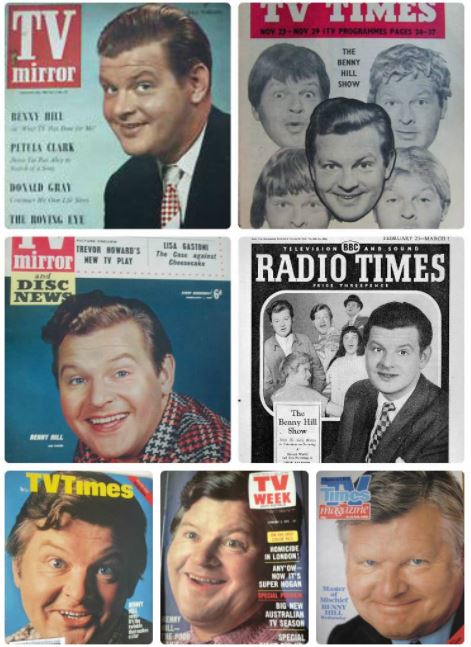
Benny Hill: A Centenarian Celebration

January 21, 2024 marks the 100th anniversary of Benny Hill's birth. Now, of course, when you do the math that means he was born January 21, 1924. His name at birth was Alfred Hill but he changed it when he got into show business and began going by the name of Benny Hill. It's long been reported that he chose that first name because it was associated with one of his comedy idols, Jack Benny. I've written numerous blog entries over the years about Benny Hill and my appreciation of his comedy and the television programs for which he starred in. This blog entry is a bit different because it happens to deal with the remembrance of his birth 100 years ago. Benny's half hour edited programs which first saw airing in the United States in 1979 have been running on Antenna TV for over a year now. The current schedule has them airing from 12:30am until 2am early Sunday morning. The programs had aired on Antenna TV in the past. When the episodes began airing on Antenna TV, originally, it marked the first time that those episodes had aired on American television since the early 1990s. The half hour, edited Benny Hill episodes had become a phenomenon in the United States through local syndication. The programs were syndicated by Don Taffner and by the early 1980s those fast paced half hour episodes were airing all over the country. The most common time of the day in which local television stations were airing the programs were in the late night time slots but mostly they aired at various times in the over-night time slots. As cable TV was starting to become more and more commonplace with 24/7 time slot offerings there needed to be something to place in those over-night time slots. Some local stations chose to air movies...other stations aired long form commercials or reruns of sitcoms...and a large number of the stations that didn't choose either of those options opted to air, instead, Benny Hill. 

Benny Hill had been entertaining British audiences on television since the mid 1950s. He was with the BBC for over a decade prior to moving on to Thames Television in 1969. The relationship with Thames TV lasted almost 20 years... from November 1969 until April 1989. I come across an article about Benny's 100th and it's so good that I decided to share a link to it in this blog entry. You can read the remembrance/celebration when you click HERE

It's a very good overview of his career.. and something that should never be forgotten is that Benny's fans have never, ever, stopped loving his style of comedy and entertainment even during the time in the mid 1980s when the British media didn't hide their feelings about his TV specials. The "suits", in other words the executives, turned their backs on Benny Hill in 1989 but the fans never did. The attacks by the British media and those within the alternative comedy scene, with most of their criticisms laced with innuendo and ignorance, played itself out in the newspapers and magazines of the day. Ironically the most well known and massively popular comic export from Europe, Benny Hill, had become toxic in his home country...yet the international market, especially the United States, continued airing the half hour programs even while the British media was on the attack. 

Benny Hill passed away in April of 1992. He had previously starred in a TV special titled Benny Hill's World Tour: New York!. The special aired on the USA Network in 1991 but it had been recorded in 1990 at his usual studio in London. The exterior shots and some other footage of Benny in New York City were taped on location here in the United States but the sketches and songs were all recorded in London. The 'World Tour' series of TV specials was meant to be a comeback for him where Benny would focus on the culture and entertainment of select cities across the globe and satirize, celebrate, or spoof the culture of those cities but unfortunately only the first special was ever recorded and aired. Among the mail found at his house on the day his body was discovered was a contract for a series of comedy specials for Central Independent Television. This contract, it's been speculated, would certainly have been for the remaining 'World Tour' series of comedy specials that never materialized due to his death. 

Benny Hill: 1924 - 1992

Tuesday, October 31, 2023

Vincent Price Remembrance...30 Years

We are 6 days removed from the sad anniversary of the October 25th death of Vincent Price. I decided to write this blog entry on Halloween Day, on purpose, because for several generations of people Vincent was synonymous with Halloween. While it's true that horror movies became increasingly gory and eye shocking as the 1980's dawned...and Vincent appeared in several of those kind of horror movies in the 1980's...the legacy of his film career is tied to the wide appeal of the style of horror film he was often cast in. The films almost always were set in historical time periods...the 15th century, 16th century, 17th century, etc. He appeared in films set in contemporary times as well but if you were to ask fans of Vincent Price to randomly select their top 10 favorite movies chances are 90 percent of those films will have been set in past centuries rather than in contemporary times. 

Vincent Price passed away on October 25, 1993...and as I've always made mention of and as countless others have made mention, his passing away during the Halloween season sounded like something straight out of a satiric horror movie script. The ironic fact of when it took place made his death even more surreal. Local television stations were still airing his Halloween/horror movie themed television commercials for Tilex mildew remover. He had been making those commercials for a number of years but since they weren't dated and it was for a product still available in stores the commercials continued airing even after the production of new commercials had ended. His horror movies were airing on late night television. 

I have my share of Vincent Price movies...almost all of them are on VHS tape. A few are on DVD. His movies are widely available online and so I've moved to video hosting sites if ever I'm wanting to see one of his movies. So many of his best known movies were based on poems and short stories from the pen of Edgar Allan Poe...and a series of those movies were directed by Roger Corman...although Vincent would continue starring in Poe-related films for other directors into the early 1970s. The official "Poe cycle" under the direction of Roger Corman included nearly every fan's favorite Vincent Price movies:

1. The Fall of the House of Usher
2. The Pit and the Pendulum
3. The Raven
4. The Masque of the Red Death
5. The Tomb of Ligeia

Now, in addition to those, there were other highly entertaining Vincent Price fan favorites: Shock, House of Wax, Dragonwyck, The Story of Mankind, House on Haunted Hill, The Tingler, Return of the Fly, Tales of Terror, Twice Told Tales, The Haunted Palace, The Comedy of Terrors, Matthew Hopkins: Witchfinder General, Cry of the Banshee, The Abominable Dr. Phibes, Dr. Phibes Rises Again, Theatre of Blood, and Madhouse. 

Vincent holds a rare distinction of appearing in two films utilizing the same title but taking on different roles in each. Vincent co-starred in the film, Tower of London, in 1939 and played the role of the Duke of Clarence. The stars of the film were Basil Rathbone and Boris Karloff...then, more than 20 years later, Roger Corman directed Vincent in a quasi-remake in 1962. In 1939 Basil Rathbone played the role of Richard III...but Vincent took the role in the 1962 release. Vincent had one of the longest careers in the entertainment industry...from his earliest supporting roles in the late 1930s to his starring roles beginning in the mid to late 1940s. He became a drive-in movie attraction, specifically in the 1960s, and throughout it all maintained a genuine appreciation for practically everything he was involved in. He had clashes with only a few co-stars and a director or two in his multi-decade career.    

Vincent Price was a one-of-a-kind performer/entertainer. He was not confined to just one style although horror films are what his lasting legacy continues to be. He had very prolific careers on the theatrical stage, on radio, and on television. In fact, Vincent has two stars on the Hollywood Walk of Fame for his Film and Television careers. In addition to his acting in the theater, on radio, in movies, and on television he also had a long time passion for the arts and did lectures on art as well as on gourmet cooking. There were several cookbooks published and he had a long time association with the East Los Angeles College where paintings that he purchased and donated to the college were put on display beginning in the early 1950s. This eventually morphed into the much larger Vincent Price Gallery and decades later it became the Vincent Price Art Museum which is operational to this day at the East Los Angeles College. In my opinion Vincent Price should also have a Star for his radio work...not only for his guest starring work in numerous dramatic anthology programs and sitcoms but also for his starring role as Simon Templar in "The Saint". Vincent portrayed the character the longest on radio...starring as Simon Templar, on and off, from 1947 until 1951. 

Sunday, September 3, 2023

Jimmy Buffett: 1946 - 2023

Now, I'll say at the start of this blog entry, I happened to be familiar with the songs of Jimmy Buffett that he and his fans dubbed 'The Big Eight'. I wasn't a dedicated fan but I was well aware of him and his music and I liked his songs. Most of the things you're going to be reading will be information I came across online throughout the process of my research for this blog entry but the wording/text is all mine. A pet peeve of mine is reading a blog and it's nothing but a copy/paste job.

In my region of the country Jimmy was treated almost like royalty. Throughout the years, as long as I can remember, he played Cincinnati, Ohio annually at the River Bend concert venue. On local news there were always heavy media reporting and interviews with fans before and after his concerts. I do not know if this kind of attention was commonplace in other areas of the country but it's something I remember happening here every year in the summer. 

If you're not familiar with his music it's long been described as escapist Island music.. tropical rock.. or gulf and western. He made a living writing and performing songs that often had the listener wishing they were there and one of the under reported aspects of his career is how he was able to achieve considerable longevity as a touring act rather than your conventional "one album a year performer". Oh, sure, he put out his share of albums but it's his concerts, in my opinion and in the opinion of others online, that will be his lasting legacy. 

It's in his concerts where he turned his recorded songs into epics and where he emotionally connected with the audience. Precious few in the music industry actually emotionally connect with an audience and he did so on such a level that it comes as no surprise, to me, the level of outpouring of feelings of sadness and sorrow that filled up social media sites all day long yesterday when the news broke. In fact, fan and music industry memorials and memories of him continue to come in from all over the world. 

Earlier I mentioned 'The Big Eight'. What were those songs? It was dubbed this because they were the most requested and most loved songs in Jimmy's career and his fans expected/wanted to hear them in every concert. In no particular order here are those songs:

1. Margaritaville
2. Fins
3. Cheeseburger in Paradise
4. Come Monday
5. Why Don't We Get Drunk
6. A Pirate Looks at Forty
7. Volcano
8. Changes in Latitudes, Changes in Attitudes

On albums and in concert he could be very unpredictable and he also had a flair for comedy and could come off like a practical joker. That was simply his personality coming through in a concert setting. His party persona and Island escapism was financially rewarding and beloved by those who actually lived on the Islands or wish they could escape to some tropical Island somewhere. In the image below, the album cover of his 1988 release, Hot Water, we see him acting out the album's title. The water being hot it's caused the shark to jump out. The hand signal above his head represents a fin...and if you're familiar with his concert performances of the song, "Fins", he did that gesture several times throughout the song. To clarify, though, "Fins" isn't on that 1988 album. That song came out in 1979.


Historians report he sold millions of albums based almost entirely on the strength of his personal appearances and concert tours rather than through the traditional method of radio airplay and in the modern era the practice of well placed ads on social media websites. 

Something I read online yesterday is one of his albums, titled License to Chill, hit number one on the Country Album chart in 2004...becoming the first chart topping album of his career...followed by another Country Album number one in 2006 titled Take the Weather With You. He would  hit number one on the Country Album chart a third time in 2020 with an album titled Life on the Flip Side. The License to Chill album also hit number on the Pop Album chart...marking the only number one album of his career (to date) on the pop chart. 

His flair for humor was not only visible in some of his songs and concert patter but quite a few of his albums had pun titles. A couple of examples being an album he issued in 1973 titled A White Sport Coat and a Pink Crustacean. The album title was a pun/parody of the Marty Robbins song "A White Sport Coat and a Pink Carnation". Later on, in 1985, he released an album called Last Mango in Paris, the title derived from the movie Last Tango in Paris. It reached the Top-10 on the Country Album chart. Havana Daydreamin', released in 1976, was a pun on the phrase 'having a daydream'. The previously mentioned License to Chill was a pun on the phrase 'license to kill' which was also the name of a James Bond movie years before the album was released. 


One of the most revealing aspects of his albums is that quite a few of them performed much better with country music audiences in spite of the fact that people who worked in country radio didn't necessarily embrace him as a 'country' artist. Albums he released in the 1970's charted higher country than pop. In the 1980's 6 of his albums reached Top-40 status and 4 of the 6 were Top-40 with country audiences. Ironically, the role was reversed with his single releases. His single releases charted the most frequently on the pop chart (Hot 100) but he did have a handful of country music entries, too.

Now, everybody and their parrot has shared audio of 'The Big Eight' throughout Saturday and into the early morning hours of Sunday and rightfully so, those were indeed his biggest and best-known recordings outside his fan base, but instead of being another in a million miles long list of bloggers that'll share those particular audio tracks I instead have picked out this bouncy, comical song called "Pencil Thin Mustache". How many songs do you know that reference Errol Flynn, Desi Arnaz/Ricky Ricardo, and Andy Devine of all people!? It's from the 1974 album Living and Dying in 3/4 Time. On the photo that accompanied some of the single releases you can't help but notice his thick mustache as you hear him singing of wishing he had a "Pencil Thin Mustache". 

Saturday, September 2, 2023

Bob Barker: 1923 - 2023

You'd had to have been living under a rock to not have heard of the recent death of Bob Barker at age 99 on August 26th. Born on December 12, 1923 he was several months shy of reaching the 100 milestone.

1923 - 2023

When I was a kid, literally, when I was in Kindergarten is when I say that was the first time I'd heard of Bob Barker. When I was in Kindergarten we had what they called AM and PM Kindergarten. I went to PM which began around 12:30pm. It was the early 1980s and I walked to school myself. Anyway, why I'm saying all of that, is I watched "Price is Right" every week day at 11am before having to leave for school. I'd watch often during summer break from school and for the rest of my school life, of course, the only time I'd get to see the game show or ANY weekday daytime programming happened to be during summer break from school. As a kid I developed a fondness for some of the pricing games that were played. I'm sure like most other people that loved the show we couldn't wait to see if one of those games would be on an episode. My favorites were Plinko, Cliff Hangers, Hole in One, Any Number, Safe Crackers...and the game where you punch your fist into a plastic covering to reveal a piece of paper with a dollar amount. I was always forgetting it's title.. Punch a Bunch? Then there was One Away where the contestant would have to say "Do I have at least one number right?" and you'd hear a car horn or not. There were so many games that were favorites but the one everybody loves is Plinko. 

Bob Barker became the host of "Price is Right" while being the host of "Truth or Consequences". He had been the host of the latter game show since December 31, 1957. Bob became the host of "The Price is Right" on September 4, 1972. It was a Mark Goodson-Bill Todman Production. It was a revamped version of the original hosted by Bill Cullen (1956-1965). The revamp originally aired half an hour but it was expanded to it's familiar hour long format several years later due to the unprecedented ratings it was receiving. When it expanded to an hour in 1975 it introduced the concept of the Showcase Showdown. This segment featured the use of a large spinning wheel with money amounts up to $1.00 and whichever contestant got closest to a $1.00 without going over would appear in the showcase near the end of the show. There were two showdown segments per show to determine who appeared in the final segment. The game made catchphrases out the simplest sayings. Bob, after hearing all the bids in contestants row for an item, would pull out a card from his envelope and say one of the catchphrases: "Actual retail price...". Whichever bid was closest to the actual retail price without going over won the item and then got to come up on stage and play a pricing game. "Without going over" was another catchphrase of the show. Another phrase happened to be Bob's sign-off "help control the pet population. Have your pets spayed or neutered". Now, although those were iconic catchphrases attached to the show, the one that tops them is "Come on Down!!!". That phrase is heard by the announcer after calling a contestant's name from the audience. 

Bob's run on "Truth or Consequences" was 19 years (1957-1975). That series was created and previously hosted by Ralph Edwards. When "Price is Right" returned in 1972, as you could guess, millions of people were so used to seeing him on the other show that it took some viewers a little getting used to seeing Bob hosting pricing games instead of presiding over wild stunts. As a child of the '80s I was familiar, of course, with "Price is Right". Once I saw episodes of the other game show I was tickled to see him in a different setting even though it was the same guy. 

Bob was also familiar to viewers of beauty pageants and bake-off's...hosting nationally aired beauty contests (Miss USA), parades, and bake-off's for about as long as he hosted game shows. 

In addition to everything else he also became known all over the world for his animal rights advocacy and in a more light-hearted recognition was his cameo appearance in Adam Sandler's movie, Happy Gilmore, and the hysterical scene on the golf course. 

Bob and "Price is Right" became an institution. He hosted the show for 35 years (1972-2007) and it completely overshadowed and towered over the 19 years he hosted "Truth or Consequences" (1957-1975) but it didn't matter which game show you enjoyed the most or the least... it was Bob Barker presiding over it all... and that's who we're remembering. 

Monday, January 16, 2023

Remembering Jerry Clower once again...

Nearly 10 years ago (February 2013) I wrote a blog entry about the late entertainer, Jerry Clower. You can read that blog entry when you click this LINK. In that blog entry I provided some detail about his life and career in addition to remarking that I have a copy of all of his albums in one format or another (vinyl, cassette, CD). 

Earlier today I purchased three books that he wrote...yes, you read that correctly...he was an author/co-author of several entertaining books. The books featured his commentary and recollection of his past, partial copies of some of the humorous expressions/catchphrases from his comedy stories, and how life in America dramatically changed...some for the good but some aspects of progress changed the country in a negative way. His religious convictions were interwoven into his comedy stories and can be found in each of his books...particularly the first one. The books with Jerry Clower's name as author/co-author are:

1. Ain't God Good? (1975)
2. Let The Hammer Down! (1978)
3. Life EverLaughter (1987)
4. Stories from Home (1993) 

The first book was a massive success and sold so strong that it had at least 3 reprintings...and it inspired a documentary. Jerry Clower recorded all of his comedy albums for MCA Records...except for one...a 1977 release on Word Records (a religious imprint) titled Ain't God Good?. The album was a follow-up to the 1976 documentary and the 1975 book. In addition to comedy records Jerry was also a consistent presence on syndicated radio and television programs...and local/regional television commercials. As an entertainer he toured all over the South and Midwest heavily. In a separate career he was indeed a major radio and television personality. On radio he was a co-host on the Country Crossroads program...a syndicated radio series with a religious overtone created by Bill Mack. In fact, Bill Mack hosted the series solo in it's early years. Jerry Clower and Leroy Van Dyke came on board as co-hosts and interviewers. Jerry's debut on the series happened in 1973...and he stayed with the program for several decades. In addition to the local/regional TV and radio commercials he also found time to co-host the syndicated country music television show, Nashville on the Road. He co-hosted this travel show with Jim Ed Brown for 6 seasons, 1975-1981. Jerry Clower was a member of the Grand Ole Opry from 1973 until the year he passed away in 1998. He recorded a 1978 album on the stage of the Opry. The publishers/editors and readers of various country music magazines awarded him Country Comic of the Year throughout the 1970s and into the early 1980s. 


He always remarked that he backed into show business...that he would have been perfectly content making a living working for the Mississippi Chemical Corporation...had it not been for some of his sales pitches for the chemical been recorded and sent to radio stations and record companies. He inserted comical stories into his sales pitches and recordings of those stories began surfacing...and eventually one thing led to another. Ralph Emery played Jerry's comical story of racoon hunting and, as Jerry Clower often recalled, that one airplay turned this chemical/fertilizer salesman into a stand-up country comic seemingly overnight. Born in 1926 as Howard Gerald Clower, the nickname Jerry was derived from his middle name, he was 44 going on 45 when Decca Records came calling on his services...or "how I backed into show business" as he would say.  

Lemon Records issued a comedy album on Jerry in 1971...and this was picked up by the much larger Decca company (eventually retitled MCA). From 1971 until 1978 Jerry released one comedy album per year. Following a 1979 Greatest Hits release he launched another string of releases in which one comedy album per year was released from 1980 until 1995. I was never able to find out why but he didn't release a comedy album in 1996 but what turned out to be his final comedy album shown up in 1998...released after he passed away. It was an album recorded, mostly, in Clanton, Alabama. 

Here's the Jerry Clower album discography. I don't include any of the greatest hits compilations to surface after 1998. Charlie Douglas introduces Jerry on the 1975 album. Charlie, at the time, was a fixture of WWL radio before moving to WSM radio. Ralph Emery does the introduction on the 1986 album...recorded in McEwen, Tennessee on 'Ralph Emery Day'. I include the 1979 release because it's a Gold selling album as are his first two albums. His 1988 album is a live album from Ocilla, Georgia where the selections are newly recorded performances of some of his previously told stories. The 1994 album commemorates Jerry's military service and features a photo of him from 1944 in his Navy uniform. He served in the Navy during WWII (1944 to 1946) and received multiple service medals including an Asiatic-Pacific Campaign Medal. 

In 2010, more than a decade after he passed away, he was included in a list of dozens of other Mississippi-born performers to receive a historical marker. His marker was unveiled in 2011 in Liberty, Mississippi (his birthplace). 

Howard Gerald "Jerry" Clower
September 28, 1926 - August 24, 1998  

1971: From Yazoo City, Mississippi Talkin'**
1972: Mouth of Mississippi**
1973: Clower Power
1974: Country Ham
1975: Live In Picayune
1976: The Ambassador of Goodwill
1977: On the Road
1977: Ain't God Good? (Word Records; religious testimony)
1978: Live from the Stage of the Grand Ole Opry
1979: Greatest Hits**
1980: Ledbetter Olympics
1981: More Good 'Uns
1982: Dogs I Have Known
1983: Live at Cleburne, Texas
1984: Starke Raving!
1985: An Officer and a Ledbetter
1986: Runaway Truck
1987: Top Gum
1988: Classic Clower (a live album in which Jerry re-tells some of his classic stories)
1989: Let There Be Light!
1990: The Mouth of the Mighty Mississip' (this was his 20th album on MCA)
1991: Racoonteur
1992: Sidewinder
1993: Stories Told Funny
1994: Jerry Joins the Navy
1995: Fish 'n Frogs, Hawgs 'n Dawgs
1997: Live at Dollywood
1998: Peaches and Possums (this was his the last album he recorded) 

Tuesday, October 4, 2022

Loretta Lynn: 1932-2022

I just woke up about 20 minutes ago (I work nights) and I went to a news feed on my home page and seen the news that country music icon, Loretta Lynn, passed away earlier this morning at the age of 90. I first knew of Loretta, by face, before I knew her name. She used to do television commercials for Crisco. As a little kid I'd see those commercials...sometimes there would be a guy in them that I later found out was her husband...but at the time I didn't pay much attention to screen detail so if her name appeared on the screen identifying her I didn't notice. I only noticed her and the overall commercial for Crisco and how she reminded me of some of my relatives with her mannerisms and the way she spoke. She'd end the commercials with a catchphrase, too. 

As I got older I began to learn more and more about country music...Loretta, in addition to the Crisco commercials, would pop up on Hee Haw frequently. There are, and will be, numerous new websites and blogs that will show up on the internet beginning today that will detail Loretta's life and career. In an effort to not look like a carbon copy of all of those memorial sites, I'm inserting my own thoughts/opinions, in addition to looking back at her career, as a way to come off different. The thing to know about Loretta, if you're familiar with her career at all, is how she kept the roots of her origins alive within the songs she either wrote or recorded. Her earlier successes in the 1960s, prior to her major breakthrough, are all tied into an association with The Wilburn Brothers. She was part of their touring ensemble (1960-1968) and a cast-member of their long running syndicated television series, 1963-1971. 

Loretta made a name for herself by the mid 1960s...she'd been releasing singles since 1960. "I'm a Honky Tonk Girl" reached the Top-20 in 1960. She signed to Decca in 1961...teaming up with record producer Owen Bradley for the first time. This artist-producer relationship would last nearly 20 years. Loretta's first Top-10 hit soon followed...a single called "Success". The song had been recorded by Loretta in the fall of 1961 but wasn't released as a single until the spring of 1962. Loretta had a couple more Top-10 hits ("Before I'm Over You" and "Wine, Women, and Song") before teaming up with Ernest Tubb for the first time in 1964. Their first duet recording, "Mr. and Mrs. Used to Be", was a major hit which spawned a duet album in 1965. In addition to the The Wilburn Brothers it was Ernest Tubb that also played a major, major role in Loretta's eventual launch into super-stardom. "Blue Kentucky Girl" hit right around the time of her duet with Ernest Tubb, "Our Hears Are Holding Hands". That song was written by Bill Anderson. "Blue Kentucky Girl" became Loretta's first signature song after it became a hit in the summer of 1965. 

Loretta was on her way to becoming a country music super-star everything was set in motion, in hindsight, in early 1966. She released a topical single in January called "Dear Uncle Sam". She wrote the song and it's about a woman's thoughts when it come to watching her husband have to go off to war. It reached the Top-10 but it was her next single, "You Ain't Woman Enough", that introduced an assertive side to Loretta's songs. This song is about a woman (Loretta) confronting the other woman in her husband's life. The song spawned a self-titled album which reached number one on the Country Album chart. It was Loretta's first number one album on Billboard's Country Albums chart. In November 1966 came the song, "Don't Come Home a Drinkin'". This song, and it's immediate predecessor, began to establish Loretta as a sort of feminist icon of the era. Women singers of all music formats had never had much success with the types of songs Loretta was writing and that Owen Bradley was finding for her. Loretta's solo recordings from this point onward became massive hits...and she continued a duet partnership with Ernest Tubb for the remainder of the decade. Some of her iconic country music hits in the late '60s included "Fist City", "Your Squaw is on the Warpath", "You've Just Stepped in From Stepping Out on Me", and in this era of feminist anthems Loretta issued "Woman of the World Leave My World Alone" which hit number one. A few months later she and Ernest Tubb issued a comical duet, "Who's Gonna Take the Garbage Out", and it's reached the Top-20.

In the 1970's Loretta Lynn was the super-star of country music female artists...with two close rivals during most of that decade being Tammy Wynette and Dolly Parton. In 1970, her third single release, happened to be an autobiographical song called "Coal Miner's Daughter". This recording became her new signature song and her lifetime anthem. It also became her professional nickname...introduced as "The Coal Miner's Daughter, Loretta Lynn!!" in a lot of her TV appearances. The song would inspire an Oscar winning movie. In 1971 she teamed up with Conway Twitty and the two of them became a powerful duet for the next 10 years. The duo was often referred to as 'Conway and Loretta' and they enjoyed dozens of hits together as well as several duet awards from the CMA, ACM, and the Music City News organization. As a duo she and Conway had 12 Top-10 hits during a 10 year period (1971-1981) ...6 of those singles reaching number one including "After the Fire is Gone", which won a Grammy; "Louisiana Woman, Mississippi Man", and "As Soon as I Hang Up the Phone". Her solo recordings were also hitting the Top-10 with regularity. "You're Lookin' At Country", "One's on the Way", "Love is the Foundation" were massive hits...and she had a pair of controversial hits (at the time) called "Rated X" and "The Pill". In 1977 she had what turned out to be her final number one, "Out of My Head and Back in My Bed". She would continue reaching the Top-10 the rest of the decade. She had her final Top-10 hit with "I Lie" in 1982. The previous year she and Conway had their final Top-10 hits as a duo: "I Still Believe in Waltzes" and "Lovin' What Your Lovin' Does to Me". 

In 1979 Loretta began appearing in television commercials for Crisco...and this is where I first knew of her. As a child of the 1980s I'd see her grace the TV screen advertising Crisco, appearing on Hee Haw, and showing up on other country music programs. She did commercials for Crisco for practically the entire 1980s decade. Her touring never decreased. She became a member of the Grand Ole Opry in 1962 and she remained a member until today. Once an Opry member passes away they're no longer a member of the organization. She joined the Opry roster in September 1962...and so she was a member for a full 60 years. Loretta's career and her impact in country music and on the people she knew and the fans of country music was enormous. She was one of the last surviving members of country music royalty in my opinion. There aren't too many left. 

Monday, August 8, 2022

Vin Scully: 1927-2022

It's been several days since the news broke on the death of legendary broadcaster Vin Scully at age 94. He was born Vincent Edward Scully on November 19, 1927 in the Bronx, New York. Now, unless you do not like the game of baseball or simply don't pay much attention to broadcasters, Vin Scully's voice was an iconic symbol of broadcasting...and he set a record for play-by-play baseball broadcasting with his 67 seasons with the Dodgers baseball team. The team was in Brooklyn, New York at the time of Vin's hiring in 1950. He moved West with the team when they settled in Los Angeles. He was a play-by-play broadcaster for the Dodgers from 1950 until his retirement in 2016, his 67th season. 

This is one of the later photos of Vin Scully taken at the ballpark. He worked with several broadcasters over his many decades. One of the longest lasting pairings happened to be with Jerry Doggett for 32 seasons (1956-1987) but there was also Ross Porter (1977-2004), Don Drysdale (1987-1993), and Rick Monday (1993 until Vin's retirement). The pairings weren't formatted as a bantering duo like the type of commentary you hear on sports broadcasts today...Vin called the baseball innings solo, split with whoever happened to be his on-air partner, and the on-air partner called his innings solo, too...there wasn't any conversation going on between Vin and whichever broadcaster was sharing the play-by-play duties. In other words Vin, Jerry Doggett, Ross Porter, or Rick Monday worked solo as broadcasters and didn't utilize a color commentator/analyst. I happen to live in the Midwest and so I wasn't born into a West Coast sports culture...and I didn't know of Vin Scully until I got older (around my middle teenage years). I grew up on the baseball broadcasting team of Marty Brennaman and Joe Nuxhall with the Cincinnati Reds. I'd heard Marty talk about Vin Scully's talents a lot during Reds games and Marty often cited Vin Scully and Red Barber as major influences. Marty was play-by-play broadcaster for Cincinnati Reds games for 46 seasons (1974-2019).  

Vin's broadcasting career wasn't limited to Dodgers baseball, though. Even though he was part of the organization for 67 seasons he expanded his reach and stepped into national broadcasting in by the mid 1970s. Vin worked for CBS Sports from 1975 until 1982. In his assignments from CBS he was most often placed inside the broadcasting booth for NFL games...rather than Major League Baseball games. It's with CBS that Vin branched out into NFL play-by-play and he also had assignments covering PGA Tour Golf, the Masters Golf Tournament, and Tennis games. His Golf assignments had him broadcasting the Skins Game for NBC (1983-1989) and then for ABC (1991-1996) as well as the Senior Skins Game on ABC (1992-2000). Vin's on-air partner for PGA Tour golf at NBC (1983-1990) was Lee Trevino. Vin also did Golf broadcasts for TBS. 

Like Curt Gowdy and Dick Enberg, Vin was now becoming nationally known as a multi-sportscaster...going beyond the local radio and television markets that covered Dodgers baseball. However, Vin's NFL play-by-play career was short lived by comparison to his baseball broadcasting. Vin called his final NFL game in January 1982...it was the NFC Championship Game. In his NFL broadcasting career at CBS he was paired with a wide array of broadcast partners during his 7 years with the network. Some of them happened to be: Hank Stram, Alex Hawkins, Jim Brown, Paul Hornung, and a relative newcomer to the NFL booth, John Madden. 

While Vin did a lot of NFL games for CBS Television he wasn't completely kept out of baseball broadcasting. He did All-Star Game broadcasts for CBS Radio every year from 1977 until 1982. His on-air partner, according to research, was Brent Musburger. Vin also called the World Series games for CBS Radio, along side Sparky Anderson, from 1979 until 1982. 

Vin moved to NBC Sports beginning in 1983 and was hired to do the play-by-play of the network's Game of the Week. This nationally televised baseball game aired every Saturday on NBC stations. He was with NBC Sports until 1989. In that 6 year time period (1983-1989) he not only called the Game of the Week broadcasts but he also was the lead play-by-play broadcaster for NBC's World Series coverage (1984, 1986, and 1988); The NLCS (1983, 1985, 1987, and 1989); and the All-Star Game (1983, 1985, 1987, and 1989). His on-air partner for the national NBC baseball games was Joe Garagiola.  

A remarkable broadcasting feat arrived in June 1989 where Vin pulled off an unheard of accomplishment...calling a combined 23 innings of baseball in two different cities...in one day's time. He called a 10 inning game in St. Louis for the NBC Game of the Week...and later that day flew into Houston and ended up relieving the Dodgers broadcasters who themselves were beginning an extra inning game just as he chose to visit the Astrodome instead of going to his hotel room. That Dodgers game against the Astros went 22 innings...and Vin broadcast the final 13 innings...which gave him the unusual accomplishment of calling 23 innings of a baseball game in two different cities on the same day. Joe Buck, decades later, did something similar when he broadcast an NFL game for FOX in the afternoon and then went across town to do the national baseball Game of the Week for FOX that evening...however, Vin's accomplishment has much more awesome flavor to it because he flew from St. Louis after calling a 10 inning baseball game and arrived in Houston and called the final 13 innings of a 22 inning game.

Vin left the NBC baseball booth at the conclusion of the 1989 season and departed NBC Sports altogether in 1990. From 1990 until 1997, in addition to his Dodgers broadcasts, he'd returned to CBS Sports and called the World Series games for CBS radio until 1997. His broadcast partners were Johnny Bench (1990 through 1993) and Jeff Torborg (1995 through 1997). There wasn't a World Series in 1994 due to a player's strike. 

In 1982 Vin Scully was elected to the National Baseball Hall of Fame in Cooperstown, New York. He was inducted into the National Radio Hall of Fame in 1995. He won numerous broadcaster awards from local organizations all over California...including 33 awards as California Sportscaster of the Year.   

Vin Scully retired at the conclusion of the 2016 baseball season. His 67th season as the play-by-play broadcaster for the Dodgers. He kept an intentional low profile in retirement. He and fellow play-by-play broadcaster, Dick Enberg, both retired in 2016. The two iconic broadcasters had reached similar heights in their profession...each became noted as multi-sportscasters on a national level and each had long-held ties to Major League Baseball, particularly on the West Coast. Dick Enberg spent a decade as the voice of Major League Baseball's California Angels, the NFL's Los Angeles Rams, the UCLA Bruins...and then he become a national broadcaster known more for the NFL and College Basketball and College Football. After Dick Enberg retired from national broadcasting he remained the voice of the San Diego Padres baseball team (2010-2016). He and Vin Scully appeared together in October 2016. Dick Enberg had announced his retirement from broadcasting in 2016 followed soon after by Vin Scully's announcement of his own retirement. Dick Enberg would pass away on December 21, 2017...and Vin Scully passed away on August 2, 2022. 

In 2016, when Dick Enberg announced his upcoming retirement, Vin Scully taped this message...this shows you the kind of character and modest man Vin Scully happened to be...


Here is the footage of Vin Scully and Dick Enberg from October 2016 in the final weeks of their broadcasting careers. The two had made their retirement announcements public by this time.


Here is Rick Monday's announcement, during a Dodgers game, breaking the news of Vin Scully passing away...and I felt this would be a fitting video embed to close this overview of Vin Scully's broadcasting career...

Saturday, May 7, 2022

Mickey Gilley: 1936 - 2022

1936 - 2022
The news was released within the last hour that the country music community has lost another legendary figure. Mickey Gilley passed away today at the age of 86. March 9, 1936 - May 7, 2022. I like his singing and if I knew he was going to be on a TV show I'd always watch his performance. I saw him in concert only one time. He appeared at the Clark County Fair in 1990. My grandparent's and I went to the Fair and we sat next to a long-time fan of Mickey's who told us a lot of information about his career as well as her favorite songs. We were familiar with Mickey's songs but the more dedicated of fan told us a lot more about him. My grandparent's were aware that Mickey was a cousin of Jerry Lee Lewis and Jimmy Swaggart. I had no idea about it, at the time, until the fan told us. I recall that Mickey sang practically all of the songs of his that I was familiar with. "Paradise Tonight", the duet he did with Charly McClain, was performed with one of Mickey's harmony singers. I don't want to definitively say that he closed the show with "Don't The Girls All Get Prettier at Closing Time" but I think he did. He did a lot of boogie-woogie piano solo's in between the songs. The photo that I chose to include in this blog post shows Mickey Gilley in what a general audience might remember. Mickey had a successful string of country music hits throughout the 1970s, including several number one hits, but the Urban Cowboy movie shot his career into the pop music mainstream. The movie was mostly set inside Mickey's huge bar, Gilley's, in Pasadena, Texas. Mickey appeared in the movie and contributed songs to the movie's soundtrack. Johnny Lee, a frequent performer at Gilley's, was catapulted to stardom in 1980 as a result of his participation in the Urban Cowboy soundtrack with "Lookin' For Love" and "Cherokee Fiddle". The soundtrack included a 1978 hit from Mickey titled "Here Comes the Hurt Again" and a new recording, "Stand By Me". 

Mickey's rendition of that particular song (a previous pop/rhythm and blues hit for Ben E. King) become his biggest cross-over hit. In addition to hitting the top of the country chart in 1980 it reached the Top-30 on the pop driven Hot 100 and the Top-10 on the Adult-Contemporary chart. In fact, four of Mickey's single releases appeared on Billboard's Hot 100 pop chart. After "Stand By Me", his second highest charting Hot 100 pop single is his rendition of "You Don't Know Me", which hit number one on the country chart in 1981 and reached the Top-20 on the Adult-Contemporary chart as well. Mickey had 6 consecutive number one country hits on the Billboard country chart during the 1980-1981 time frame. His first single release of the decade, in 1980, was "True Love Ways" and he followed that chart-topper with 5 more. The single that broke the string, "Tears of the Lonely" peaked in the Top-5 here in America but it did reach number one on Canada's country music chart. Mickey would have three additional number one country hits on Billboard taking us through the second half of 1982 and into 1983: "Put Your Dreams Away", "Talk To Me", and "Fool For Your Love". The latter being his final solo single to reach number one on Billboard's U.S. country music chart, with his duet with Charly McClain in the late summer of 1983, "Paradise Tonight", becoming his final chart-topper on Billboard's U.S. country music chart. "You've Really Got a Hold on Me" and "Too Good To Stop Now" hit number one for Mickey in Canada in 1984. Mickey's final Top-10 hits arrived in 1985 and 1986...with the nostalgic "Doo Wah Days" becoming the final Top-10 of his career. He had a Top-20 country hit in 1987 with "Full Grown Fool" and a Top-30 country hit in 1988 with "She Reminded Me of You". 

Epic Records, in 1980, released this compilation album on Mickey titled Encore. The Encore series of albums were label-wide...all recording artists signed to Columbia's various record labels had an album titled Encore released on them. The Encore album they released on Mickey, as you can see, heavily promoted his night-club without using it's name on the front of the album. On the back of the album Mickey is surrounded by mostly cowboy hat wearing girls. A couple of them are wearing tops that state: "I rode the bull at Gilley's". The bull, of course, is the mechanical bull...shown prominently on the front of the album. The mechanical bull became a staple in all kinds of country-oriented bar room's and night clubs attempting to emulate the ambience of Gilley's place. It was called the world's largest Honky-Tonk. Mickey co-owned the club with Sherwood Cryer. The club opened in 1971 and once Urban Cowboy hit theaters and became a massive box-office hit Gilley's night club in Pasadena, Texas became a super destination for locals and out of State tourists. The club branched out into television and radio productions...numerous country music singers stopped by and recorded concert performances for a local radio series tied to the nightclub and there was also a television program that originated from Gilley's for awhile. Gilley's became part of most tour stops for Country and Adult-Contemporary performers. The night-club burned to the ground in 1989 leaving some music critics and historians to point out that a night-club so synonymous with 1980's country music should happen to burn to the ground at the close of the decade. 

Mickey, following this period of his career, moved on and opened up a theater in Branson, Missouri...and he remained a fixture in Branson for the next several decades. An accident while helping move furniture in 2009 impacted his performing career and he spent a year or more recovering and in physical therapy. The accident left him paralyzed and although he did the rehab and physical therapy there were lingering effects for the rest of his life. In January 2018 Mickey and his son were involved in a car accident while traveling from Texas to Missouri. They never made it out of Texas, though, and neither were seriously injured. Mickey and Johnny Lee, during this point in time, had been on something of a national reunion tour with an Urban Cowboy theme. The movie, in 2015, turned 35 and by 2020, of course, it hit 40. The two had performed an extended reunion series of shows at Mickey's Branson theater for the last several years. The news of Mickey passing away today at the age of 86 seems surreal. He released numerous singles...and among my many, many favorite Mickey Gilley recordings is the cleverly titled "The Power of Positive Drinking". It was a Top-10 hit for him but it wasn't one of his signature songs and so it's sort of fallen into obscurity. I saw him sing it on an episode of Hee Haw and it became an instant favorite...

Monday, April 18, 2022

Benny Hill: Going Back to April 20th 1992...

I was going to begin this blog entry with a familiar greeting by Fred Scuttle, one of Benny Hill's famous characters, but I don't know if the phrase is copyrighted or not. We're a few days away from April 20, 1992...a sad day for millions of Benny Hill fans around the world. It was on that day Benny Hill passed away. Those who knew him personally may have expected it...but in the years since a lot of us fans have become aware of Benny's final weeks. There's been a lot of essays and commentary about his death in the last 30 years...and I'd say there's been a heavy dose of commentary circulating about him within the last 10 years. The video hosting site, YouTube, came along in 2005 and within 5 years video content from around the world had been accessed tens of millions of times, combined. Benny Hill videos...specifically his comedy sketches, comedy monologues, and Hill's Angels features...gained an entirely new audience. There had been a market established for Benny's comedy on VHS tape and on DVD...but with YouTube it enabled the content from those VHS and DVD releases as well as full episodes of his hour long television specials to be readily available. All a person needed to do is simply type in Benny's name in a YouTube search box and the results are nearly endless. Benny was chased off of television in 1989...after 20 years at Thames TV. Prior to his association with Thames he worked at the BBC. His television specials at the BBC were titled The Benny Hill Show. Highlights from his BBC programs have been issued on VHS and DVD...they're in black and white and can be accessed online. In the BBC episodes some of his supporting players were usually Jeremy Hawk, Patricia Hayes, and Rita Lloyd. 

It's been reported that his first performance to a mass audience was on a radio series, Variety Bandbox, in 1947. Benny made his television debut in 1950. He appeared regularly on the BBC airwaves throughout the 1950s and 1960s. In 1956 he starred in the comedy movie, "Who Done It?". He had a radio series, Benny Hill Time, for 2 years (1964-1966) and 26 episodes in total. He headlined a couple of television specials for ITV and ATV during his long association with the BBC but the most significant change happened in 1969 when he joined Thames Television. It's with this company that Benny became an international comedy star. His hour long television specials would be sprinkled throughout a calendar year...in most years he would deliver 3 or 4 one hour specials. His television specials became events and much anticipated. His supporting cast in the first decade of the Thames specials were Henry McGee, Bob Todd, Jackie Wright, and some faces familiar from his BBC years like Patricia Hayes and Rita Lloyd. In 1979 the syndicator, Don Taffner, brought Benny Hill to American television screens...and from America to television screens all over the world. Taffner conceived the idea of selling half hour installments of Benny's comedy to local television stations across America. An editing team carefully pieced together numerous half hour episodes using the footage from Benny's hour long television specials for Thames TV.

These half hour episodes aired practically all over the world in late-night time slots or in pre-dawn, early morning time slots. Benny also added a collection of female dancers to his show around this same time and he called them Hill's Angels. The dancers also doubled as comedic foils for Benny. As the 1980's progressed and the edited half hour Benny Hill programs were spiking local television ratings, becoming increasingly popular in various non-English speaking territories (thanks to a lot of pantomime sketches), the comics in his own homeland were on the verbal attack...and by 1989 with mounting pressures from British comics, critics, and feminist groups (collectively a very loud minority of people), Thames TV canceled the Benny Hill television specials. The last television special aired on May 1, 1989. The half hour episodes were still airing around the world...including America. 


Due in large part to the success that the half hour shows were still having in America the syndicator, Don Taffner, asked Benny if he would do another television special and that he'd handle the distribution. They hit on a concept called Benny Hill's World Tour. The television specials would spotlight a different major city/town in nearly every country on the planet. The first, in this proposed World Tour series of specials, spotlighted New York City. The USA Network bought the broadcast rights and Benny Hill's World Tour: New York! hit the airwaves on May 30, 1991. It was his first comedy special since 1989. Unfortunately, Benny's health began to decline as the year went on...in February 1992 he suffered a mild heart attack. He declined further medical treatment (a bypass) and experienced kidney failure and he passed away on April 20, 1992. His body was discovered by his long-time television producer, Dennis Kirkland, several days later. Several people had called Benny's house and there were no answers for several days. The lack of reply caused great concern, obviously, and with the help of the police Dennis Kirkland was able to get inside Benny's locked house where they found him sitting in front of the television in his favorite chair, non-responsive. 

The memorials and outpouring of grief was almost immediate once the news broke. It was revealed that among the mail in Benny's living room was a contract awaiting his signature...a contract for a series of new television specials for Central Independent Television. Apparently, and I'm just guessing, but this was the company Benny would've worked for on the World Tour series of television specials...with syndication rights perhaps held by Don Taffner. Nobody outside of a few has ever seen the actual unsigned contract so any number of us over the decades have made wild speculations as to what it may have contained. Benny Hill reruns have been scarce on television since the early 1990s. In the last 20 plus years BBC America and Antenna TV have aired variations of Benny's show. BBC America aired edited hour long episodes whereas Antenna TV in 2011, and added again to the line-up this year, air edited copies of the half hour edited programs. Antenna TV has been airing the half hour episodes in program blocks from 12am to 2am early Sunday morning. So, as I mentioned earlier, Benny Hill is always going to be there...ready to be discovered by successive generations of people. 

Tuesday, April 5, 2022

C.W. McCall: 1928 - 2022

A few months ago news was released that C.W. McCall had been placed under the care of hospice. The news was abrupt and matter of fact without too much information given as to the reason why. Then, out of the blue, news surfaced that C.W. had passed away on April 1st at the age of 93 from cancer. He was born Billie Fries, according to most websites, and later legally changed his name to William Fries, Jr.. He was born November 15, 1928 in Audobon, Iowa. He had a career in the advertising business when he created the character, C.W. McCall. He didn't portray the character in the television commercials but the product, Old Home Bread, became something of a major sales hit in the Omaha, Nebraska area in 1973. The commercial won a Clio Award, which is the Oscar of the advertising world, in 1974. The commercials spawned professionally recorded songs with emphasis on the sights and culture of the Plains States (Nebraska, Iowa, Colorado). Bill Fries became C.W. McCall on recordings. He wrote the lyrics to his recordings while Chip Davis wrote the music. His first single release, "Old Home Filler Up and a Keep on a Truckin' Cafe", was a direct tie-in with Old Home bread and it became a Top-20 country music hit and landed on the Hot 100 pop chart as well. "Wolf Creek Pass" was his second single and it, too, reached the Top-20 on the country music chart and reached Top-40 status on the Hot 100 pop chart. In 1975 "Classified" reached the country Top-20 followed by the chart hit, "Black Bear Road". 

His style was narration...meaning that he didn't sing too much on his single releases. He wasn't sad in his recitations like Red Sovine famously happened to be but given the narration approach and the mostly up-tempo, rollicking music arrangements it gave McCall a style and sound that set him apart. The massive hit single in his career came along later on in 1975... the iconic "Convoy". This recording was massively popular...a monster hit...a million selling country and pop hit. It was officially released in November of 1975 and it, as I said, was a monster hit. 

It reached Number One on the country and pop charts here in America. It was number one for 6 weeks on the country chart. It hit number one on the pop chart in Canada early in 1976 and the Top-10 on their country chart. It also hit number one in Australia and New Zealand. The single popularized the C.B. fad that swept the entire country and Canada. The recording cemented C.W. McCall's long-lasting popularity as a 'truck driver singer'. There are many compilation albums filled with songs specializing in the truck driving industry...and there's almost always inclusion of "Convoy" or several other singles from his career. The single, being incredibly popular and spearheading a national fad, ultimately had it's share of detractors/critics. The critics were definitely in the minority opinion, however. 

Now, as it turned out, 1976 turned out to be the peak year for C.W. McCall's recording career. There wouldn't be another recording by him that would match the phenomenal popularity of "Convoy" but he continued recording and releasing singles. He would have several chart hits during the remainder of the decade but nothing else reached the charts as the new decade began. Some of those latter day recordings that hit happened to be "There Won't Be No Country Music", a country Top-20. "Crispy Critters", "Four Wheel Cowboy", and "Round the World with the Rubber Duck" all reached the country charts in 1976. 

In 1977 he issued a couple of recordings...first up is "Audubon", a recording about his hometown in Iowa which serves as something of a prequel to his first single release. It's mid-tempo and highly entertaining...he mentions Mavis Davis, a character from the Old Home bread commercials and there's a refrain of his first single's chorus heard in this recording. For whatever reason it didn't register as high on the Country singles charts as his previous releases. The follow-up, the mellow "Roses for Mama", was his last major hit single...reaching the Top-10 on the country music charts here in America and in Canada early in the fall of 1977. Red Sovine recorded a version of the recording, too. McCall would have one final chart hit...a commentary on country music titled "Outlaws and Lone Star Beer" in 1978. It clocks in at just under 2 minutes and it features him singing...a departure from his recitations. In the song he laments that most people see country music as nothing but what the song's title says...so he decides to reveal there's more to country music. "Convoy", in the meantime, inspired a truck driver movie starring Kris Kristofferson, Ali McGraw, Ernest Borgnine, and Burt Young among others. The movie was released in 1978 and it featured a revised recording of the song by McCall. 

C.W. McCall officially 'retired' from country music following his 1979 album containing "Outlaws and Lone Star Beer". There is the existence of two rare single releases by him in the 1980's...the first being "Kidnap America" in 1980. A social/political commentary on the Iran Hostage crisis. The other is 1983's "Pine Tar Wars", commenting on the charged use of excessive pine tar on the bat of Major League baseball player, George Brett. Living in Colorado he ran for and was elected the mayor of Ouray, Colorado in 1986...a small town/hamlet in the mountains...and he remained mayor of the town until 1992. 

He maintained a low profile and kept out of the spotlight until just this year...soon after news broke that he was in hospice care he was asked about the Freedom Convoy that was taking place in Canada and the potential for it to move into the United States. The organizers received McCall's consent to use his "Convoy" song during the protests and he was quoted as being enthused and energized in the knowing that there was a revival of interest in his song and it's overall message. His quoted statements are from a February 9th conversation. He passed away on April 1, 2022 at the age of 93!

Sunday, January 16, 2022

Ralph Emery: 1933-2022

It's been such a sad couple of weeks in the world of country music. On New Year's Eve (December 31, 2021) the wife of legendary entertainer/comic Ray Stevens, Penny Ragsdale, passed away at age 78. The two had been married since 1961. Songwriter, musician, music executive/record producer, Jerry Crutchfield, passed away on January 11th at 87. Legendary songwriter, Dallas Frazier, passed away on January 14th at age 82 and the news broke yesterday afternoon that legendary country radio and television broadcaster, Ralph Emery, passed away at age 88.

Born Walter Ralph Emery on March 10, 1933. Ralph, according to his memoir, became infatuated with radio as a way to escape the realities surrounding his childhood. He cites WLAC radio personality, John Richbourg, known on-air as John R, as a major influence. Ralph has often cited sportscaster, Curt Gowdy, as an influence, too. Ralph's broadcasting career began in 1951, first on regional small watt radio stations, and then onto larger radio stations. The early radio stations that Ralph Emery called home between the years of 1951 and 1957 were WTPR, WNAH, WAGG, WSIX, and WMAK. In 1957 he joined WSM radio and he became the all-night disc jockey there. The all-night show, as it was informally called, was officially titled Opry Star Spotlight. The focal point of the show was to play a majority of songs from Grand Ole Opry members, take requests/calls from listeners, deliver weather reports and other information. Truck drivers made up a lot of his listeners even though he didn't specifically tailor the show as a "truckers show". Eventually country music artists began to call-in. One thing led to another and Ralph's all-night radio show became must-hear conversation. Country music artists not only called in to Ralph's show but many of them stopped by in person to talk one on one with Ralph. He'd play their latest recordings or their most recent...if it happened to be a legendary performer Ralph more than likely played that artist's best known songs in between the conversation. On Ralph's programs he preferred to focus on conversation rather than act as a promoter. I've seen quotes from him stressing how didn't want his program to become an arm of a record label's publicity department and that publicity for a singer's latest product would be secondary to the interview/conversation. 

While at WSM Ralph became one of the announcers on the Grand Ole Opry in 1961. It was not too long after this that he ventured into television in a big way. In 1963 he became the host of an early morning local television show called "Opry Almanac" which aired 6-7am Central time. Now, keep in mind, Ralph was hosting the all-night radio program on WSM. This show aired from 12am until 5am Central time, Monday-Friday. This meant that an hour after his all-night show ended he'd have to be in the television studio awaiting his cue to go on the air. This schedule eased up considerably by 1966 when the morning show moved to the afternoons and was re-titled "Sixteenth Avenue". This series ended in 1969. In 1971 he began a brand new syndicated radio program. This show would feature a different guest co-host each week. The co-hosts were country music artists. The program ran 1 hour, five days a week. Ralph recorded 5 hours worth of shows in recording blocks. Those 5 hour recordings were edited down into 5 separate hour long radio programs. This syndicated radio series was in production for more than 15 years. In 1972 Ralph retired from the all-night radio program on WSM after a run of 15 years. The same year he returned to local morning television with "The Ralph Emery Show" in the same 6-7am time slot. 

Ralph's next major career move was becoming the host of the nationally syndicated country music show, "Pop! Goes the Country". This show, due to it airing nationally, is the program that introduced Ralph Emery to most of the television viewers in the United States. In the decades before this show came along Ralph was regionally popular/famous on local radio and television. "Pop! Goes the Country" aired all over the United States. The program debuted in 1974 and Ralph hosted it until midway through 1980. After Ralph stepped down as host in 1980 the show remained in production for another two years...hosted by Tom T. Hall. Cable television station, TBS, went country and hired Ralph to host it's talk/performance show, "Nashville Alive!". This program aired for a season, 1981-1982. The same year it was announced that a brand new cable television station was in the works...called The Nashville Network...it became known by it's initials, TNN. This channel went live in 1983...and Ralph hosted the nightly talk show, "Nashville Now", during the station's first 10 years (1983-1993). This program brought Ralph a lot of Cable Television awards and nominations during this era in his career. He became known as the Johnny Carson of Cable Television. Ralph's other industry nick-names were The Dick Clark of Country Music; The Mike Wallace of Country Music; and Dean of Country Music Broadcasters. He co-authored four books: Memories, More Memories, The View from Nashville, and 50 Years Down a Country Road. The last book, published in 2000, was in reference to Ralph's broadcasting career nearing it's 50th anniversary. 

Ralph's career as a broadcaster brought him numerous awards. In 1989 he was inducted into the Country Radio Hall of Fame. In 2007 he was elected to the Country Music Hall of Fame. In 2010 he was inducted into the National Radio Hall of Fame. He married his wife, Joy, in 1967. They remained married until his death...a union of nearly 55 years. He had previously been married to country singer, Skeeter Davis, for four years (1960-1964). 

There hasn't been any information released about Ralph's funeral or what he passed away from. 

In 2019 Ralph was among those who spoke at the election of Ray Stevens into the Country Music Hall of Fame. Ralph and Ray were great friends...he was one of Ray's strongest supporters within the music industry. Ray appeared as a guest on every radio and television show Ralph hosted from the early 1960's to the early 2000's. 

Ralph Emery: 1933 - 2022

Saturday, August 21, 2021

Tom T. Hall: 1936-2021

I found out the news that Tom T. Hall passed away when I arrived from home in the latter half of yesterday. It was by pure luck that I decided to check the internet Friday evening after spending most of yesterday watching national news. I went to the social media sites I frequent and learned that Tom T. Hall had passed away at age 85. It's eerie because I had recently watched a vintage clip on YouTube of Tom T. from the late '60s on an episode of The Del Reeves Show. I've always liked the songs of Tom T. Hall and I've known of his music for more than 30 years. I first heard of him through television. On the weekends there used to be a lot of country music television shows that aired on a local channel...and I'd see him in television commercials for Tyson products. I also think I saw him doing a commercial for Purina as well...but I'm for certain I've seen commercials he did for Tyson in the early 1980s. If you are familiar with his songs then you're very, very familiar with his speaking voice. Ralph Emery once described the vocal performances of Tom T. Hall as being the closest thing to sung narration. Tom T. had a style all his own...it was like rhythmic narration. No, I'm not saying it was primitive rap music, but it was definitely a narration set to music. As I struggle to find a proper description let's simply say, as I previously stated, he had a style all his own. His songs were not filled with a lot of instrumentation and almost all of the songs he wrote were based on something that had happened in his life. He once had an album out called I Witness Life. His songs had such descriptive storylines that he was nicknamed The Storyteller...and it's a nickname that remained with him throughout his career and into retirement. If you are of a certain age, or, like myself, you love hearing classic country music...well, once you hear the nickname The Storyteller you know it's a reference to Tom T. Hall. He was born in Olive Hill, Kentucky on May 25, 1936.

Some of Tom T.'s classic songs run the gamut from heartbreak, aspiration, inspiration, social comment, good fortune, misfortune, and the simplicity of living simply without a lot of trappings and grandeur. "I Love" is the song that had the biggest commercial impact in pop music for Tom T., the singer, as it crossed over from country to pop in late 1973 / early 1974. "I Love", statistically, was his biggest hit as it reached number 1 on the country music chart here in the U.S., for 2 weeks, and it the top in Canada on their country music chart while it peaked just outside the Top-10 on the pop music charts here in the U.S. and in Canada. 

Tom T. Hall was, of course, equally known as a songwriter. While "I Love", written by Tom T., spent several weeks at number 1 country and was a Top-20 pop hit, therefore becoming his biggest hit as a singer, his biggest overall hit came with a song he'd written but was a hit for Jeannie C. Riley. That hit, "Harper Valley, P.T.A.", was massive. It hit the country and pop music charts here in the U.S. in 1968 and it was a smash hit nearly all over the globe. Sales reportedly reached 6,000,000. Tom T. had been a pretty successful songwriter throughout the early and mid 1960s. Mercury Records, in 1967, issued "I Washed My Face in the Morning Dew". The song became a Top-40 country hit...his first chart appearance as a singer. It was followed up by two more chart hits in the first half of 1968 and then, perhaps in the aftermath of Jeannie C. Riley's massive success with "Harper Valley, P.T.A.", Tom T.'s name was elevated to a more higher profile and when Mercury Records issued their fourth single on Tom T. late in October of 1968, "Ballad of Forty Dollars", it became a Top-10 hit early in 1969. 

Tom T.'s albums were produced by Jerry Kennedy throughout the latter half of the '60s and into most of the '70s. Tom T. would eventually move to RCA Records...releasing an album referencing the change in record labels: 1978's New Train Same Rider. He released several albums and singles for RCA during a three year period, until 1980, when television took up a lot of his time. Ralph Emery had retired from hosting the syndicated country music show, Pop! Goes the Country following the 1979-1980 season. Tom T. became the program's new host...unlikely selection some may have thought...but he remained the host of the series for two seasons, 1980-1981 and 1981-1982. Did you know Tom T. Hall recorded a duet album with Earl Scruggs? Oh yes he did! Columbia Records released the album, The Storyteller and the Banjo Man, in 1982. 

Tom T. returned to Mercury Records and released his first solo album in three years in 1983: Everything From Jesus to Jack Daniels. The album reunited him with record producer, Jerry Kennedy. 

In the photo off to the left it's me and the box set that Mercury Records released in 1995 on Tom T. Hall called Storyteller, Poet, Philosopher. When I began purchasing my own music in the mid and late 1990s Tom T. Hall was more or less out of print and there was hardly anything available at retail stores. This 1995 box set is something I came across at a larger music store in a shopping mall several dozen miles away. I bought the box set, as you can see, and I immediately discovered a whole lot of Tom T. Hall recordings that I'd never heard before. The booklet gave me a lot of information about him beyond what I'd already knew. In the beginning of this memorial blog entry I mentioned that Tom T. had written and sang so many songs...and nearly all of them are based in real life experiences he'd had. You can hear the reality hit home on so many of his songs. One of the many wonderful songs from Tom T. is "The Ballad of Bill Crump". The song is simply about a man who was a great craftsman and Tom T. had this ability to make you, the listener, care for the people he was telling you about in his songs. If you're a Tom T. fan then you'll all recall the name, Clayton Delaney. Tom T. told us about "The Year Clayton Delaney Died". Although none of us I suspect have ever seen or met Clayton Delaney...or have met the person that the song is actually based on...Tom T., through his songwriting talents, has us mourning the loss when we listen. The songs he wrote and directed toward children such as "I Care", "Sneaky Snake", "One Hundred Children", and "The Mysterious Fox of Fox Hollow" just to name three, are intelligent and they lack a lot of the other ingredients that populate songs that were 'written for kids'. In other words Tom T. didn't talk down to kids or give lengthy, moral lectures. "One Hundred Children" could be seen as social commentary but I always took it as being aspirational. Speaking of social commentary...Tom T. could infuse contemporary happenings into his songs if he wanted to. There are several that leap to mind: "Watergate Blues", "The Monkey That Became President", and a song that Dave Dudley had a big hit with, "What We're Fighting For". Tom T. had previously written another social commentary recording, "Hello Vietnam". That song spent three weeks at number one for Johnny Wright in 1965. 

A lot of Tom T.'s early songwriting hits came from recordings released by Dave Dudley...and the two of them eventually released a duet together, "Day Drinking", which Tom T. wrote. Some of the songs Tom T. wrote that became hits for Dave Dudley: "Mad", "Listen Betty I'm Singing Your Song", "George and the North Woods", "This Night Ain't Fit for Nothin' But Drinkin'", and "The Pool Shark". Bobby Bare had hits with Tom T. songs "Margie's At the Lincoln Park Inn" and "That's How I Got to Memphis". Jimmy C. Newman had a hit with "D.J. for a Day". A song Tom T. wrote in 1967 would become a hit for George Jones in 1980, "I'm Not Ready Yet". In addition to all of the songs that Tom T. wrote for himself as well as for other recording artists he was also an author of books. A couple of his books were The Storyteller's Nashville and later, The Laughing Man of Woodmont Coves and What a Book!

He was elected to the Kentucky Music Hall of Fame in 2002. He was elected to the Country Music Hall of Fame in 2008. When he was elected he was part of the larger group of country music artists that were going into the Hall of Fame that year. The Class of 2008 included not only Tom T. Hall but Emmylou Harris, Pop Stoneman, and The Statler Brothers. One of the ironies is the B-side of The Statler Brothers hit, "Flowers on the Wall", was a song written by Tom T. called "Billy Christian". 

Tom T. was elected to the Nashville Songwriters Hall of Fame in 1978. He was given the Icon Award from the International Bluegrass Music Association in 2012. He and his wife, Dixie, were elected to The International Bluegrass Hall of Fame in 2018. In 2019 Tom T. was elected to the National Songwriters Hall of Fame.

What a lot of people might not know about Tom T. is he had a love for Bluegrass music. He actually started out playing Bluegrass, locally, but didn't professionally record Bluegrass until many years into his recording career. He put out an album in 1976 titled The Magnificent Music Machine...an album chock full of Bluegrass flavored songs. "Fox on the Run" leads off that album. The title track was written by his brother, Hillman Hall. The album features a duet with Bill Monroe on "Molly and Tenbrooks". In 1982, as previously mentioned, he released a duet album with Bluegrass legend, Earl Scruggs titled The Storyteller and the Banjo Man. In 1997 Tom T. issued the Bluegrass flavored, Home Grown...and from that album came his single, "Bill Monroe For Breakfast". It was his final studio album for Mercury Records. A decade later, in 2007, he released Tom T. Hall Sings Miss Dixie and Tom T. This became Tom T.'s final studio album of his career...but he remained moderately active within the Bluegrass community as a writer. He passed away at the age of 85 on August 20, 2021.

Tom T. Hall had a fascinating career...and he had a fascinating life...and all of us got to hear a glimpse of the things he experienced as he witnessed life. 

Tom T Hall: 1936 - 2021